Clean Water Can Change What is Possible For A Community. But What Happens Next Depends on More Than the Water.
The well is finished. The water is flowing. Families arrive with their containers, children crowd around to watch, and the community celebrates something they may have worked toward for months—or years.
It would be easy to end the story there.
Many stories about the clean water crisis in Africa do. They show the problem, the project, and the first glass of safe water. Then the camera leaves.
But a water source is not the end of a community’s story. It is the beginning of a new set of possibilities.
Clean water can reduce exposure to waterborne disease. It can shorten the hours women and girls spend collecting water. It can make it easier for children to attend school, for caregivers to protect their families, and for people to invest more of their time and energy in farming, earning income, and community life.
But none of those outcomes is automatic.
A well does not create a business. It does not guarantee that a girl will remain in school. It does not suddenly place women in decision-making roles. And it does not maintain itself simply because everyone needed it.
Clean water removes a barrier. What determines what happens next is the power a community has built around it.
The Hidden Cost of Unsafe Water
Before we talk about what clean water makes possible, we have to understand what unsafe and unreliable water takes away.
In communities without nearby access to clean water, someone must collect it every day—a responsibility carried disproportionately by women and girls. Depending on the location and season, that journey may take hours.
Those hours come from somewhere.They may come from school, farming, earning income, caring for family, participating in community decisions, or simply having time to rest.
And after all that walking, the water may still be unsafe. Waterborne illness can keep children out of school and adults out of work. Families may spend scarce income treating preventable illnesses—money that might otherwise have gone toward food, school fees, farming, savings, or emergencies. Clinics are left responding to diseases that access to safe water could help prevent.
This is why clean water access is important for ending poverty. Unsafe water is not only a health problem. It creates a chain of costs paid in time, income, education, opportunity, and human potential.
Clean water does not automatically end poverty. But without it, families are forced to spend enormous amounts of energy surviving a problem that should already have been solved.
When that burden is removed, something precious becomes available again: Time. Health. Money. Possibility.
What happens with that possibility depends on what else has been built.
The First Change is Health—but Not Only Health.
The most immediate purpose of a clean water project is, of course, safer water.
When families no longer have to rely on an unprotected spring, contaminated river, or other unsafe source, they have a better chance of avoiding the illnesses that repeatedly drain household income, interrupt education, and keep people from working.
That matters enormously. Health is not merely one development outcome among many. It is part of the foundation that allows people to participate in family, economic, and community life.
But the effects of clean water rarely remain neatly inside the category marked “health.” Life is inconsiderate that way. It refuses to stay in our program boxes.
When illness decreases, a family may spend less on treatment. When water collection takes less time, a woman may have more time for paid work, farming, rest, or leadership. When children are healthier, school attendance may improve. When a community successfully builds and manages an essential resource together, it has evidence that collective action works.
One intervention can affect health, time, income, confidence, relationships, and local decision-making at once.
This is why clean water should not be treated as a standalone service. Water is an essential system—and changing one essential system can create movement across many others.
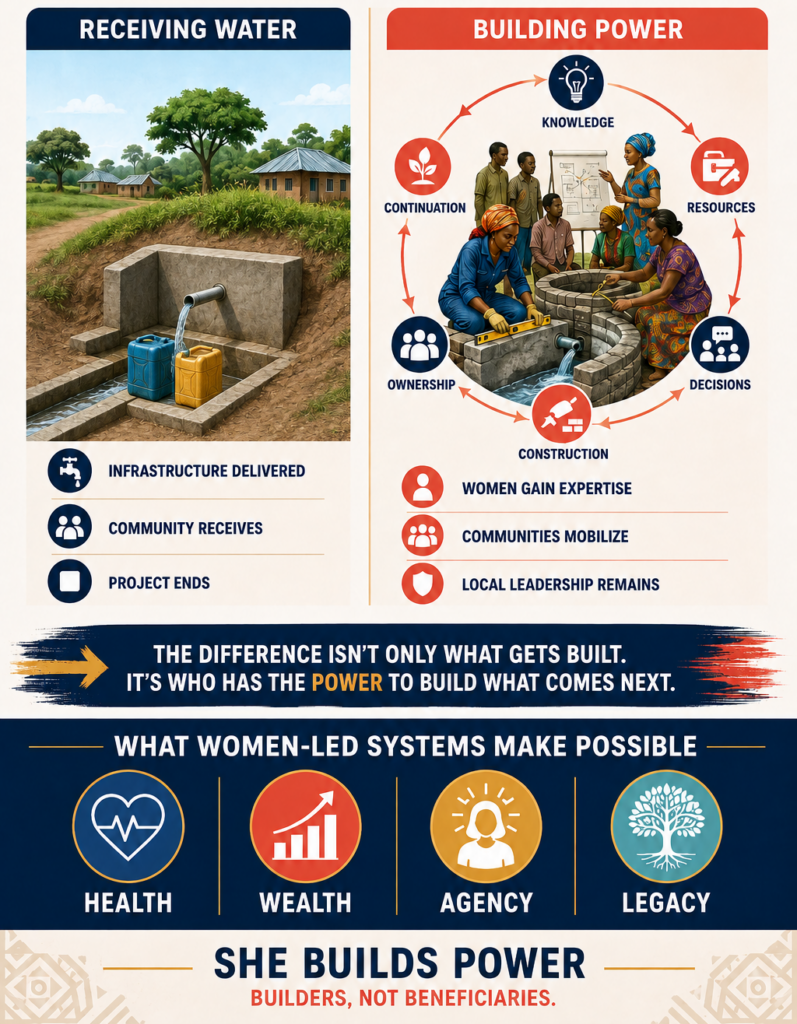
The Difference Between Receiving Water and Building Power
At She Builds Power, we believe every well tells two stories.
One is the story of the infrastructure: the water source that is protected, repaired, or built.
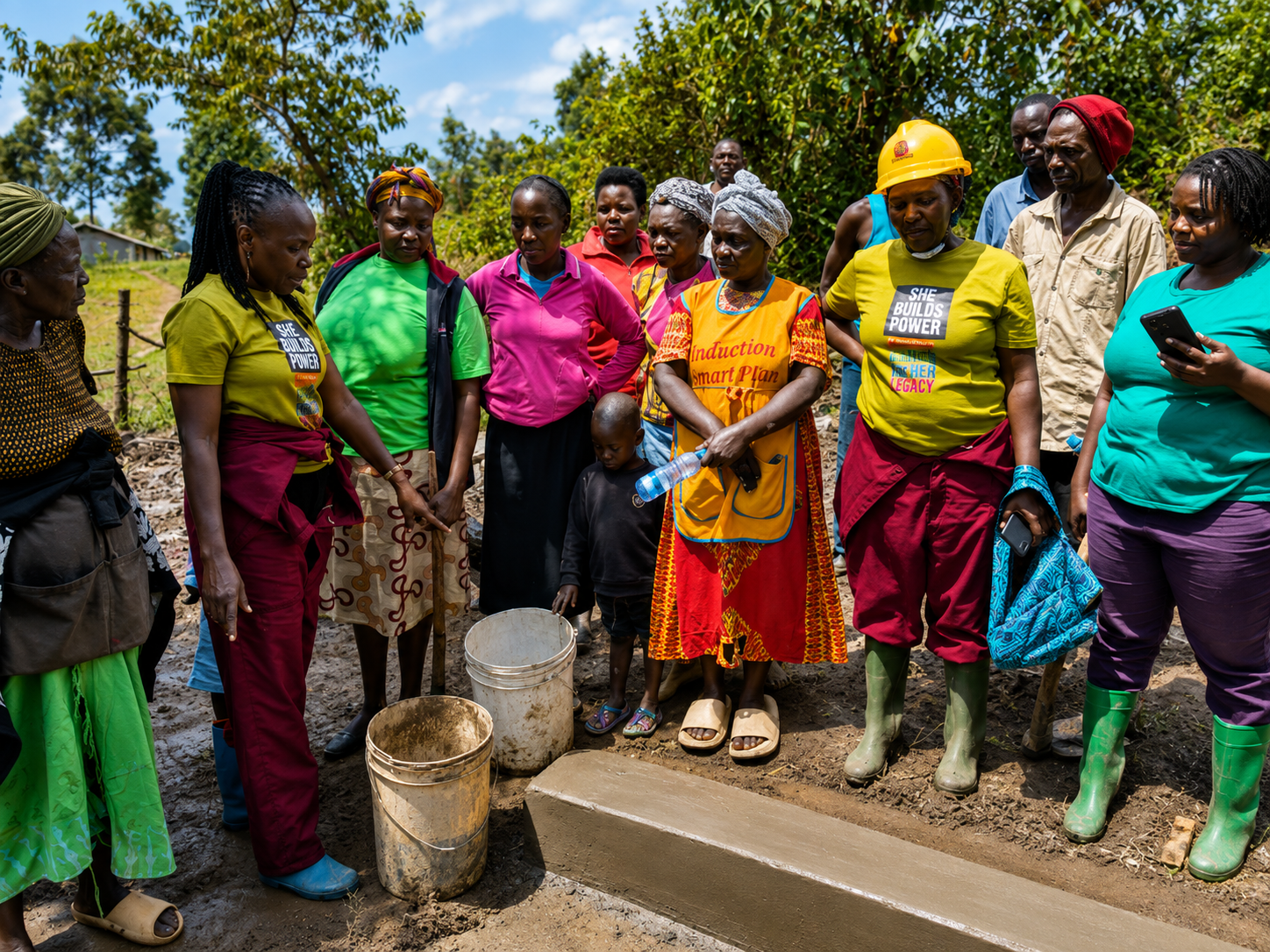
The other is the story of the people who made it happen: the women who gained technical knowledge, organized their neighbors, negotiated for materials or land, coordinated with local leaders, solved problems during construction, and helped create a system the community could continue to manage.
The first story is about access.
The second is about power.
This distinction matters because communities are too often positioned as recipients of a finished solution. Women may be asked to contribute labor or take responsibility for maintaining a project without being given real authority over its design, resources, or decisions.
She Builds Power takes a different approach. We train women before the build and support them to assess local needs, identify existing assets, choose appropriate solutions, mobilize community contributions, and lead construction alongside their communities.
They are builders, not beneficiaries. The difference is not only who appears in the project photograph. It is who holds the knowledge, relationships, confidence, and authority after the project team leaves.
Clean Water is an Entry Point, Not The Whole System
We think of this as the She Builds Power Operating System.
Water, food, and finance are essential systems through which communities meet immediate needs and shape their futures. But infrastructure and resources alone are not enough.
Durable change also requires local expertise, collective action, decision-making power, ownership, and the ability to pass knowledge and leadership to others.
In that sense, the well is one application running on a much larger operating system.
When that system is strong, a water project can contribute to four interconnected forms of change:
- Health: People are better able to live, learn, work, and participate.
- Wealth: Families and groups have a stronger foundation from which to build and retain resources.
- Agency: Women and community members have greater ability to influence decisions and act on the issues affecting their lives.
- Legacy: Knowledge, leadership, and locally owned systems continue beyond a single project or funding cycle.
These are not four tidy steps, and we should be suspicious of any development diagram that makes transformation look as orderly as assembling flat-pack furniture.
The outcomes overlap. Progress can be uneven. A water project may improve health quickly while shifts in income or decision-making take longer. In another community, the experience of organizing the build may immediately strengthen women’s public leadership.
The point is not to promise that one well will produce every possible outcome. The point is to build the conditions that allow communities to decide what comes next—and have more power to pursue it.
Why Women-led Poverty Solutions Matter
Across many communities, women already manage water, food, caregiving, household resources, and the daily consequences of systems that do not work.
That does not mean women should simply be given more unpaid responsibility. It means their knowledge should be recognized, their expertise expanded, and their authority strengthened.
Women-led poverty solutions work differently when women are not invited in at the end to maintain someone else’s idea, but equipped from the beginning to help assess, design, build, and lead.
A woman who learns to protect a spring or lead a water build gains more than a technical skill. She practices mobilizing people, managing resources, solving public problems, and working with community and government leaders. Other people see what she can do. Just as importantly, she sees what she can do.
That capability does not disappear when the cement dries.
It can be applied to the next water source, the next food-security challenge, the next savings group, or the next decision the community must make together. This is how a project designed to meet an immediate need can also strengthen the people who will meet needs in the future.
So, What Happens After a Community Gets Clean Water?
The most honest answer is: it depends on what was built along with it.
If a project delivers infrastructure without local capability and ownership, the community may receive water but remain dependent on outsiders for repairs, resources, and future solutions.
But when women gain expertise, communities contribute and make decisions, and local leadership is strengthened through the work, clean water can become more than the outcome of one project.
It becomes proof. Proof that a community can organize around an essential need. Proof that women can lead technical and public work. Proof that local knowledge and outside resources can meet without one replacing the other. Proof that the people closest to a challenge can do more than live with it. They can build what comes next.
The well may take only days to construct. The leadership it reveals can shape a community for generations.
See what seven women-led wells set in motion—and meet the builders behind them.