The Deep Dive: Understanding Kenya’s Water Security and Climate Resilience Project
Kenya Is Running Out of Water — Here’s the Project Trying to Change That
The Kenya Water Security and Climate Resilience Project (KWSCRP) is a World Bank-funded national initiative designed to tackle one of Africa’s most pressing crises: Kenya’s chronic water scarcity. Here’s what you need to know at a glance:
- What it is: A multi-phase infrastructure and institutional reform project funded by the World Bank and implemented by Kenya’s Ministry of Water, Sanitation and Irrigation
- Core goals: Increase bulk water supply, expand irrigation, strengthen climate risk management, and build institutional capacity
- Key projects: Mwache Multi-Purpose Dam (coastal Kenya) and the Lower Nzoia Irrigation Project
- Current status: Mwache Dam is 69% complete as of February 2026
- Scale: Serving millions across Mombasa County, Kwale County, and beyond
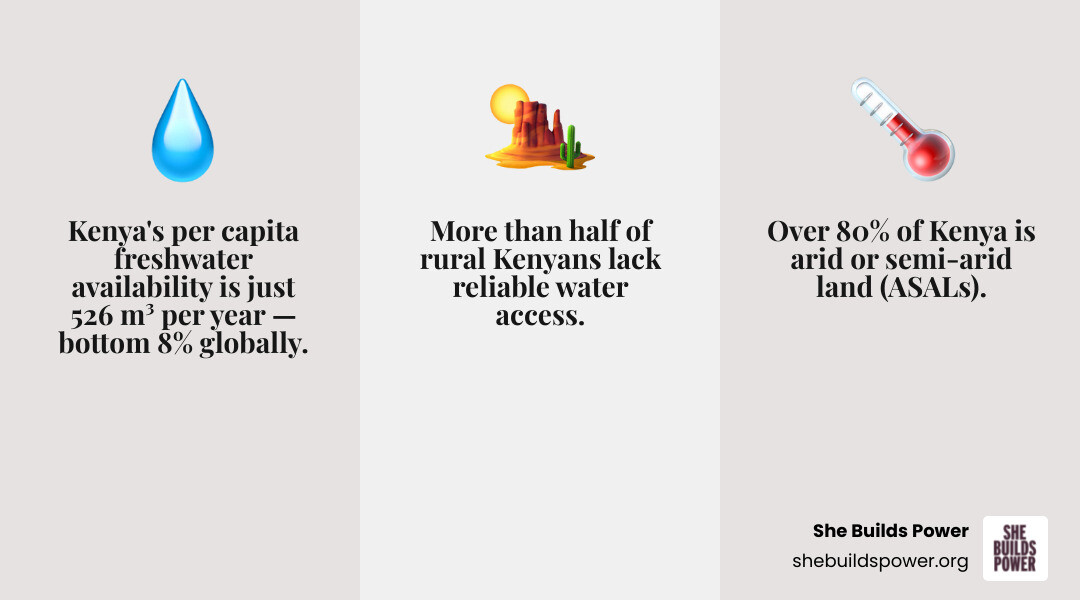
- Why it matters: Kenya’s per capita freshwater availability sits at just 526 m³ per year — placing it in the bottom 8% of countries globally
The numbers alone tell a hard story. Over 80% of Kenya is arid or semi-arid land. More than half of its rural population lacks reliable water access. And 54% of Kenya’s water resources are shared with neighboring countries — making every drop a potential point of conflict or cooperation.
This isn’t just an infrastructure problem. It’s a systems problem. Water scarcity in Kenya is tangled up with food insecurity, climate vulnerability, economic instability, and — most critically — the exclusion of women from the leadership and decision-making that shape community survival.
I’m Gemma Bulos, founder of She Builds Power, and I’ve spent years working at the intersection of water, food, and finance to train women as community system builders — the same integrated approach that makes a project like the Kenya Water Security and Climate Resilience Project worth understanding deeply. In this deep dive, we’ll break down how the project works, what it’s achieving, and what it still needs to get right.
The Architecture of the Kenya Water Security and Climate Resilience Project
To understand the Kenya Water Security and Climate Resilience Project, we have to look past the concrete and steel. This project is built on a foundation of institutional reform and “green growth.” In a country where 526 m³ of freshwater per capita is the norm—compared to 1,000 m³ in South Africa—the goal isn’t just to build a dam; it’s to build a system that can survive a changing climate.
The project is a massive collaboration. It is primarily financed by the World Bank and implemented by the Ministry of Water, Sanitation and Irrigation. We see this as a critical shift toward Water Resource Management that treats water as a finite, shared asset rather than a commodity to be extracted. By focusing on the Kenya Water Security and Climate Resilience Project (KWSCRP), the government is attempting to modernize how water is governed across six major basins.
Strategic Objectives of the Kenya Water Security and Climate Resilience Project
The KWSCRP isn’t chasing a single “win.” It has a multi-pronged strategy:
- Bulk Water Supply: Ensuring that growing urban centers like Mombasa have the water they need to thrive.
- Irrigation Productivity: Moving beyond rain-fed agriculture to ensure food security even during droughts.
- Climate Risk Management: Building the data systems needed to predict floods and manage water scarcity.
- Institutional Strengthening: This is where the Water Resources Authority (WRA) comes in. The project has helped make the WRA operational, ensuring there is a “sheriff in town” to regulate Water use and protect catchments.
Implementing Agencies and Global Partners
No one builds resilience in a vacuum. The Project Management Unit (PMU) oversees the daily grind, but they are supported by a web of partners. This includes the Coast Water Works Development Agency (CWWDA) and technical experts like the Zutari engineering consultancy. By bringing together global financing and local engineering, the project aims to bridge the gap between high-level policy and on-the-ground reality.
Flagship Infrastructure: Mwache Dam and Lower Nzoia Irrigation
The “superstars” of the project are the physical structures. These are the engines that will drive economic growth and climate adaptation in the coastal and western regions.
| Feature | Mwache Multi-Purpose Dam | Lower Nzoia Irrigation Project |
|---|---|---|
| Primary Location | Kwale County (serving Mombasa) | Siaya and Busia Counties |
| Main Goal | Bulk water supply & small-scale irrigation | Large-scale rice and vegetable production |
| Climate Benefit | Storage for drought resilience | Flood mitigation in the Nzoia basin |
| Community Impact | Livelihood restoration & infrastructure | Increased farm income for smallholders |
The Mwache Dam is particularly vital. It’s designed to tackle the “water gap” in Mombasa while the Lower Nzoia project focuses on turning floodwaters from a threat into an agricultural asset.
Current Progress of the Kenya Water Security and Climate Resilience Project (2026 Update)
As of February 2026, the progress is tangible. The Mwache Dam has surpassed 69% completion. If you look closer at the components, the Lower Check Dam (LCD) is even further ahead at 78%, while the Main Dam stands at 68%.
This is progress we can feel. It reminds us that Every Drop Builds Power: Amina’s Story from Uganda is a reality for women across East Africa. When the water arrives, the work of building local systems—led by the women who use the water most—really begins.
Coastal Resilience in Mombasa and Kwale Counties
In the coastal region, the stakes are high. Rising sea levels and groundwater salinity are making traditional wells unusable. The KWSCRP addresses this by providing a reliable bulk water supply and improving sanitation access. We are also seeing the influence of the Resilient Water Accelerator, which helps unlock the finance needed to keep these projects moving. For the people of Kwale, this isn’t just about pipes; it’s about health, dignity, and the ability to run a business without worrying where the next liter of water will come from.
Beyond Concrete: Nature-Based Solutions and Basin Management
If you only look at the dams, you’re missing half the story. The Kenya Water Security and Climate Resilience Project is pioneering nature-based solutions. Why? Because a dam is only as good as the forest above it. If the hills are bare, the dam fills with silt and becomes a very expensive mud hole.
The project has developed 260 sub-catchment management plans and 6 major Water Resources Authority Basin Plans. These plans focus on protecting the “water towers” of Kenya—the high-altitude forests that feed our rivers.
Scaling Climate-Smart Farming in the Mwache Catchment
In the Mwache area, we’ve seen a beautiful example of community-led change. Farmers have expanded sustainable practices from a tiny 5.5-acre pilot to 28 acres, with a target of over 1,000 acres. By using terraces and better soil management, they reduce erosion and sediment loss. This is exactly how we see the transition From Wells to Wealth: How Water Builds Power—when farmers become the guardians of their own resources, resilience becomes permanent.
Institutional Capacity and Digital Innovation
We can’t manage what we can’t measure. The project has revitalized monitoring networks and introduced a “training-of-trainers” model. WRA staff were seconded to expert teams to learn real-time data mapping and flood forecasting. This technical backbone, supported by the Water Act and updated sector policies, is outlined in the latest Implementation Status Results Report. It ensures that even after the World Bank leaves, Kenya has the tools to manage its own water future.
Community Agency and the Reality of Resettlement
Let’s be honest: large infrastructure projects often come with a human cost. The kenya water security and climate resilience project requires moving people to make way for the reservoir. In Kinango, Kwale County, we’ve seen how critical transparency is. Chaired by leaders like Eng Sam Alima, routine stakeholder meetings ensure that the community isn’t just told what’s happening—they are part of the process.
The Resettlement Action Plan for West Mainland is the roadmap for doing this with dignity. At She Builds Power, we believe that resettlement shouldn’t just be about moving houses; it should be about building better systems for those who move.
Compensation and Livelihood Restoration Efforts
The numbers here are significant. Over Ksh 3.4 billion has been paid to compensate approximately 4,400 households across 2,475 hectares. But money isn’t enough. The project has also delivered:
- New schools and health facilities.
- Rehabilitated roads.
- Direct water provision for affected villages.
- Livelihood restoration programs to help families start new businesses.
This aligns with our mission for She Builds Power—to ensure that “development” actually empowers the people it touches.
Frequently Asked Questions about KWSCRP
What is the primary goal of the Kenya Water Security and Climate Resilience Project?
The primary goal is to enhance water security and build climate resilience. It does this by increasing the bulk water supply for cities, improving irrigation for farmers, and strengthening the national institutions (like the WRA) that manage water and climate risks.
How does the project address the needs of project-affected persons?
The project uses a comprehensive Resettlement Action Plan. This includes direct financial compensation (over Ksh 3.4B paid so far), building new community infrastructure like schools and roads, and running livelihood restoration programs to ensure families are better off than they were before.
What is the current completion status of the Mwache Dam as of 2026?
As of February 2026, the Mwache Multi-Purpose Dam project is 69% complete. The Main Dam is at 68%, while the Lower Check Dam, which is crucial for managing sediment, is further ahead at 78%.
Conclusion: From Infrastructure to Integrated Power
The Kenya Water Security and Climate Resilience Project is a massive undertaking, but infrastructure is only half the battle. At She Builds Power, we know that the real “powerbuilding” happens when women are at the center of these new systems.
When a dam provides water, it’s the women who will design the irrigation systems, manage the family finances, and lead the community water committees. By integrating water, food, and finance, we can turn the progress of the KWSCRP into long-term Impact that meets Kenya’s Vision 2030 and the Sustainable Development Goals.
We invite you to join us in Transforming Access into Agency. Whether you are a donor, a partner, or a community member, your support helps us ensure that these national projects lead to local power.
Donate Now Water to support women-led resilience in Kenya and beyond.