What Actually Builds Power That Lasts
Across seven blogs, we kept returning to familiar words in development: care, innovation, inclusion, empowerment, resilience, sustainability, and participation.
Each word opened into something deeper. Care contained the observation, planning, memory, negotiation, and systems thinking we often reserve for leadership. Innovation was happening not only in labs or formal institutions, but wherever women and communities solved complex problems with too few resources and too little recognition.
Inclusion meant little when a seat at the table came without influence. Resilience was both extraordinary and unfair when people were praised for surviving conditions they should never have had to endure. Sustainability depended not only on whether something remained standing, but on whether people had the authority, financing, skills, and standing to repair, adapt, and continue.
And empowerment — perhaps the most overused word of all — required a harder question:
What kind of power are we talking about?
At She Builds Power, power means the practical ability to make decisions, mobilize resources, shape the systems that affect daily life, and act again without waiting for permission or the next project. It lives within women and communities as knowledge, judgment, relationships, and leadership. It also has a systemic dimension: whether institutions, markets, land systems, and public structures recognize that capability and allow it to influence what happens.
The more we looked, the more the same pattern appeared: capability was already there. What was missing was not the person. It was the conditions that allow her power to be recognized, exercised, connected, and sustained.
That is the idea this piece names directly. She Builds Power is not simply building wells, gardens, savings groups, catalytic capital, certifications, or businesses.
Those things matter deeply. But they are applications. The deeper work is the operating system beneath them.
She Builds Power works with women and communities to strengthen essential systems across water, food, and finance. We train and resource women to build water systems, improve food production, manage savings and catalytic capital, lead enterprises, and mobilize others around shared priorities. We also help connect their capability to land pathways, certification, markets, technical support, and other resources—so women can exercise greater decision-making power in their households, build economic independence, and lead solutions that continue beyond the first project.
The Question Beneath the Work
Development work often begins with a diagnostic question:
What do people lack?
Do they lack money? Education? Confidence? A market? A skill? A technology? A well? A loan?
The question seems practical. Responsible, even. But often, it is aimed at the wrong layer of the problem. Because people are not empty vessels waiting to be filled. They are already thinking, caring, organizing, experimenting, adapting, calculating, negotiating, and building. Often under conditions that would overwhelm institutions with far more money and far fewer constraints.
The problem is not usually that power is absent. The problem is that power has nowhere to go.
A woman may have leadership, but no public authority. She may have business instinct, but no capital. She may understand soil, weather, water, and risk, but have no secure access to land. She may be trusted by her community but excluded from formal decision-making. She may know exactly what needs to be repaired, but have no access to the tools, money, or recognition to repair it.
This distinction matters. Because if we misdiagnose the problem as a lack inside the person, we design programs that try to fill her. But if we understand the problem as a lack of conditions around her, we design systems that allow her power to emerge, connect, move, and last.
That is a very different kind of work.
What the Operating System Means
An operating system is not a single application. It is the underlying layer that allows applications to run.
A well is an application. Training is an application. Catalytic capital is an application. A kitchen garden, government certification, or a lease-to-own land pathway is an application. Each one can matter.
But none of them, by itself, is the operating system. The operating system is what allows those interventions to become more than isolated projects. It is the layer of trust, authority, skills, resources, accountability, confidence, and local decision-making that allows women and communities to keep building after the first project ends.
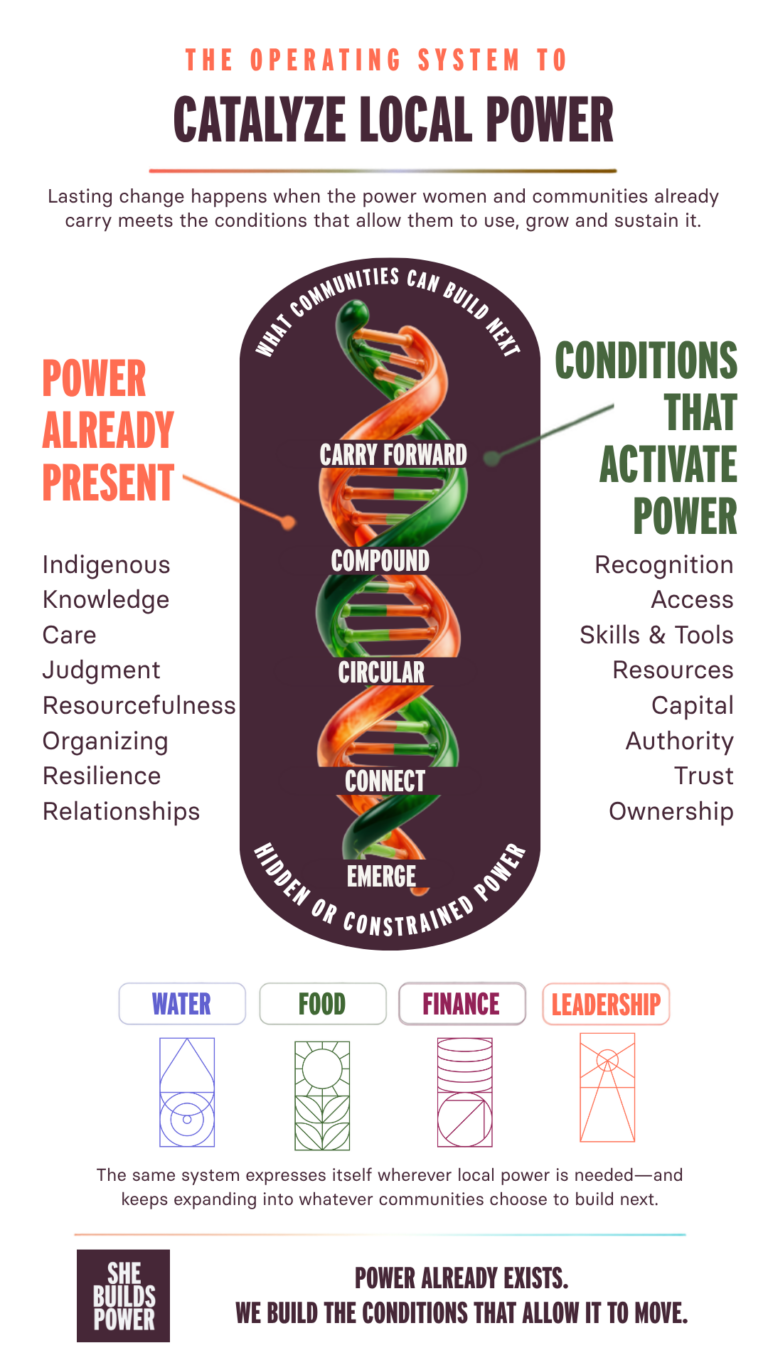
At She Builds Power, we are not trying to deliver one solution and call it transformation. We are building an operating system to catalyze local power — one that creates the conditions for power to emerge, connect, circulate, compound, and last.
The Conditions of Power
If power already exists, then the work is not to give it. The work is to build the conditions that allow it to become usable. For us, those conditions include:
Recognition.
Women are seen as builders, not beneficiaries. Their care work, organizing, farming, financial judgment, technical curiosity, climate intelligence, and community leadership are recognized as forms of intelligence, not treated as invisible labor.
Access.
Women gain access to training, tools, capital, land pathways, certification, markets, and technical support. Not because they lacked ability, but because ability needs pathways.
Capability.
Women bring knowledge, judgment, intuition, resourcefulness, and skills developed through lived experience. Through training and practice, they add technical expertise—building water systems, increasing food production, managing finance, leading savings groups, running enterprises, tracking repayment, and mobilizing communities. Capability grows when innate and lived intelligence is recognized, then strengthened with new knowledge, tools, and opportunities to apply it.
Agency.
Women make meaningful decisions in their households, livelihoods, groups, and communities. They have greater influence over how household resources are used, how family needs are prioritized, and which opportunities they pursue. Individually, women decide how to use the resources they access; collectively, women-led groups determine how shared resources will be managed and invested.
Trust.
Savings groups, matching grants, community conversations, and transparent contribution systems create the relationships that allow people to act together. Trust is not soft. Trust is infrastructure.
Ownership.
Communities do not simply receive. They contribute labor, materials, land, meals, transport, local knowledge, leadership, and commitment. A matching grant does more than fill a funding gap. It turns outside support into local investment.
Adaptation.
Communities draw on indigenous knowledge, lived experience, and generations of observing changes in water, soil, weather, crops, markets, and community life. Landscape field studies create a structured way for that knowledge to guide decisions—helping communities identify risks, recognize assets and opportunities, and adapt solutions as conditions change.
Legacy.
Each cycle leaves women and communities better equipped for the next one. The skills, systems, confidence, relationships, assets, and leadership developed through one project make the next effort easier, faster, and more locally led. Those capabilities can also be strengthened, adapted, and applied elsewhere—from repairing a water system to expanding a business, improving food production, mobilizing resources, or addressing a new community priority. Legacy is not only what remains. It is what people can now build from.
This is the operating system. Not one project. The conditions beneath the projects.
Power is Not a Ladder. It is a Double Helix.
It can be tempting to describe this work as a ladder: first we listen, then train, then women lead, communities own, and the work lasts. There is some truth in that sequence, especially when trust is new and outside support plays a larger role.
But a ladder suggests that recognition, access, capability, agency, and ownership arrive one rung at a time. That is not how power actually works. Power is not built in a straight line. It is braided.
Recognition, access, capability, agency, trust, ownership, adaptation, and legacy are interdependent. Each condition helps make the others meaningful and usable. Recognition without access becomes praise without possibility. Capability without agency becomes training without authority. Ownership without resources becomes abandonment. No single condition can catalyze power alone. They must exist and evolve together.
Momentum matters too. Once women have mobilized a community, managed catalytic capital, built an emergency fund, or led a project together, the next effort does not begin from zero. Trust, memory, skill, and authority carry forward.
But the deeper shape of the She Builds Power framework is a double helix.
A helix carries the code. Its strands wind together, each incomplete without the other.
One strand is the capability already present in women and communities: knowledge, care, judgment, discipline, resourcefulness, climate intelligence, organizing power, financial instinct, and the will to build.
The other strand is the enabling conditions that allow that capability to be exercised: training, tools, capital, land, certification, markets, authority, accountability, trust, and technical support.
Neither strand is enough on its own.
Capability without conditions remains invisible. Conditions without recognizing capability become another project imposed from the outside. But when the strands connect, power begins to express itself. A well becomes more than infrastructure. A garden becomes more than food. A savings group becomes more than money. Catalytic capital becomes more than repayment. A certificate becomes more than paper. Land becomes more than soil.
Each one becomes a site where power can be recognized, practiced, trusted, resourced, and carried forward.
That is the operating system to catalyze local power. Like DNA, the double helix carries the living code of the system: the capability already present within women and communities, intertwined with the conditions that allow it to be exercised. Together, these strands enable power to emerge, connect, adapt, compound, and carry forward.
Water, Food, and Finance are Not Separate Programs
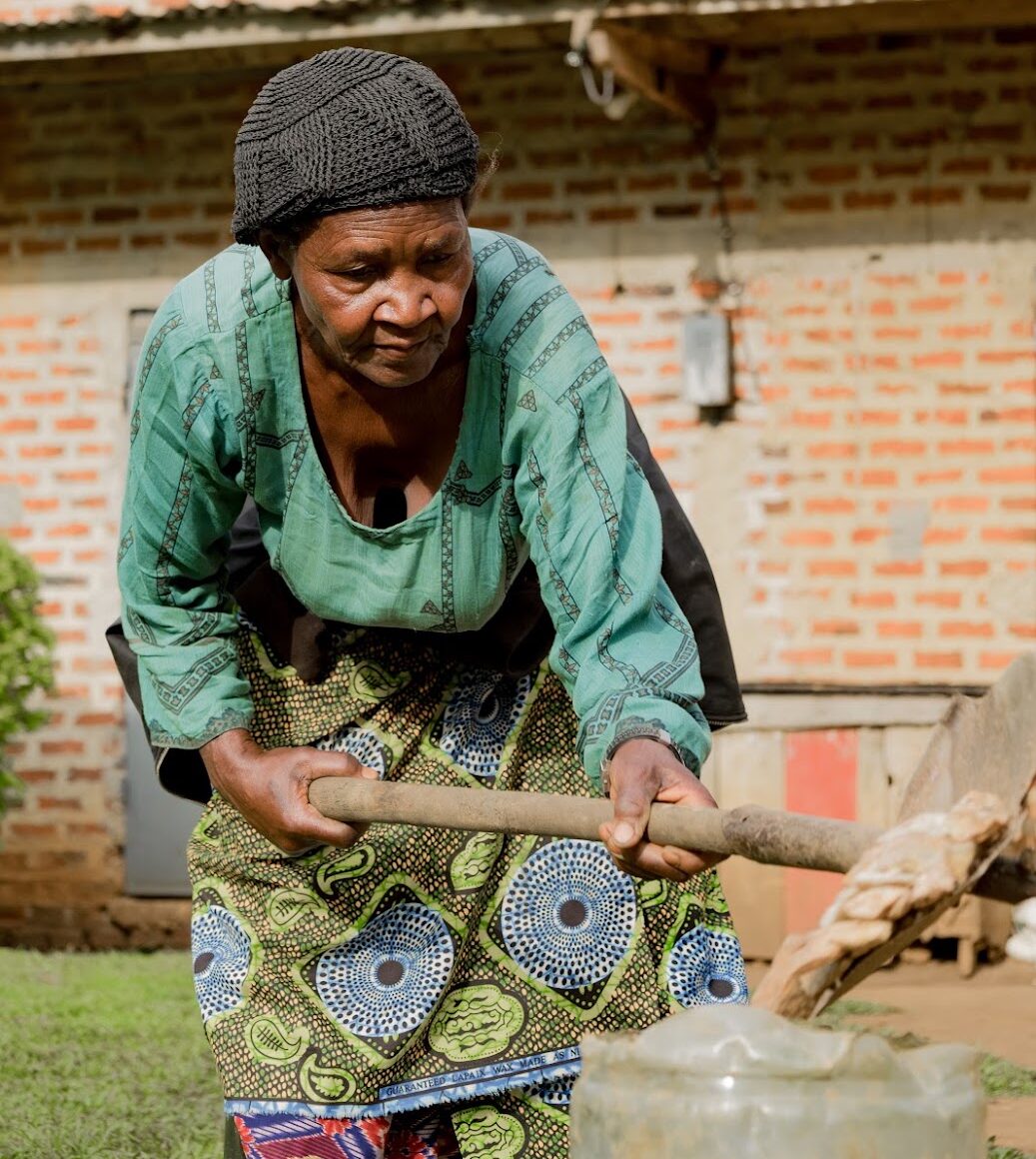
This is why She Builds Power brings water, food, and finance together. Not because we are trying to do everything. Because poverty does not happen in silos, and neither does power.
In Odesso, that connection became visible. Sofia’s community mobilized to match support for a water tank; they then built a water system that connected to the utility. But the work did not stop at water. Women organized through a savings group, invested in chickens and other livelihoods, and strengthened their ability to make collective decisions.
One intervention became a platform for food, income, finance, and leadership — because the operating system around it was growing stronger.
Together, water, food, finance, and leadership form a practical operating system.
Water protects health and restores time. Food turns water, land, climate intelligence, and strategic production into nourishment and income. Finance turns greater stability into choice and investment. Leadership allows communities to shape what comes next.
This is why infrastructure alone is not enough.
A well matters. Of course it matters. But a well is one condition of possibility, not the whole transformation. If women build the well but are not recognized as builders, something is missing.
If the water flows but there is no maintenance plan, something is missing. If food can be grown but women cannot access land, something is missing. If capital is available but women cannot decide how it is used, something is missing. If a group can produce something but cannot sell commercially because it lacks certification, something is missing. If a community contributes labor and materials but has no say in what happens next, something is missing.
The visible project may be complete. But the operating system is not yet strong.
From Service Delivery to Power That Moves
Traditional development often asks: Did we build the thing?
The operating system asks a different question: What can people do now that they could not do before?
And even more importantly: Where does that capability show up next?
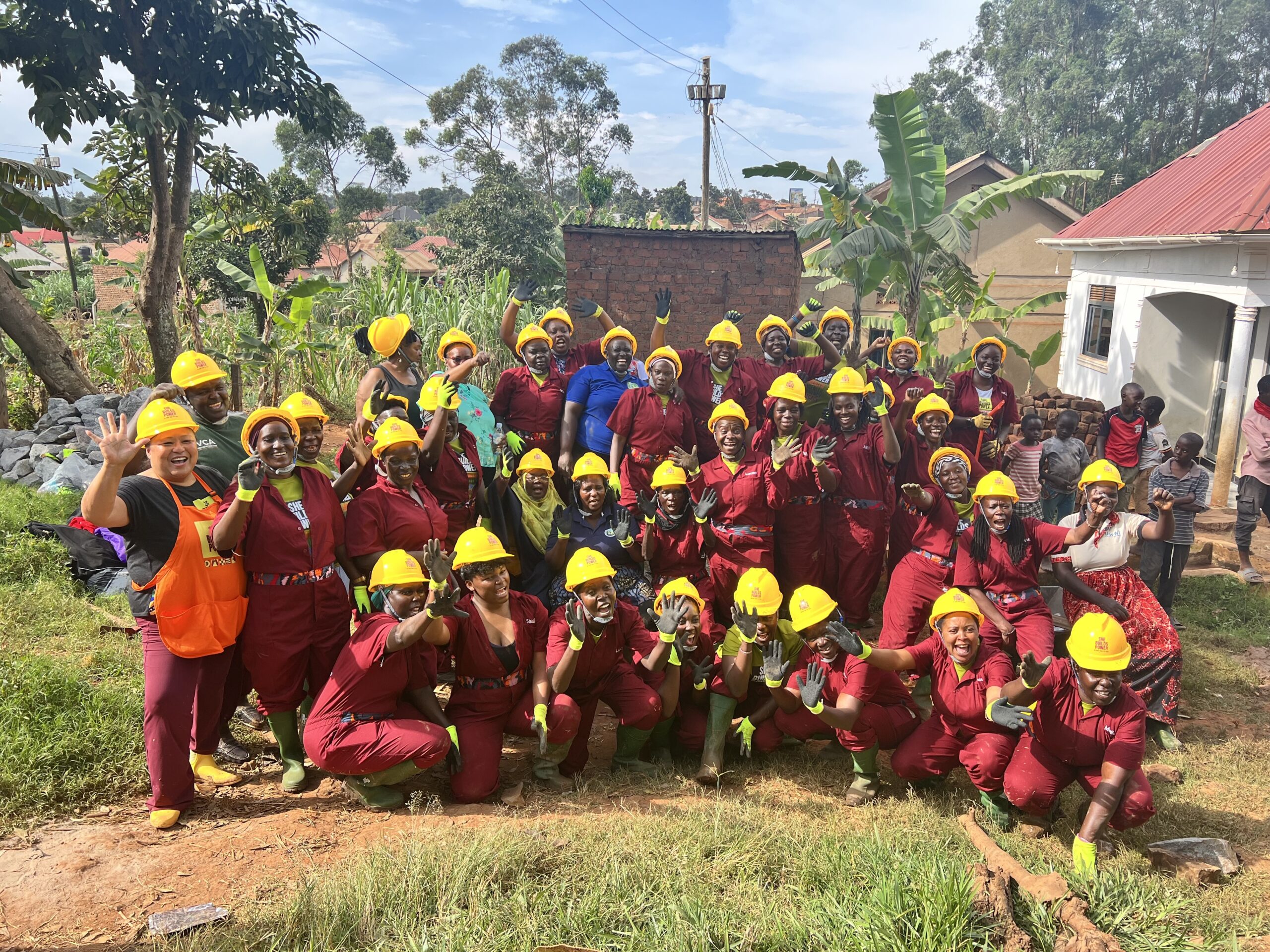
A woman who learns to help lead a water build may later speak in a community meeting with more authority. A savings group that first creates an emergency fund may later decide to invest in a group business. A group business that begins with local production may later pursue government certification so it can sell commercially. A kitchen garden that begins as household food security may become a source of income, savings, and investment. A community that mobilizes materials to match a well grant may later organize resources for a school, a road, a market stall, or another water point.
That is how you know the operating system is beginning to run: not because one application worked, but because capability travels. We can look for that movement in women taking on new leadership roles; growth in savings, assets, and group businesses; communities initiating and funding their next priorities; women training others; and activities continuing after SBP support ends. These are not merely outputs. They are evidence that power is becoming usable and mobile.
Power has started to move.
Power Already Exists. Access Does Not.
This is where the nuance matters. Saying that power already exists does not mean communities already have everything they need.
They do not. To suggest otherwise would romanticize hardship and erase the real barriers communities face.
Training matters. Capital matters. Land matters. Certification matters. Infrastructure matters. Technical expertise matters. Public health matters. Engineering matters. Government endorsement matters. Market access matters.
The point is not that outside investment is unnecessary. The point is that outside investment has too often been aimed at the wrong layer.
It funds the application but ignores the operating system. It funds the well but not the women builders. It funds the training but not the pathway to income. It funds capital but not women’s control over how it is used and grown. It funds participation but not authority. It funds resilience but not relief from the conditions that require so much resilience in the first place. It funds launch day but not repair.
The intervention is not for installing power into people. The intervention is for changing the conditions around the power already there.
That is a harder job, not an easier one. It requires more accountability, not less.
Because if women’s power has been suppressed by land systems, financial exclusion, gender norms, lack of certification, extractive markets, weak infrastructure, or decision-making structures that exclude them, then the work is not to praise their resilience and walk away.
The work is to rebuild the conditions that have kept their power from being fully exercised.
What Makes This Framework Different
This is not only a theory of empowerment. It is not only a participation model. It is not only a sustainability framework. It is not only community-led development with better language. It is a practical framework for asking:
What conditions must exist for local power to become usable? What needs to be recognized? What needs to be resourced? What needs to be taught? What needs to be transferred? What needs to be trusted? What needs to be owned? What needs to be repaired? What needs to remain?
That is why She Builds Power focuses on the architecture beneath the visible work — and why every practice is tied to a condition of power:
Recognition and adaptation: community conversations and landscape field studies shape project design around local knowledge, assets, risks, and priorities.
Access and ownership: matching grants bring outside resources while communities mobilize labor, materials, land, transport, meals, and local leadership — without asking them to carry costs they cannot reasonably bear.
Agency and trust: women strengthen their influence over decisions in their households and exercise greater choice in their own livelihoods. Through women-led groups, they also make collective decisions about shared resources and community priorities—building trust through shared responsibility, transparency, and accountability.
Capability and agency: women combine existing knowledge and intuitive skills with new technical expertise—and have the authority to apply them. Individually and collectively, they make decisions, mobilize resources, solve problems, and shape the systems affecting their households, livelihoods, and communities.
Wealth and shared upside: group businesses allow collective capability to become income, assets, and economic choice beyond a single funding cycle.
Access and recognition: government certification helps women move from informal skill to legitimate commercial opportunity and stronger market standing.
Ownership and legacy: lease-to-own land pathways help women move from temporary access toward long-term stability, productive assets, and inheritance.
Each of these is a condition. Together, they form the operating system.
What Was Actually Being Built
The well was never only a well.
The garden was never only a garden.
The savings group was never only a savings group.
The capital was never only capital.
The certificate was never only a certificate.
The land was never only land.
Each one was a place where power became visible and practical — where women could exercise it, communities could trust it, and both could carry it forward.
That is what we mean when we say She Builds Power. We do not give women power. We recognize the power already present and build the conditions that allow it to rise.
We are not only building infrastructure. We are strengthening the operating system that allows women and communities to keep building.
Lasting change is not proven only by what gets delivered. It is proven by what becomes possible after the delivery is done.
The goal is not to make communities better at receiving. It is for power that has been hidden, constrained, underfunded, and underestimated to become visible, usable, shared, and lasting.
Power that can repair, adapt, earn, decide, teach — and build again.
That is the operating system to catalyze local power.
And once it starts running, the work no longer ends with what we built. It continues through what women and communities are able to build next.
Selected Sources
Martha Nussbaum, Creating Capabilities: The Human Development Approach (2011)
Naila Kabeer, “Resources, Agency, Achievements: Reflections on the Measurement of Women’s Empowerment,” Development and Change (1999)
Ghazala Mansuri and Vijayendra Rao, Localizing Development: Does Participation Work? World Bank (2013)
Matt Andrews, Lant Pritchett, and Michael Woolcock, “Escaping Capability Traps Through Problem-Driven Iterative Adaptation” (2012)
Abhijit Banerjee, Esther Duflo, and Garima Sharma, “Long-Term Effects of the Targeting the Ultra Poor Program,” American Economic Review: Insights (2021)
Abhijit Banerjee, Esther Duflo, et al., “A Multifaceted Program Causes Lasting Progress for the Very Poor: Evidence from Six Countries,” Science (2015)