What We Actually Owe the Things We Build
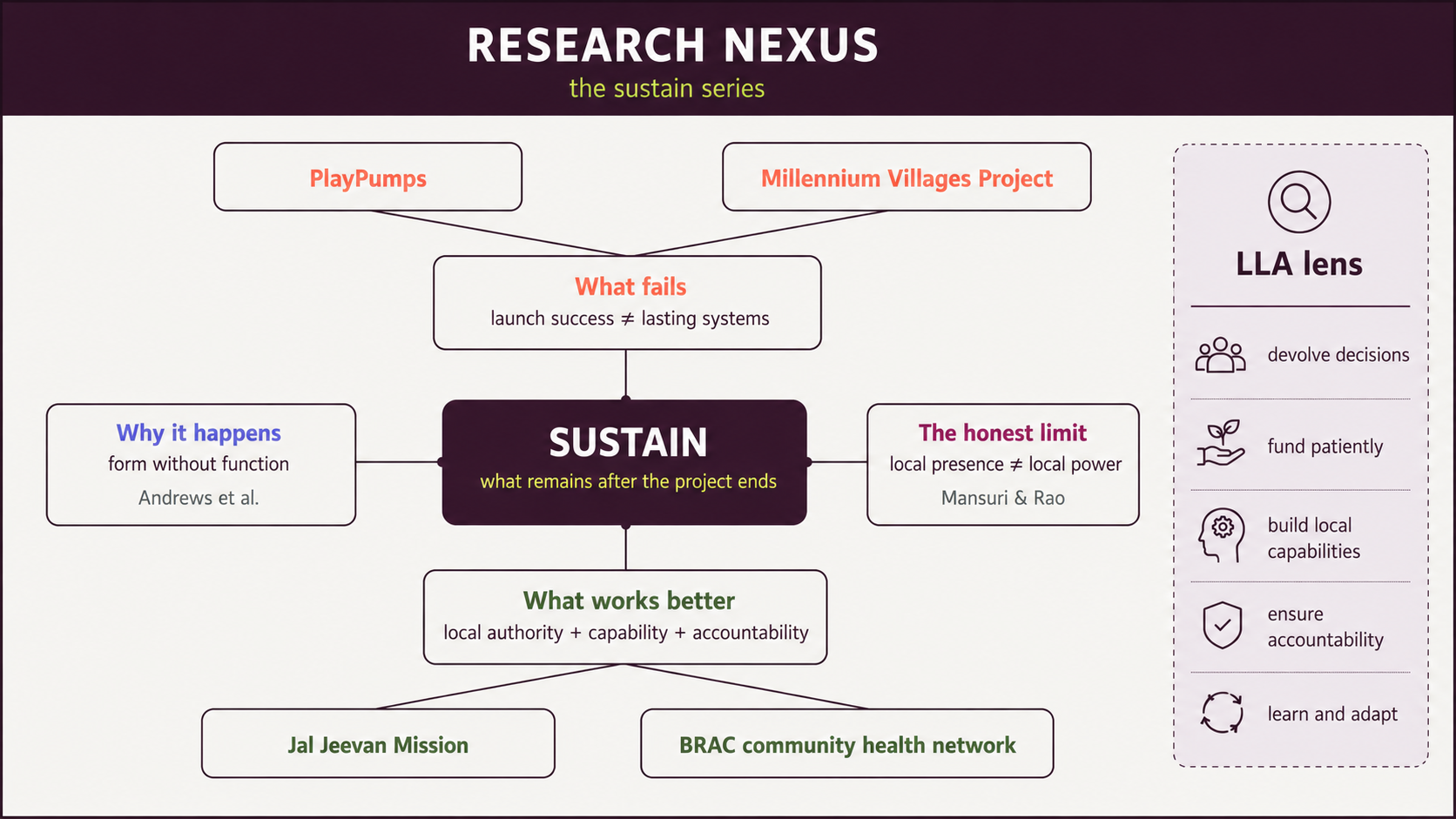
In the mid-2000s, a water pump shaped like a merry-go-round became one of the most celebrated ideas in international development.
The PlayPump was installed over a borehole. As children spun the roundabout, the movement pumped groundwater into an elevated storage tank. It was an irresistible story: children could play while their communities gained clean water, and advertising displayed on the tank would help finance maintenance.
In 2006, the United States government announced a public-private alliance involving PlayPumps International, USAID, PEPFAR, the Case Foundation and other partners, with a fundraising goal of $60 million. The ambition was to install thousands of pumps and provide water to as many as ten million people across Sub-Saharan Africa. It was elegant, photogenic, and supposedly self-sustaining by design. (George W. Bush White House Archives)
It did not hold up.
A 2007 UNICEF evaluation found that filling the PlayPump’s 2,500-litre tank could require approximately four hours of continuous pumping. Children often tired quickly, meaning adults—primarily women—were left to operate equipment that was more physically demanding than the conventional handpumps they had previously used. The evaluation also found that maintenance arrangements were highly centralized, leaving communities with limited local control over repairs and uncertainty about whom to contact when systems failed. (rural-water-supply.net)
A separate 2008 evaluation of PlayPumps in Mozambique found that 43 of 71 installations outside one UNICEF-supported group had replaced pumps that were either still functioning or had only minor problems that could have been repaired locally. The advertising revenue intended to finance maintenance was also insufficient in that context, while replacement parts and technical support depended heavily on systems located far from the communities using the pumps. (rural-water-supply.net)
I do not tell that story to mock an idea that, on paper, was not unreasonable.
I tell it because it is one of the clearest illustrations of a pattern that appears across the development sector: a structure can be well-funded, beautifully designed, and celebrated at launch—and still fail to survive contact with the years that follow.
Not necessarily because the technology was foolish. Because nobody built the ecosystem of repair, financing, accountability, local decision-making, and technical capacity that the technology quietly depended on.
That distinction sits at the heart of sustainability. And increasingly, it sits at the heart of climate adaptation as well.
The principles of Locally Led Adaptation remind us that the people closest to climate impacts should not simply be the recipients of adaptation projects. They should have real agency over how actions are defined, prioritized, designed, implemented, monitored, and evaluated.
That is a powerful idea. But it is also a demanding one. Because sustainability is not created by declaring that something is locally led.
It is created by investing in the local capabilities, institutions, financing, accountability, and relationships that allow people to keep solving problems after the launch, after the ribbon cutting, and after the cameras leave.
When the International NGOs Leave
PlayPumps is a story about a single technology. The Millennium Villages Project is a story about what happens at a much larger scale.
Launched in 2005 under the direction of economist Jeffrey Sachs and Columbia University’s Earth Institute, the project concentrated investments in agriculture, health, education, infrastructure, and water across ten principal sites in ten Sub-Saharan African countries. Its aim was to demonstrate that a coordinated, intensive package of investment could help rural communities achieve the Millennium Development Goals within ten years. (The Lancet)
The project’s 2018 endline evaluation estimated favourable effects on 30 of 40 measured outcomes, particularly in agriculture and health. But it found no significant effect on consumption-based poverty and concluded that approximately one-third of the project’s targets had been met. The study used data collected in 2015, at the conclusion of the ten-year intervention, and compared project villages with villages selected retrospectively. (The Lancet)
Earlier critics Michael Clemens and Gabriel Demombynes had already warned that estimates of the project’s effects changed substantially depending on the evaluation method used. Their argument was not that the project had accomplished nothing, but that its original design made it difficult to distinguish changes caused by the intervention from improvements taking place across the surrounding countries and regions. (IDEAS/RePEc)
But there is another limitation that matters for sustainability.
The 2018 study was an endline evaluation, not a long-term follow-up after the project had ended. It measured what was present at the end of an intensive, highly resourced intervention. It could not tell us what remained several years later, once the funding, staffing, and specialized support had receded.
That distinction matters.
Impact measured during—or immediately at the end of—a well-resourced project period tells us something important. But it does not automatically tell us what happens after it.
Most evaluations stop precisely where the sustainability question begins. That is one reason the Locally Led Adaptation principles call for patient and predictable funding. Local governance processes, institutional capability, technical knowledge, and community decision-making power do not become durable in a twelve-month project cycle simply because a report needs them to.
If we want local systems to last, we have to fund them as if time matters. Because it does.
The Honest Counterargument
There is a useful piece of research from the field of institutional reform that helps explain why this happens.
Matt Andrews, Lant Pritchett and Michael Woolcock use the term isomorphic mimicry to describe a pattern they observed repeatedly in government and development reform: organizations adopt the visible form of a successful institution without building the underlying capability that allows it to function.
The org chart exists. The policy has been written. The committee has been formed. The training certificates have been distributed. Everything looks right from the outside. But the organization may still lack the authority, skills, resources, incentives, or problem-solving capacity required to make the system work when circumstances change. (ScienceDirect)
That framework helps reframe the sustainability question. It is not enough to ask whether a water committee exists, whether a training was completed, or whether a structure was handed over with a ceremony.
The real question is whether people can solve the next problem when it appears. Can they identify what has broken? Can they mobilize the money, materials, relationships, and technical knowledge needed to repair it? Can they challenge a decision that is not serving the community? Can they adapt the system when the original plan no longer fits? Can they do any of this without an outside organization standing by?
Or did we mistake the appearance of readiness for the fact of it?
This is also where Locally Led Adaptation becomes useful language for sustainability. LLA is not simply about locating a project in a community. It is about devolving decision-making to the lowest appropriate level and strengthening local institutions so they are inclusive, agile, and responsive in the face of uncertainty.
That matters because climate risk is not static.
Water sources shift. Rainfall patterns change. Droughts intensify. Floods damage infrastructure. Household needs evolve. Markets fluctuate.
A system that cannot adapt is not sustainable simply because it once worked.
Sustainability requires local people and local institutions to have the knowledge, authority, financing, relationships, and accountability to keep adjusting as conditions change.
Where the Evidence Points the Other Way
Not every large system gets this wrong. It is worth examining what more promising models attempt to do differently.
India’s Jal Jeevan Mission, launched in 2019, assigns substantial responsibility for village water systems to local governments and Village Water and Sanitation Committees, often called Pani Samitis. The program’s operational guidelines place these local bodies at the centre of planning, implementation, management, operation, and maintenance. They also call for women to constitute at least 50 percent of committee membership, alongside representation from historically marginalized groups. (Jal Jeevan Mission)
That does not, by itself, guarantee meaningful authority. A woman can occupy a seat and still be excluded from the decisions made around it.
But the structure creates the possibility for something more substantial than consultation: local people formally participating in the management of the system they rely upon.
Early research from Gujarat offers promising, although still preliminary, evidence. A 2026 study by the Council on Energy, Environment and Water examined villages where established community institutions—including women’s self-help groups and agricultural credit societies—had taken on responsibilities such as collecting water fees, recording leaks, overseeing repairs, and coordinating operation and maintenance.
Several villages reported improvements in fee collection and quicker responses to breakdowns. But the researchers were appropriately cautious. Some arrangements had been operating for less than six months, and the study called for longer-term independent evaluation before firm conclusions could be drawn about durability or replication. (CEEW)
That caution is not a weakness.
It is what serious sustainability work looks like: building local institutions, tracking what happens, and resisting the urge to declare victory before the system has lived through enough problems to prove itself. It also reflects an important principle of locally led work: learning has to be built into the system itself.
Flexible programming and adaptive management are not luxuries. They are essential when communities are facing climate uncertainty, shifting resources, and changing needs.
Sustainability is not proven by whether everything goes according to plan. It is proven by whether people can keep learning when it doesn’t.
BRAC’s community health network in Bangladesh offers a parallel example from another sector. Rather than relying entirely on professionals sent from outside each community, BRAC recruits and trains local women as Shasthya Shebikas—community health volunteers who provide health information, basic services, household visits, and referrals. They are supported by a second tier of paid health workers, known as Shasthya Kormis, who supervise volunteers and provide services requiring additional training. (PMC)
The model is not sustained by a single training workshop. It depends upon an ongoing architecture: local recruitment, initial and refresher training, supervision, referral relationships, standardized services, incentives, and an organization that remains responsible for supporting the people delivering the work.
Research on the program has also documented genuine challenges, including delayed training, uneven incentives, and difficulties retaining active volunteers. Community-based does not mean magically self-sustaining, and it certainly should not become a polite synonym for underpaid. (PMC)
That is precisely the point. Local capacity does not replace the need for systems. It changes what those systems should be designed to do.
Instead of delivering every service themselves, durable institutions equip, support, and remain accountable to the people who will continue delivering the work when a particular grant, project, or campaign has ended.
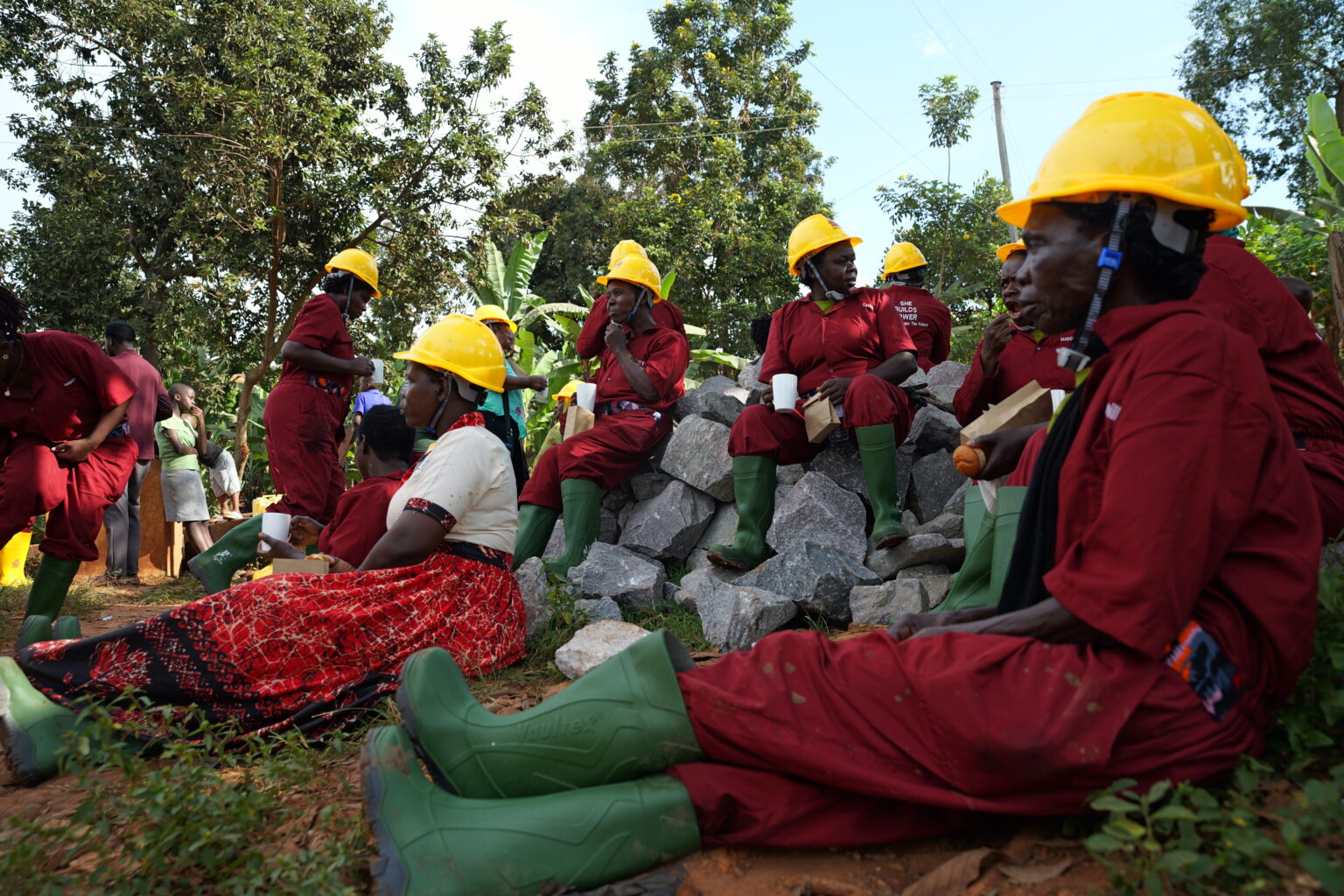
What We’re Actually Trying to Sustain
The more demanding question is not simply: What happens when we leave?
It is: What will remain because people here were able to lead?
That reframes the deliverable. It is not only a functioning structure. It is capability—real rather than mimicked, distributed rather than borrowed. It is the knowledge to diagnose a problem. The confidence to act. The relationships to mobilize support. The authority to make decisions. The financing to maintain what has been built. The accountability to ensure that leadership serves more than the already powerful.
A sustainable system is not one that never breaks. Everything breaks. A sustainable system is one that can produce its own repair.
It develops its next generation of technicians, organizers, committee members, trainers, and leaders. It can respond to problems nobody anticipated and for which no donor prepared a tidy budget line.
That is why the LLA principle of investing in local capabilities matters so much. The goal is not simply to complete an adaptation project. It is to leave an institutional legacy. Not dependency. Not a committee that exists only on paper. Not local volunteers expected to hold together a system without training, tools, financing, or authority.
But the capabilities and institutions that allow communities to understand risks, generate solutions, manage adaptation initiatives, and keep learning over time.
Maybe sustainability was never really about how long a project lasts. Maybe it is about the life that becomes possible after it. The trainee who becomes the trainer. The committee member whose seat comes with real authority. The volunteer who is supported by an institution rather than exploited by one. The community that does not have to wait helplessly for someone to return and fix what broke. The women whose local knowledge is treated not as anecdotal input, but as strategy. The girls who grow up seeing that water systems, food systems, finance systems, and climate adaptation systems are not things that happen to their communities.
They are things their communities can shape.
That is not dependency. It is not a project frozen in time. It is possibility.
And building the systems that allow possibility to compound—rather than building the appearance of those systems—is the actual, unglamorous, fundable work of sustainability.