Capability is Not Distributed According to Talent.
It is Often Distributed According to Access.
When a community needs clean water, the instinct is understandable:
Build the well. Solve the problem. Train people afterward.
At She Builds Power, we deliberately change the order.
We Train Women Before We Build.
Not simply because we want women involved in the project, but because who has knowledge before decisions are made influences what gets built, who leads it, and where the expertise remains afterward.
Years before we developed our Operating System to Catalyze Local Power, a gender audit we helped conduct across Uganda showed us why this matters.
The Opportunity Gap Comes Before the Capability Gap
In 2017, Global Women’s Water Initiative, the original name of our organization, and the Uganda Rainwater Association interviewed 160 WASH facilitators and masons—114 women and 46 men—across 11 organizations in Uganda.
One finding was particularly revealing.
Only 6.2% of female respondents had received their first WASH technology training through a technical institute, compared with 25% of men.
Women commonly entered the sector through hygiene, sanitation, and WASH theory. Men were much more likely to enter through technical construction training.
The difference wasn’t necessarily interest. Women repeatedly expressed a desire to learn construction.
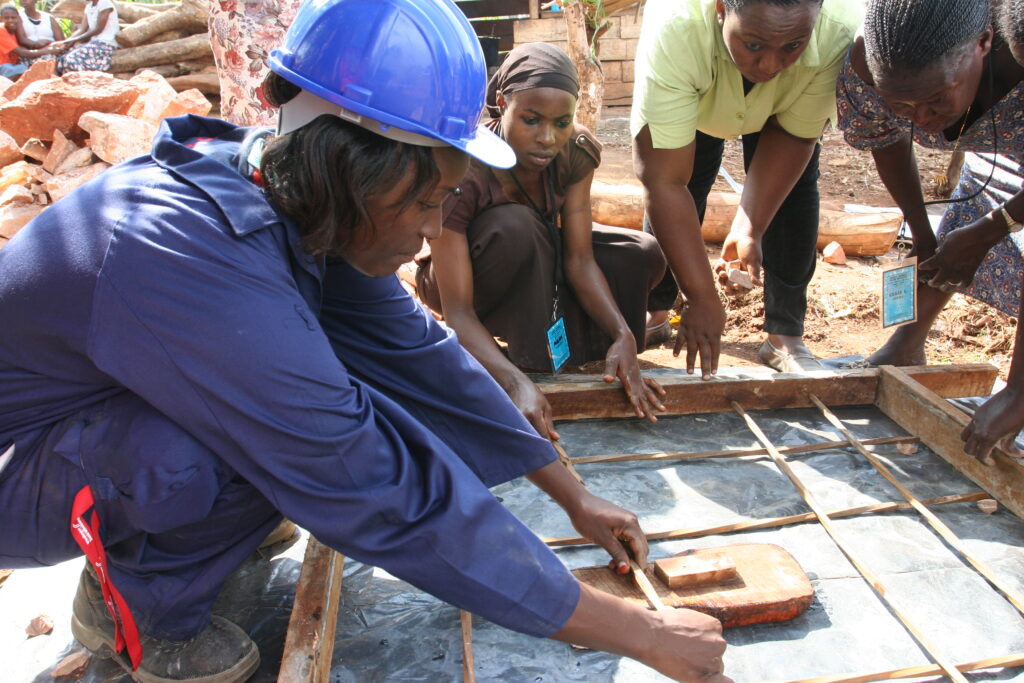
At one organization, women had never been invited to learn how to build water tanks. Instead, they carried water and construction materials and mixed cement while male masons performed the technical work.
The men had formal pathways into construction. The women largely didn’t.
That distinction matters.
If we look only at who possesses technical expertise today, we can easily mistake unequal access to learning for unequal capability.
Then Something Interesting Happened
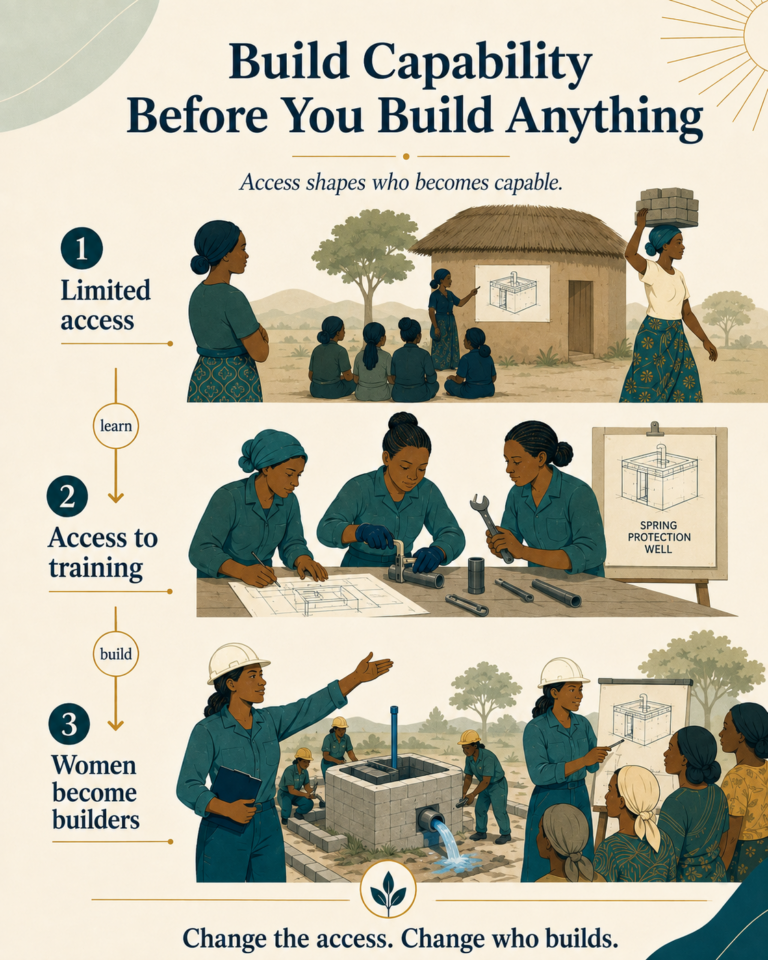
Where women were given access to specialized technical training, the pattern changed.
The audit found unusually high numbers of women constructing biosand filters. But the researchers flagged the result as an anomaly: those women belonged to organizations where GWWI had specifically provided them with technical training.
Similarly, the only organizations in the study constructing lower-cost ISSB water tanks had learned the technology through GWWI’s technical director.
Change the access, and suddenly you change who becomes the technician.
This is one reason capability is one of the eight conditions in our Operating System—but it cannot stand alone.
Capability depends on access.
You cannot ask why women aren’t building if they were never invited into the room where people learn how to build.
Knowledge Can Become Community Infrastructure
The audit revealed something else.
Women didn’t simply acquire knowledge. They spread it.
Thirty-nine percent of female respondents had conducted WASH trainings during the previous two years, compared with 28% of men. Five women reported conducting more than 20 trainings during that period; only one man reported the same.
Women were also more likely to say they planned to continue educating and training their communities.
In one community, a woman trained all 167 households to construct handwashing stations. Women in another organization collectively trained nearly 400 community members in technologies including water tanks, biosand filters, and latrines.
The report described a ripple effect: knowledge gained by one person becoming knowledge shared across households and communities.
That changes how we think about training.
A trained woman isn’t simply one more skilled person.
She can become part of the community’s knowledge infrastructure
This is Why Investing in Women Fights Poverty Differently
When people ask why investing in women is one of the best ways to fight poverty, our answer isn’t that women are inherently more generous or should be expected to fix their communities for free.
The audit actually exposes something more structural.
Women were carrying significant responsibility for water, sanitation, household health and community wellbeing while receiving less access to the technical skills that could generate income and influence how those systems were built.
That is a power imbalance.
Strong women-led poverty solutions address both sides of it: the problem itself and who has access to the expertise, resources and authority needed to solve it.
So We Train Before We Build
Training isn’t preparation for the intervention.
It is the intervention.
Before the first stone is laid, we want women assessing, questioning, understanding and making decisions.
Because the goal isn’t simply to leave behind a functioning well. It is to leave behind more people who know how systems work, how to adapt them, and how to teach someone else.
A well can serve a community for years.
Capability is limitless.
Source
- Thompson, Elise, and Nathalie Limandibratha.Gender Audit of URWA Member Organization Rainwater Harvesting Masons. Uganda Rainwater Association and Global Women’s Water Initiative, September 2017.