Everything You Need to Know About Community Resilience
Why Community Resilience Is the Foundation of Lasting Change
What is community resilience is one of the most important questions in development, disaster response, and systems change today — and the answer shapes everything from how we build infrastructure to how we invest in people.
Here’s the short answer:
Community resilience is the collective capacity of a community to prepare for, withstand, adapt to, and recover from disruptions — whether that’s a natural disaster, economic shock, or public health crisis — while maintaining essential functions and growing stronger in the process.
The key elements that make a community resilient include:
- Local knowledge — understanding risks, resources, and history from the inside out
- Social networks — strong relationships that hold communities together under pressure
- Communication — the ability to share information quickly and clearly when it matters most
- Health — access to physical and mental health services before and after a crisis
- Governance and leadership — trusted, inclusive decision-making structures
- Economic investment — diverse, locally rooted economies that can absorb shocks
- Preparedness — plans, skills, and systems ready before disaster strikes
- Mental outlook — collective hope, adaptability, and the will to rebuild
This isn’t about surviving. It’s about building systems that don’t break — or when they do, come back stronger.
The stakes are real. When Hurricane Katrina hit New Orleans, cascading failures across transportation, power, and communication networks showed exactly what happens when communities aren’t built to hold. When the Gujarat earthquake struck in 2001, a hospital collapse killed 176 people — a stark reminder that resilience isn’t abstract. It’s life and death.
And yet, despite decades of research — over 80 academic papers reviewed in one major study alone — there is still no single agreed definition of community resilience. What is agreed: it’s built from the bottom up, not handed down from the top.
That’s exactly where women come in.
I’m Gemma Bulos, founder of She Builds Power, and I’ve spent my career working at the intersection of water, food, and finance to understand what is community resilience from the ground up — training over 12,700 women who went on to train 34,000 more. In this guide, we’ll break down the core elements, real-world examples, and proven strategies so you can see — and support — what real resilience looks like when women lead it.
Defining the Concept: What is Community Resilience?
To truly understand what is community resilience, we have to look past the buzzwords. At its core, the National Institute of Standards and Technology (NIST) defines it as the ability to prepare for anticipated hazards, adapt to changing conditions, and withstand and recover rapidly from disruptions. But for us at She Builds Power, resilience isn’t just a defensive crouch; it’s an offensive strategy.
There are three main ways researchers classify this concept:
- Process-based definitions: These view resilience as an ongoing cycle of adaptation. It’s not a destination you reach, but a way of operating. It’s the constant “tuning” of a community’s systems to handle stress.
- Outcome-based definitions: These focus on the result. Did the community maintain its essential functions during the crisis? How quickly did the lights come back on or the water start flowing again?
- Attribute-based definitions: These look at the characteristics of the community itself—things like social cohesion, diverse income streams, and robust Water Resource Management.
The shift from adaptation (adjusting to survive) to transformation (changing the system so the threat no longer has power) is where the real magic happens. In places like the Butambala District in Uganda or Siaya County in Kenya, resilience isn’t just about fixing a broken well; it’s about transforming the community’s relationship with water so they are never “water insecure” again.
The Difference Between Individual and Community Resilience
It is a common mistake to think that if you have a group of “tough” individuals, you have a resilient community. That’s not how it works. Individual resilience is about personal grit. What is community resilience, however, is about collective efficacy—the belief that we can work together to produce a desired effect.
Think of it like a safety net. A single thread might be strong (individual resilience), but it can’t catch a falling person. It’s the way those threads are woven together (social capital) that creates the net. Community resilience relies on network dependencies. If one person is prepared but the local health clinic collapses or the water system fails, that individual’s resilience is quickly exhausted.
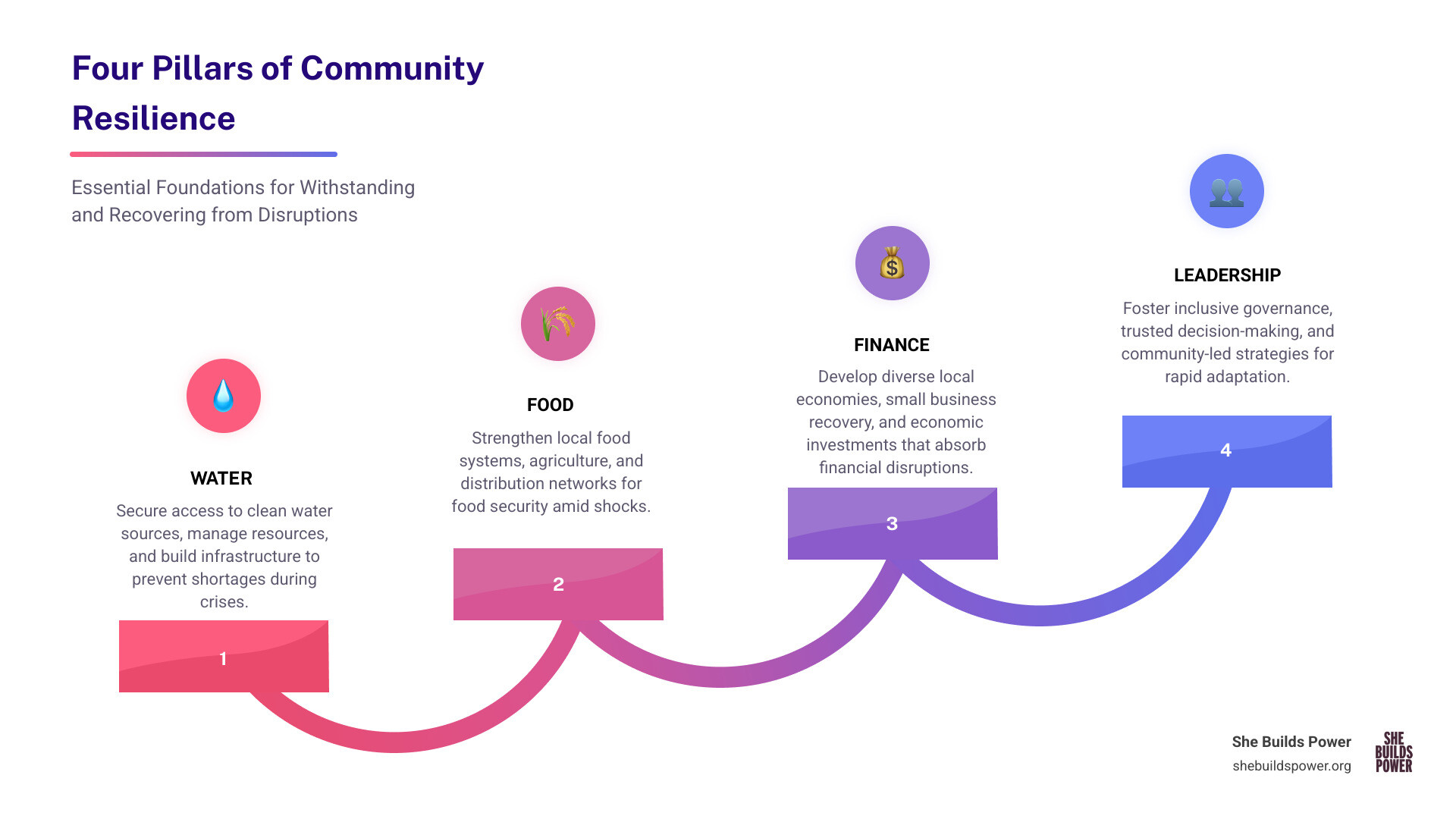
We focus on building Water, Food, and Finance: Our New Pillars of Power because these are the collective systems that support everyone. When a woman in Siaya County leads a local savings group, she isn’t just building her own bank account; she’s building a financial buffer for her entire neighborhood.
Understanding the Shiftmaker Perspective on What is Community Resilience
At She Builds Power, we view the question of what is community resilience through a lens of agency over access. Traditional aid focuses on “access”—giving someone a bag of grain or a one-time repair for a pump. We focus on “agency”—equipping women with the technical skills and leadership authority to design, build, and maintain those systems themselves.
This is Powerbuilding. It’s the difference between being a beneficiary of charity and being a builder of systems. When women move From Wells to Wealth: How Water Builds Power, they are fundamentally changing the structural power dynamics of their community. They aren’t just surviving the next drought; they are managing the water resources so the drought doesn’t become a disaster.
The Core Elements of a Resilient System
What makes one community bounce back while another falls apart? Research identified nine core elements that consistently appear in resilient communities.
| Element | Individual Resilience | Organizational Resilience | Community Resilience |
|---|---|---|---|
| Focus | Personal wellbeing | Business continuity | Collective survival & growth |
| Resources | Personal savings/skills | Supply chains/capital | Shared infrastructure/ecosystems |
| Leadership | Self-direction | Executive decision-making | Inclusive, local governance |
| Social Connection | Family/Friends | Group networks | Cross-demographic cohesion |
These elements aren’t just academic; they are the gears of a functional society. For instance, the Importance of Women in Food Security cannot be overstated. When women have a seat at the table, the “Economic Investment” and “Preparedness” elements of resilience tend to focus more on long-term stability and household health.
The Role of Local Knowledge in What is Community Resilience
You cannot build resilience from an office in a distant city. What is community resilience if not the application of local knowledge? This includes traditional wisdom—like knowing which areas flood during the long rains in Uganda—combined with modern data-driven monitoring.
We train women to conduct community-led assessments. They monitor rainfall, track water sources and access, and analyze water quality. This turns “local knowledge” into actionable data. By understanding the factual risks and resources of their specific landscape, they can implement Water solutions that actually last because they are grounded in the reality of the soil and the people.
Infrastructure and Economic Interdependencies
One of the biggest threats to resilience is the “cascading failure.” This happens when one system fails and knocks out others. During Hurricane Katrina, the failure of the power grid led to the failure of communication systems, which then paralyzed emergency services.
In a resilient community, infrastructure is redundant and flexible. But it’s not just about pipes and wires; it’s about the economy. A community that relies on a single crop or a single employer is fragile. Resilient communities foster diversified local economies. By integrating Food systems with micro-finance, we ensure that if a harvest is lean, the community has other financial pillars to lean on.
Real-World Impact: From Crisis to Powerbuilding
Real resilience is tested in the fire of crisis. Take the COVID-19 pandemic. While it was a global health crisis, the impact was felt most acutely at the community level. Communities with strong social support networks saw lower rates of loneliness and better distribution of resources.
In our work across Uganda, Kenya and Tanzania, we see this every day. In the Butambala District in Uganda, we don’t just talk about resilience; we build it through integrated systems. When the 2008 financial crisis hit, it was a reminder that global shocks have local consequences. The communities that fared best were those with “community wealth”—local cooperatives and savings groups that kept capital circulating within the village.
Stories like Every Drop Builds Power: Amina’s Story from Uganda show that when a woman gains control over a water source, she doesn’t just save time; she gains the power to invest in her farm, her children’s education, and her community’s future. That is the ultimate “mental outlook” shift—from scarcity to abundance.
How Equity and Inclusion Factor Into What is Community Resilience
You cannot have a resilient community if half the population is left behind. Equity isn’t just a moral goal; it’s a functional requirement for resilience. Marginalized populations—including low-income families and women—often face the highest risks and have the slowest recovery times due to systemic inequality.
Inclusive leadership ensures that the needs of the most vulnerable are baked into the planning process. When we talk about our Impact, we are talking about shifting the power balance so that those who are most affected by climate change and economic instability are the ones designing the solutions. A system designed by and for the entire community is always stronger than one designed by a small elite.
Strategies for Building and Measuring Resilience
So, how do we actually build this thing? It starts with a plan. NIST offers a 6-step Community Resilience Planning Guide that we find very effective:
- Form a Collaborative Planning Team: You need everyone at the table—local leaders, business owners, and especially women.
- Understand the Situation: What are the actual risks? Use that local knowledge we talked about.
- Determine Goals and Objectives: What does “success” look like? (Hint: It’s more than just a repaired pump).
- Plan Development: Create the roadmap for water, food, and finance systems.
- Plan Preparation, Review, and Approval: Ensure the community owns the plan.
- Plan Implementation and Maintenance: This is where the training and powerbuilding happen.
Measuring resilience is notoriously tricky because you’re often measuring something that didn’t happen (e.g., the community didn’t go hungry during the dry spell). However, tools like the BRIC index (Baseline Resilience Indicators for Communities) and the RIMA framework (Resilience Index Measurement and Analysis) help us track social, economic, and institutional capital over time.
Enhancing Health Services and Mental Outlook
Resilience is as much about the mind as it is about the machine. After a disaster, “Psychological First Aid” is just as critical as medical first aid. A community’s “mental outlook”—their sense of hope and adaptability—is a measurable predictor of how well they will recover.
Strong social support networks are the primary driver of this positive outlook. When people know their neighbors and trust their leaders, they are less likely to fall into despair. We encourage communities to use Emergency preparedness resources to build these connections before the crisis hits. A connected community is a protected community.
Frequently Asked Questions about Community Resilience
What is the difference between resilience and preparedness?
Preparedness is about having the “kit”—the plan, the extra water, the emergency contacts. Resilience is about the “capacity”—the underlying strength of the systems and relationships that allow you to use those kits effectively and adapt when the plan inevitably changes. Preparedness is a component of resilience.
How do interconnected crises like climate change impact resilience?
We are no longer dealing with “mono-crises.” Climate change creates “multi-crises” where a drought might lead to a food shortage, which leads to economic instability, which leads to social unrest. This is why a systems approach is vital. You cannot solve for water without also solving for food and finance.
Can community resilience be measured quantitatively?
Yes, though it’s complex. We look at statistics like reduced mortality rates, lower economic losses during shocks, and improved influence and leaderhip. In SBP communities, we also track the number of women in leadership roles and the stability of local water and food prices as key indicators of a resilient system.
Conclusion: Building Systems That Last
When we ask what is community resilience, we are really asking: “How do we build a world that can hold us?”
At She Builds Power, we believe the answer lies in women-led leadership and integrated systems. We are replacing fragmented, “band-aid” aid with a model that treats water, food, and finance as a single, interconnected engine of power.
In Siaya County and Butambala, we are seeing the results. We are seeing communities move from the fragility of poverty to the stability of power. We aren’t just building wells; we are building wealth. We aren’t just planting seeds; we are growing leaders.
The journey from vulnerability to resilience is a long one, but it is the only path to a sustainable future. It requires us to move beyond charity and into the hard, rewarding work of systems change.
Are you ready to stop managing symptoms and start building power?
Join the movement to build power and help us equip the next generation of women builders. Together, we can create communities that don’t just survive—they thrive.