Rethinking Resilience
Resilience may be the most admired word in international development. The World Bank, UNICEF, and the UN system all use it to describe how communities absorb shocks and keep functioning through drought, conflict, displacement, and economic collapse. We use it to describe the women who hold families together through crises, the farmers who adapt to a shifting climate, the children who keep learning through instability.
There is truth in that admiration. Human beings are extraordinary. But the data underneath the word tells a second, less comfortable story.
The Evidence Behind the Word
Consider what “resilience” actually requires of people, in hours and in risk:
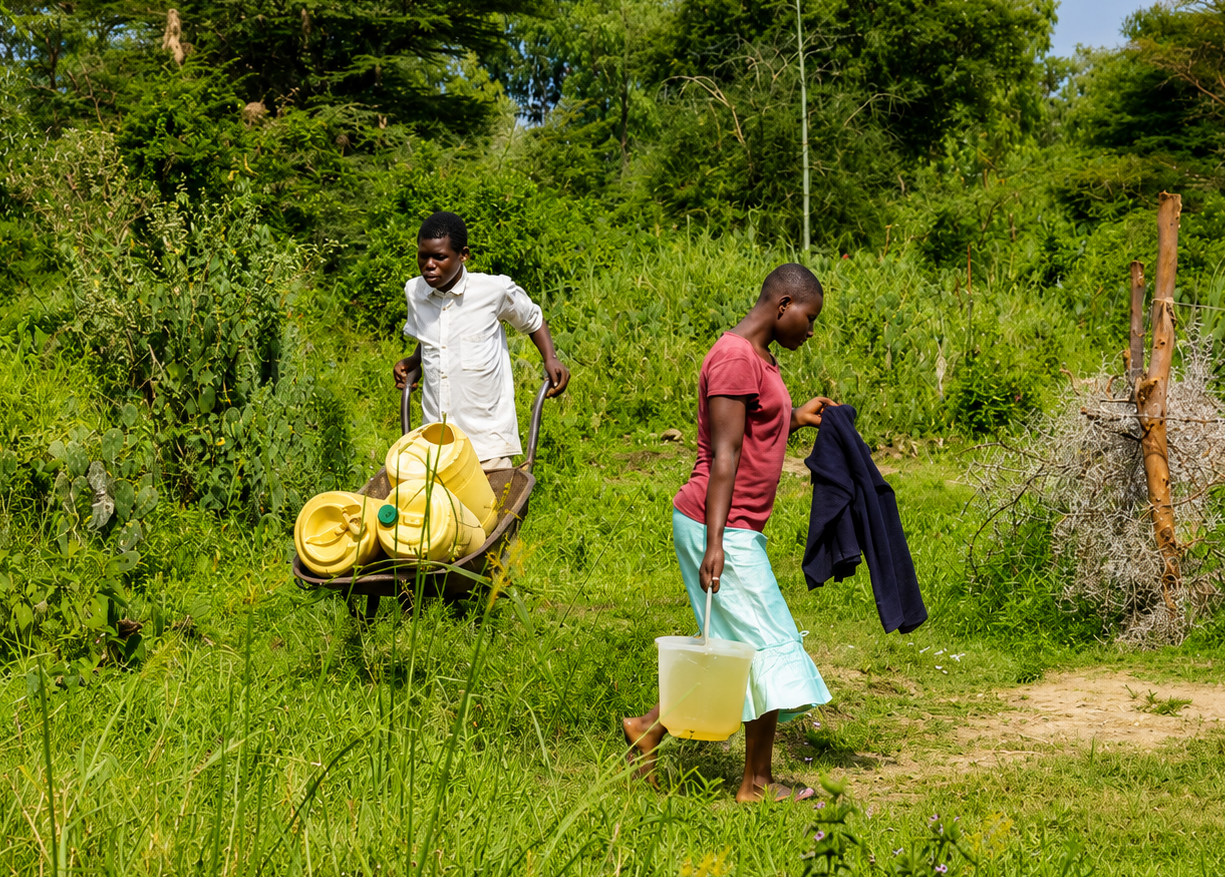
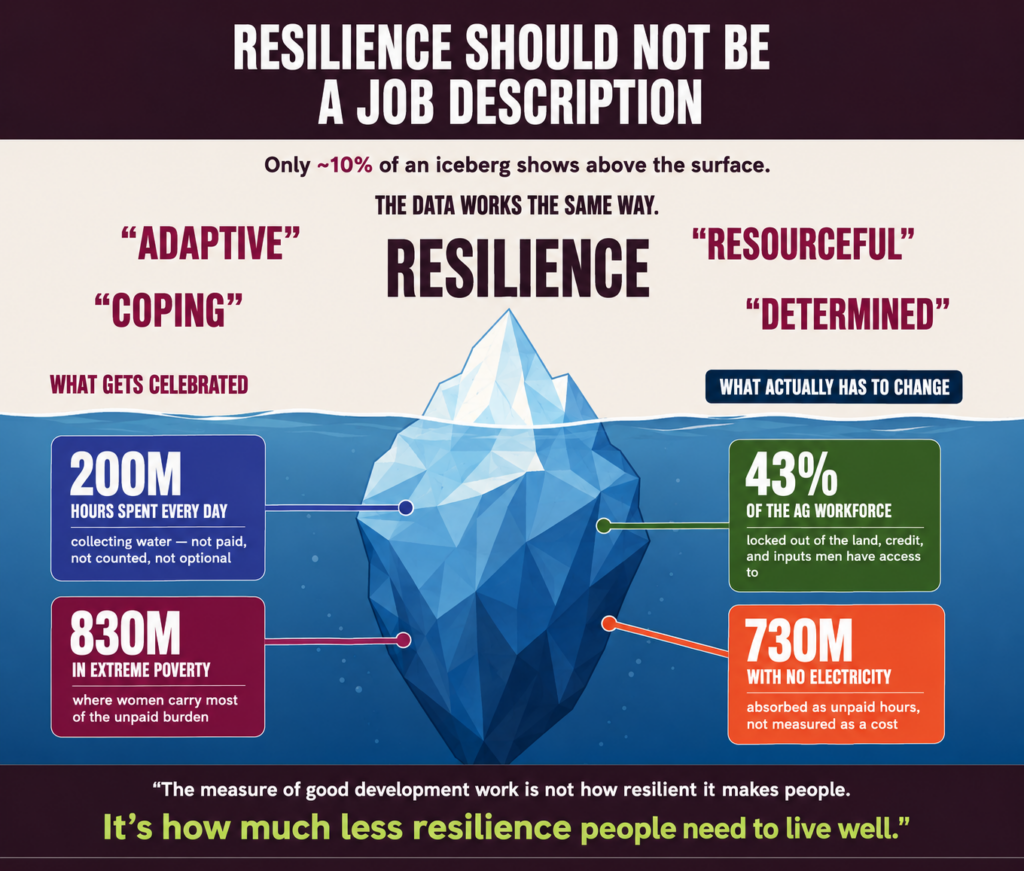
- Water. UNICEF and WHO estimate that women and girls collectively spend roughly 200 million hours every day collecting water worldwide. In sub-Saharan Africa, women and girls perform an estimated 70–80% of water-collection labor (UNICEF, 2016, Collecting Water Is Often a Colossal Waste of Time for Women and Girls). That labor rarely appears in GDP. It appears in missed school days, in spinal and reproductive-health strain, and in exposure to gender-based violence along collection routes.
- Agriculture. The FAO’s landmark State of Food and Agriculture report found that women make up roughly 43% of the agricultural labor force in developing countries, yet control a fraction of the land, credit, and inputs that men do. FAO’s own modeling suggests that closing this gender gap in agricultural resources could raise total agricultural output in developing countries by 2.5–4%, and could reduce the number of hungry people in the world by 12–17% — on the order of 100–150 million people.
- Poverty. The World Bank’s current estimates put more than 830 million people living in extreme poverty (under roughly $2.15/day), concentrated disproportionately in rural households where women perform the majority of unpaid care and subsistence labor.
- Energy. The International Energy Agency reports that roughly 730 million people still lack access to electricity, a constraint that falls hardest on girls’ study time and women’s economic participation, since energy poverty is absorbed disproportionately through unpaid domestic labor — fetching fuel, cooking over open fires, working after dark by candlelight.
None of this is anecdote. It is structural allocation of burden, measured at global scale, decade after decade, by the institutions that claim resilience as a development outcome.
When Admiration Becomes an Alibi
Here is the tension: resilience is a real and valuable human capacity. But it is also, in development practice, sometimes the outcome we settle for when the harder work — infrastructure, land rights, credit access, electrification — hasn’t happened yet.
There is a difference between honoring resilience and relying on it.
When a woman walks miles for water, she may indeed be resilient. But resilience is not the goal. Proximity to safe water is the goal — and we know precisely what changes when that happens. Multiple field studies (including WHO/UNICEF Joint Monitoring Programme data) show that closing the distance to safe water can cut water-collection time by as much as half, with measurable downstream increases in girls’ school attendance and measurable declines in waterborne disease.
When a girl studies by candlelight, her determination is real. But determination is not infrastructure. It is what people supply in the absence of infrastructure.
This is the quiet danger in resilience narratives: they are measurable in survival rates, recovery timelines, and adaptation strategies — all of which make for compelling reports — while equity, land ownership, and structural risk reduction are harder to graph and slower to fund. Institutions gravitate toward what they can measure. Resilience is easy to measure. Justice is not.
Scholars in critical development studies have made a related argument for years: that “resilience” as a policy frame can quietly shift responsibility from institutions to individuals — asking people to become more adaptable to conditions, rather than asking why those conditions exist and who is accountable for changing them. It is a fair critique, and one development practitioners should sit with rather than dismiss.
The Counterargument — and Where It Holds
To be intellectually honest, the resilience frame has real defenders, and their case is not weak:
- Resilience-building can be faster and cheaper than structural reform. Digging a borewell, distributing drought-resistant seed varieties, or running a cash-transfer program during a shock can save lives this year, while land reform or grid electrification may take a decade or more to negotiate and finance. In acute crises, resilience programming is often the only realistic lever available.
- Resilience preserves agency. Framing communities as capable adapters — rather than passive recipients of aid — has been a deliberate corrective to older, paternalistic development models that treated affected populations as helpless. Stripped of context, an infrastructure-only narrative can be its own form of condescension, erasing the skill and judgment people exercise every day.
- Systems change is slow, and people can’t wait. Land tenure reform, national electrification, and universal water infrastructure require political will, capital, and time horizons that outlast most funding cycles. In the interim, resilience is not a substitute for justice — but it is what keeps households fed and children in school while justice is still being built.
These points matter. The answer is not to discard resilience programming. It’s to stop treating it as the finish line.
What Justice Asks Instead
Development’s habitual question has been: How do people keep going?
The more demanding question is: What would make life less difficult to keep going through?
That reframing moves the center of gravity — from endurance to conditions, from admiration to responsibility, from survival to possibility. It does not ask communities to prove they can cope. It asks institutions to prove they are changing what people have to cope with.
In practice, that means:
- Water systems that shorten or eliminate the walk, not just water-storage trainings that help households manage scarcity.
- Land and credit access for the 43% of the agricultural workforce that is currently locked out of the inputs needed to close a measurable 2.5–4% productivity gap.
- Electrification and clean energy access for the roughly 750 million people still without it — not resilience curricula that teach children to study effectively in the dark.
- Leadership structures where the women who hold this knowledge shape the decisions, rather than absorb the consequences of decisions made elsewhere.
The Line Worth Holding
Resilience is one of humanity’s great strengths. It is not, on its own, justice.
We can hold both truths at once: admire the strength it takes to survive broken systems, and refuse to treat that strength as a reason those systems don’t need to change. We can celebrate endurance and still ask, pointedly, why so much endurance was ever required.
The measure of good development work is not how resilient it makes people. It’s how much less resilience people need in order to live well.
SELECTED SOURCES:
- UNICEF: Collecting Water Is Often a Colossal Waste of Time for Women and Girls (2016)
- World Bank: The Gendered Burden of Water Collection in Sub-Saharan Africa (2024)
- FAO: The State of Food and Agriculture 2010–2011: Women in Agriculture — Closing the Gender Gap for Development
- World Bank: Poverty and Shared Prosperity report, with the 2025–2026 international poverty line revision
- International Energy Agency: SDG7 electricity access tracking, 2025 update