The Missing Variable Is Agency
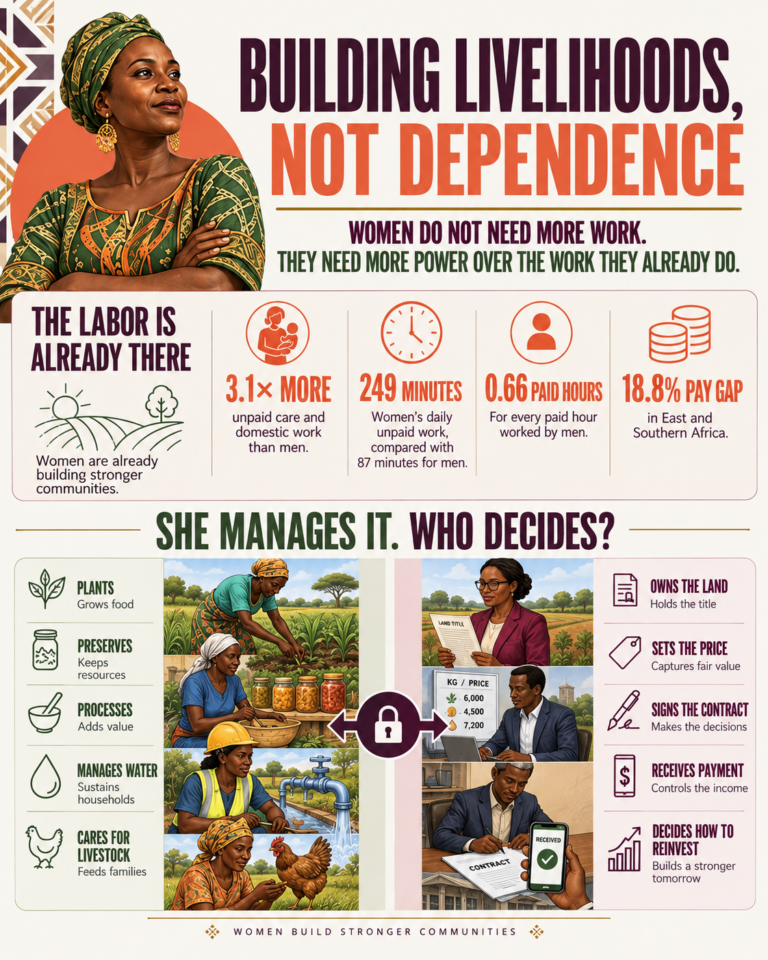
East African women do not need more work, they need more power over the work they already do. That distinction matters more than most development programs have been willing to admit. These women are among the most productive contributors to their communities, managing water and doing most of the water related chores, sustaining food supply chains, raising children, and running informal enterprises. In Kenya, women spend an average of four hours and 38 minutes a day on unpaid care work, compared with just over one hour for men. The poverty is not in the effort. It is in who controls what that effort produces.
Ownership, decision-making authority, and economic control are the variables that traditional aid programs consistently underestimate, a pattern documented across UN Women, World Bank, and J-PAL program reviews examining gender-sensitive development approaches. She Builds Power was built on a specific response to that gap: women don’t need more tasks layered onto their lives. They need authority over the systems they are already running.
The Labor is Already There, and It Is Not Being Counted
Across sub-Saharan Africa, UN Women data shows women spend roughly three times as many hours on unpaid care and domestic work than men. The IMF reports women average 249 minutes per day on that work compared to 87 minutes for men. These are structural data points, not cultural observations, and they explain why adding more training to women’s schedules is often the wrong intervention. When a woman’s day is already spoken for before the sun rises, a new skills workshop is not liberation. It is an additional obligation.
That care burden directly compresses paid work time. Women in sub-Saharan Africa work only 0.66 paid hours for every one hour men spend in paid work. The unadjusted gender pay gap in East and Southern Africa sits at 18.8%, and in Ethiopia it reaches 30.2%. Even after accounting for sector, hours, and experience, a substantial gap remains, reflecting structural barriers rather than individual choices. The systems that assign value, recognize credentials, and distribute earnings were not designed with women’s unpaid contributions as a starting point. Most programs have not corrected for that, which is why East African women continue to need power over the work they already do, not simply more of it.
She manages it. He decides.
Women in rural East Africa haul water, tend crops, preserve food, manage livestock, and hold together the daily operations of rural life. They are the operational backbone of community infrastructure. But in most cases, they do not own the land those crops grow on. Across East Africa, statutory protections coexist with uneven implementation, customary practices and significant gaps between formal ownership and meaningful control. The gap between what a statute says and what a woman can actually accomplish at a land registry office is not a legal technicality. It is the daily reality of millions of women across the region.
Qualitative and quantitative research across Uganda, Tanzania, Kenya, and Ethiopia show a recurring pattern, with important variation by country and commodity. Women do the planting, preserving, and processing. Men make the final calls on selling, pricing, and contracting. A synthesis of East African climate-adaptation studies describes women as the ones who cope with unfavorable decisions made by men. In small ruminant production, crop sales, and market contracts, men retain the higher-power position even when women perform most of the daily labor. Some research points toward measurable transfers of sale proceeds and contract value away from the women who generated them, though the full picture varies by region and commodity. That structural pattern is what programs must address.
Why Authority Over Work Matters More Than Additional Skills
This dynamic shows up clearly when you examine who receives payment after harvest. Women negotiate crop quality at the field level; men negotiate price at the market. Women preserve the grain; men sign the buyer’s contract. The labor investment is women’s. The financial return is routed elsewhere. East African women need power over the work they already do precisely because the work itself is not the obstacle, the authority gap is.
Why More Programs Can Quietly Make Things Worse
The standard development response to women’s poverty has been to add skills: agricultural training, nutrition education, hygiene promotion, income-generating activity workshops. None of that is wrong on its own. But when training is layered onto women who already carry more hours of work than men, with no corresponding shift in who holds the title, controls the income, or signs the contract, the program has not transferred power. It has transferred tasks. The woman is now more skilled at sustaining a system she still does not own.
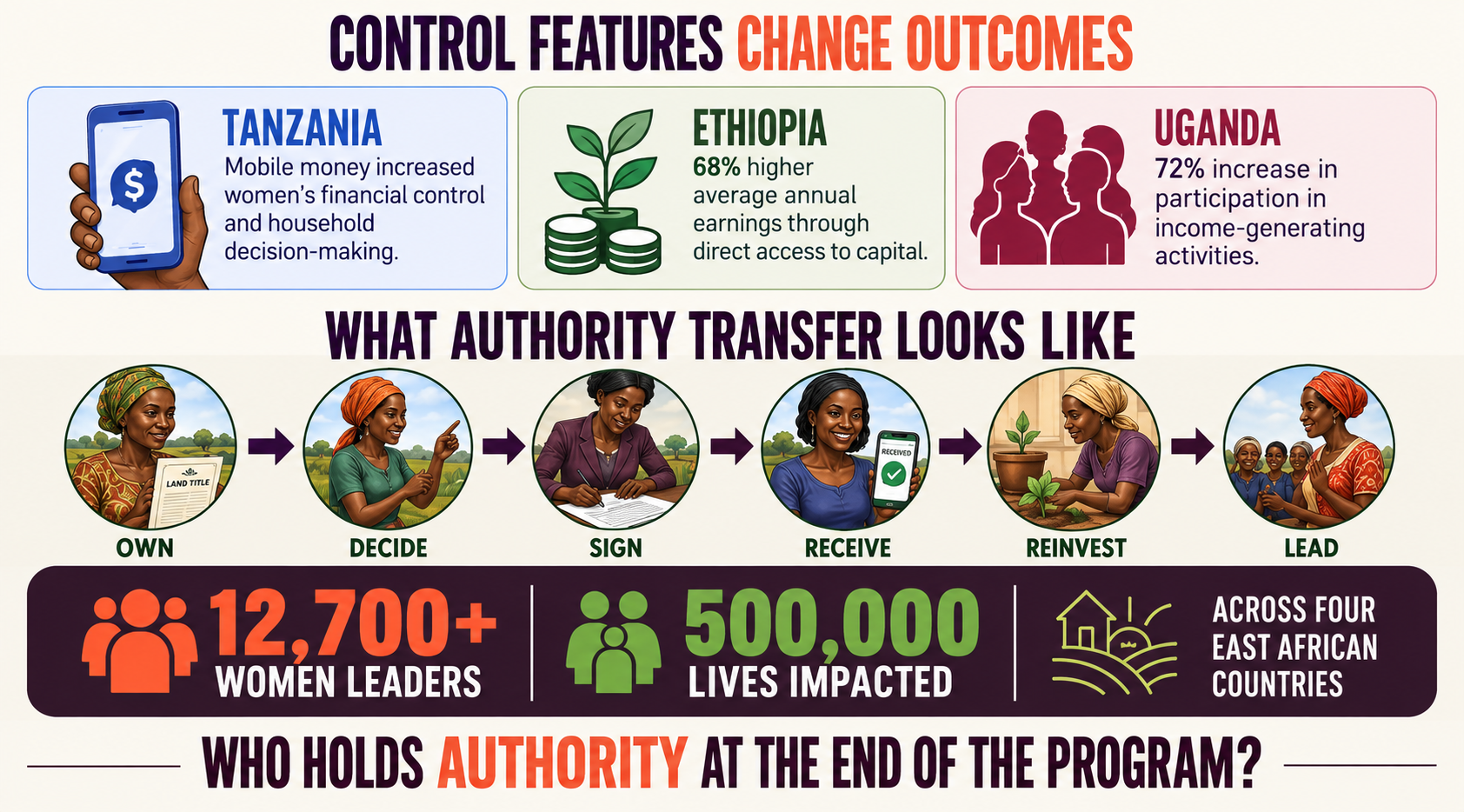
The evidence on interventions that actually shift control is instructive. Mobile money repayment systems in Tanzania increased women’s decision-making power at home and their self-reported control over finances, not just their usage of financial tools. World Bank reporting on Ethiopia’s Women Entrepreneurship Development Project found that 24,000 women entrepreneurs increased average annual earnings by 68% after securing loans through participating financial institutions. Uganda’s BRAC ELA program increased income-generating activity participation by 72%. The pattern is consistent: control features produce measurably different results than skill features alone when the goal is shifting power over work and income.
What Real Authority Transfer Looks Like On The Ground
She Builds Power does not train women to assist in water systems. It trains women to engineer, build, and manage them. It does not teach women to farm for a program, it builds women into the owners of climate-resilient food enterprises. And it does not hand over a microloan and step back. The model integrates financial literacy, savings group leadership, and revolving loan access so women control the capital and the decisions attached to it. That integration across water, food, and finance is the design principle, not the program outcome.
Across four countries in East Africa, this approach has reached more than 12,700 women leaders and, based on program monitoring data, impacted an estimated 500,000 lives. The outcomes compound when women hold decision-making authority over the systems they sustain. Children’s school fees get paid, nutrition improves, and water access becomes reliable because the woman managing a biosand filter for example, is also accountable for it. Research broadly supports the link between women’s resource control and improved outcomes across health, nutrition, education and household investment. This is what building livelihoods over dependence actually looks like: women who are not aid recipients but architects of community infrastructure, with the legal standing, technical expertise, and economic control to sustain it across generations.
The Question That Changes Everything: East African Women Need Power Over The Work They Already Do, Not More Of It
East African women do not need more work added to lives already full of it. They need ownership over the labor they already perform. They need land rights that hold in practice, not just in legislation. They need to be the ones who sign the contract, receive the payment, and decide how to reinvest. Studies on collective investment, asset-building, and intergenerational wealth transfer consistently show that when women hold meaningful authority over resources, household stability and community outcomes improve, though the scale and mechanisms vary by context.
For donors, policymakers, and program designers, the question is no longer “how do we support and uplift women?” It is “who holds authority at the end of the program?” If the answer is the same person it was at the start, the work is not finished. Supporting women as the systems leaders they have always been is not a new idea. It is simply an honest one. Programs built on that principle exist. She Builds Power is one of them.
Frequently Asked Questions
- Why is investing in women the best way to fight poverty? Because women already perform the majority of unpaid care work and much of the productive labor in their communities — the barrier isn’t effort, it’s authority over the value that labor creates. Interventions that shift decision-making power and resource control (not just skills) produce measurably larger income and household gains, such as a 68% earnings increase from Ethiopia’s Women Entrepreneurship Development Project.
- What does investing in women in global development actually mean in practice? It means giving women ownership and decision-making authority over the systems they already run — land titles, capital control, and technical leadership over water, food, and finance systems — rather than layering additional training or tasks onto their existing workload.
- How is She Builds Power’s approach different from traditional aid programs? Traditional programs often add skills without shifting who holds control. She Builds Power trains women to own and lead the systems themselves — as engineers of water infrastructure, owners of food enterprises, and managers of their own capital through savings groups and loan programs.
References
- Maina, Lucy W., et al. Gendered Patterns of Unpaid Care and Domestic Work in the Urban Informal Settlements of Nairobi, Kenya. 2019.
- UN Women. National Care Needs Assessment – Kenya. 2024.
- Kolovich, Lisa L., et al. Gender Inequality and Care Work: Valuing and Investing in Care. 2024.
- United Nations Statistics Division. Time-Use Statistics: SDG Indicator 5.4.1.
- Alarakhia, Mehjabeen, et al. Why Women Earn Less: Gender Pay Gap and Labour-Market Inequalities in East and Southern Africa. 2023.
- WHO & UNICEF. Progress on Household Drinking Water, Sanitation and Hygiene 2000–2022: Special Focus on Gender. 2023.
- Chang, Wei, et al. Enhancing Women’s Agency: Cross-Cutting Lessons from Experimental and Quasi-Experimental Studies in Low- and Middle-Income Countries. 2020.
- J-PAL. Designing Financial Services and Social Protection Programs to Enhance Women’s Economic Empowerment. 2021.
- World Bank. Voice and Agency: Empowering Women and Girls for Shared Prosperity. 2014.
- Gaddis, Isis, Rahul Suresh Lahoti, and Wenjie Li. Gender Gaps in Property Ownership in Sub-Saharan Africa.2018.
- Theis, Sophie, et al. What Happens after Technology Adoption? Gendered Aspects of Small-Scale Irrigation Technologies in Ethiopia, Ghana, and Tanzania. 2018.
- Njuki, Jemimah, et al. A Qualitative Assessment of Gender and Irrigation Technology in Kenya and Tanzania. 2014.
- Vincent, Katharine. A Review of Gender in Agricultural and Pastoral Livelihoods Based on Selected Countries in West and East Africa. 2022.
- Kinati, Wole, et al. Small Ruminant Value Chain and Empowerment: A Gendered Baseline Study from Ethiopia.2023.
- Heath, Rachel, and Emma Riley. Digital Financial Services and Women’s Empowerment: Experimental Evidence from Tanzania. 2024.
- World Bank. Transforming the Lives of Women and Girls in Eastern and Southern Africa. 2024.
- Alibhai, Salman, Niklas Buehren, and Sreelakshmi Papineni. Better Loans or Better Borrowers? Impact of Meso-Credit on Female-Owned Enterprises in Ethiopia. 2018.
- Bandiera, Oriana, et al. Women’s Empowerment in Action: Evidence from a Randomized Control Trial in Africa.2020.
- Eissler, Sarah, and Elizabeth Bryan. Women’s Control over Income and Household Spending Decisions: A Rapid Review.