Why Women’s Economic Agency Is the Most Overlooked Force in Global Development
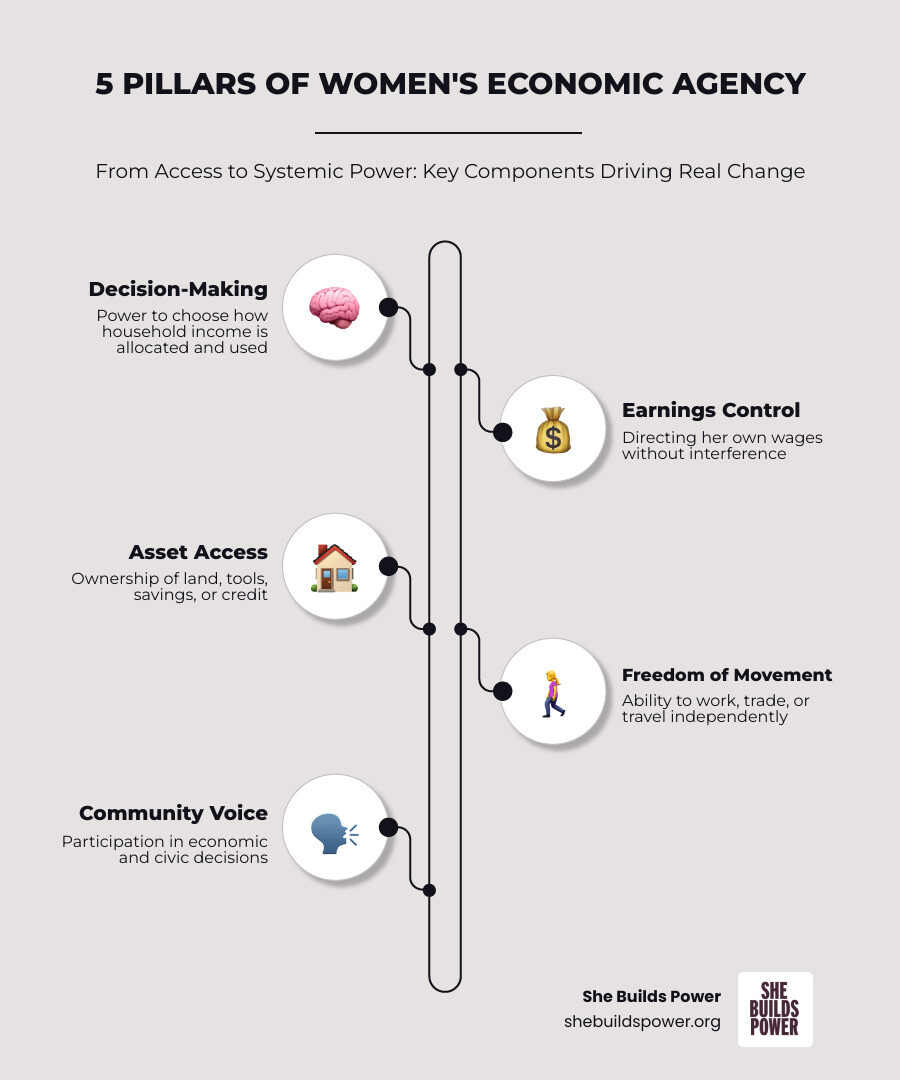
Women’s economic agency is the power a woman has to make real choices about her economic life — what work she does, how she earns, what she owns, and how she spends or saves.
It goes far beyond having a bank account or a job. Here’s a quick breakdown:
| Component | What It Means |
|---|---|
| Decision-making power | Choosing how household income is used |
| Control over earnings | Keeping and directing her own wages |
| Access to assets | Owning land, tools, savings, or credit |
| Freedom of movement | Ability to work, trade, or travel without permission |
| Voice in the community | Participating in economic and civic decisions |
This matters — not just for women, but for everyone. Closing the gender financing gap alone could add $1.1 trillion to the global economy by 2030. Adding more women to the workforce could boost global GDP by 26%. These aren’t soft numbers. They are structural opportunities sitting untapped.
Yet globally, 90 economies still have laws preventing women from working in specific jobs. No country has reached full legal equality. And millions of women are doing the work of holding families and communities together — without recognition, resources, or real power.
The gap between access and agency is where most programs fail. A woman can have a savings account and still have no say in how the money is used. She can complete a training program and still return home to a household that limits her choices.
True economic agency means she doesn’t just participate in the economy. She shapes it.
I’m Gemma Bulos, founder of She Builds Power, and I’ve spent decades working at the intersection of women’s economic agency, clean water, sustainable food, and community finance — training women not as aid recipients, but as system builders who create lasting change for entire communities. In this guide, I’ll walk you through what the research shows, what actually works, and why the integrated approach changes everything.
Defining Women Economic Agency: Beyond Financial Access

When we talk about women economic agency, we often make the mistake of confusing it with “access.” Giving a woman a loan or a seed packet is access. Agency is what happens when she has the internal confidence, the social standing, and the structural support to use those resources to transform her life and her community.
In feminist economics, researchers often point to the Three faces of agency in feminist economics: capabilities, empowerment, and citizenship.
- Capabilities: This is about the range of alternatives available to a woman. It’s not just about the choice she makes, but whether she actually had other viable options.
- Empowerment: This is the process of gaining the capacity to make strategic life choices. It involves moving from a state of “powerlessness” to having “power to” act, “power within” (self-efficacy), and “power with” (collective action).
- Citizenship: This is the stage where women move from individual success to collective leadership, influencing the institutions and policies that govern their lives.
At She Builds Power, we see this transition every day in places like the Butambala District in Uganda and Siaya County in Kenya. A woman might start by joining a local Finance group, but the real shift happens when she realizes she has the right to decide how that capital is invested. This “power within” is the engine of sustainable development.
The Critical Link Between Women Economic Agency and Global Growth
The numbers are staggering. Research from the Council on Foreign Relations suggests that Closing the Gender Gap in the Workforce could increase global GDP by 26%. That is equivalent to adding the economies of the United States and China combined.
In our work across East Africa, we see that when women control their earnings, they invest up to 90% of their income back into their families—buying nutritious food, paying school fees, and accessing healthcare. This creates a multiplier effect that breaks the cycle of poverty. For example, closing the women’s health gap alone is estimated to boost the global economy by US$1 trillion every year.
Investing in women economic agency isn’t just “the right thing to do”; it is the most effective strategy for regional stability and economic resilience. When women in Siaya County or Butambala have the agency to lead, they don’t just build businesses—they build systems that withstand climate shocks and economic downturns.
Breaking the Structural Barriers to Power
If the economic benefits are so clear, why is the progress so slow? Because the barriers aren’t just financial; they are structural, legal, and deeply cultural.
One of the most significant hurdles is the “care crisis.” Globally, women perform the vast majority of unpaid care work—cooking, cleaning, and caring for children and the elderly. This limits their time for paid employment or education. In fact, investing in universal child care and long-term services could generate 300 million jobs worldwide, according to Care at work and the global care crisis.
In rural Uganda and Kenya, this burden is compounded by poor infrastructure. When a woman has to walk four hours a day just to fetch water, her economic agency is effectively stolen. This is why our model at She Builds Power focuses on Water Resource Management. By bringing water closer to home, we “buy back” time for women to engage in Finance and leadership.
Other barriers include:
- Legal Restrictions: 90 economies still have laws that limit the types of jobs women can hold.
- The “Red Tape” of Bias: Systemic biases in banking and local governance often act as invisible barriers, making it harder for women to secure land titles or business permits.
- Gender-Based Violence (GBV): Financial independence can sometimes trigger resistance or violence from partners who feel their traditional authority is being challenged.
How Household Dynamics Shape Women Economic Agency
We cannot talk about women economic agency without talking about the home. A woman’s ability to work or save is often negotiated at the kitchen table.
Research, including the study On Her Own Account: Financial Control and Labor Supply, shows that when women have direct control over their wages—such as through direct deposit into their own bank accounts—they are more likely to work and have a greater say in household decisions. This control doesn’t just change her bank balance; it shifts gender norms. Over time, as women contribute more to the household economy, community perceptions of “women’s work” begin to liberalize.
However, we’ve also learned that simply increasing a woman’s income isn’t enough. We must engage men. Programs that include “gender dialogues” or household-level training help partners understand that a woman’s economic success is a win for the whole family. In our Siaya County projects, we’ve seen that when husbands are engaged as partners in the transition from “access to agency,” the risk of conflict drops, and the sustainability of the woman’s business skyrockets.
Proven Strategies for Building Economic Resilience
What actually works to move the needle? The What Works to Enhance Women’s Agency: Evidence Review highlights several high-impact interventions:
- Vocational and Business Training: Providing women with marketable skills like climate-resilient farming or digital financial literacy is foundational. But it must be paired with “soft skills” like negotiation and leadership.
- Direct Financial Control: Ensuring women have private, secure ways to save and receive money.
- Psychosocial Interventions: Building a woman’s “generalized self-efficacy”—her belief in her own ability to handle various situations—is a powerful predictor of long-term economic success.
- Group-Based Models: Whether it’s a savings group or a cooperative, working in groups breaks the isolation often felt by women in rural areas. It provides a safety net and a platform for collective bargaining.
At She Builds Power, we prioritize the Importance of Women in Food Security. We train women to lead microenterprises that solve local problems. For instance, a woman in Uganda might be trained to manage a community solar-powered irrigation system. She isn’t just a farmer; she’s a technical lead and a financial manager. This is “powerbuilding” in action.
Integrated Systems: Water, Food, and Finance
We believe the “siloed” approach to aid is dead. You cannot solve food insecurity without addressing water, and you cannot address water without addressing finance. Our model is built on the belief that From Wells to Wealth: How Water Builds Power is the only way to achieve lasting resilience.
When we integrate these systems, we see a massive leap in women economic agency. A woman who manages a water point (Water) can grow more produce (Food) and sell the surplus to invest in a savings group (Finance). This integrated loop creates assets that stay in the community. Our Impact data shows that women who participate in these integrated systems are 40% more likely to report having a “major say” in large household purchases.
Measurable Outcomes of Economic Powerbuilding
The results of focusing on agency over charity are measurable and profound. In programs that combine job skills with business training, we’ve seen graduates’ daily income jump by as much as 86%.
But the impact goes beyond the wallet:
- Health: When women have economic power, they are 25% more likely to access family planning and healthcare services.
- Safety: Increased economic agency is often linked to a reduction in the justification of gender-based violence. In some programs, the belief that a husband is justified in hitting his wife dropped from 20% to just 2%.
- Education: Women with agency prioritize their children’s education, ensuring the next generation has even more opportunities.
These outcomes align with the Beijing Platform for Action, which has long advocated for women’s economic independence. By focusing on Water, Food, and Finance: Our New Pillars of Power, we are turning these global goals into local realities in Butambala and Siaya.
Frequently Asked Questions about Women’s Economic Agency
What is the difference between economic empowerment and women economic agency?
Economic empowerment is often used as an umbrella term that includes access to resources (like loans or jobs). Women economic agency is more specific—it refers to the capacity to use those resources to make strategic life choices. Empowerment is the goal; agency is the engine that gets you there.
How does increasing a woman’s control over her earnings change community norms?
When a woman controls her earnings, she becomes a visible economic actor. As she invests in her family and community, the “status quo” shifts. Neighbors see that a woman’s leadership leads to better outcomes for everyone. Over time, this “demonstration effect” liberalizes community norms, making it more acceptable for all women to work, own property, and lead.
Why is a systems approach better than traditional aid for women’s agency?
Traditional aid is often “fragmented”—it might give a woman a cow but not the water to keep it alive or the market access to sell the milk. A systems approach, like the one we use at She Builds Power, addresses the interconnected needs of water, food, and finance. This ensures that the woman has everything she needs to sustain her progress long after the initial training ends. It moves her from being a “beneficiary” of a project to a “builder” of a system.
Conclusion: From Beneficiaries to Builders
The future of global development isn’t found in a checkbook; it’s found in the leadership of women in Siaya, Butambala, and beyond. When we move past the idea of women as passive recipients of aid and start seeing them as the architects of their own futures, everything changes.
At She Builds Power, we aren’t just teaching skills; we are shifting power. We are replacing the “pity narrative” with a “power narrative.” Whether you choose to Support a Trainee or help us Train a Trainer, you are investing in a model that creates long-term resilience.
Women economic agency is the key to unlocking a more prosperous, stable, and equitable world. It’s time we stopped giving women “access” and started supporting their “agency.”
Join us in building systems that last, led by the women who know their communities best. Learn more about our work in Finance and how you can be a part of the shift.
Ready to see the power of agency in action? Visit our Impact page to see stories of women building resilience in East Africa.