The Ultimate List of Sustainable Drinking Water Projects
Why Clean Water Is Still the World’s Most Urgent Unfinished Business
SDG 6 projects are the on-the-ground initiatives driving the world’s push for universal access to clean water and sanitation by 2030.
Here are a few of the most impactful types of SDG 6 projects making a difference right now:
| Project Type | Example | Key Impact |
|---|---|---|
| Large-scale infrastructure | Sabaki Water Project, Kenya | 80M litres/day for 650,000+ people |
| Transboundary governance | Volta River Basin Initiative, West Africa | Ecosystem restoration across multiple nations |
| Nature-based solutions | D-CLEAN, Danube Basin | Sustainable wastewater for small settlements |
| Climate-resilient systems | IAWASuR, Comoros | 177km pipelines, 74,000+ direct beneficiaries |
| Corporate collective action | Women + Water Collaborative, India | 150,000 people reached, women trained as leaders |
| Blended finance models | Resilient Water Accelerator | Targeting 50 million people in water-stressed regions |
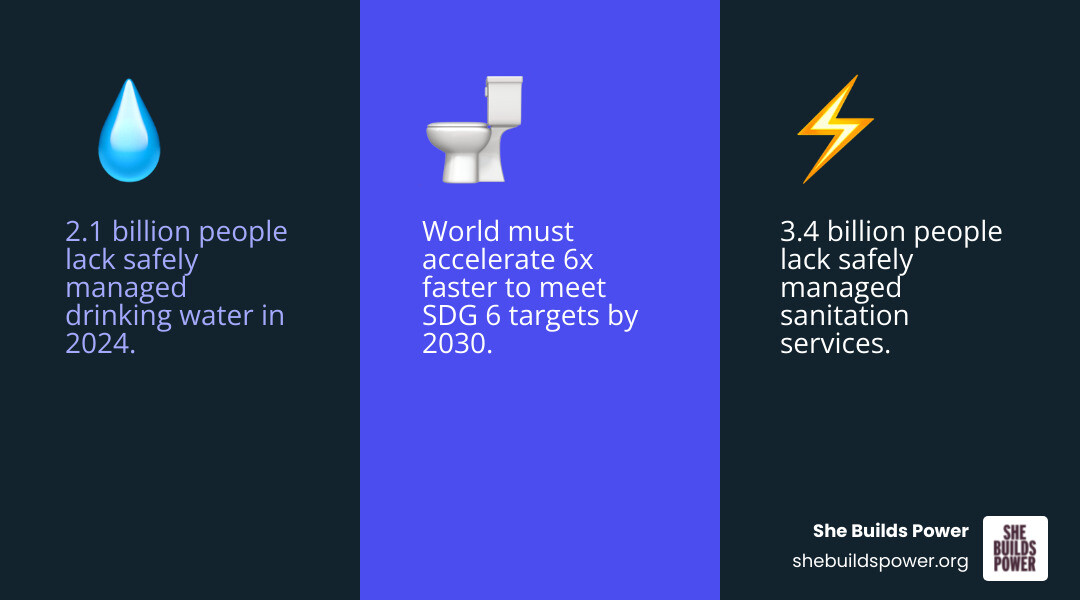
The numbers are hard to ignore. According to the latest WHO/UNICEF Joint Monitoring Programme update, 2.2 billion people lacked safely managed drinking water in 2022, while 3.5 billion lacked safely managed sanitation. The broader picture is just as urgent: the United Nations 2024 SDG 6 Progress Update reports that the world is off track on SDG 6, and meeting the 2030 deadline will require a dramatic acceleration in progress on safe water, sanitation, hygiene, and water management.
This isn’t just a plumbing problem. It’s a power problem.
When women and girls spend hours each day fetching water, they lose income, miss school, and are left out of the decisions that shape their communities. When sanitation systems fail, health collapses. When water governance excludes local voices — especially women’s — the systems built don’t last.
The good news? Across the globe, bold projects are proving that another way is possible. From solar-powered aquifer systems in coastal Kenya to nature-based wastewater solutions in the Danube region, SDG 6 projects are showing what integrated, community-led water systems can do.
I’m Gemma Bulos, founder of She Builds Power, and I’ve spent years training women to build and lead the integrated water, food, and finance systems that break cycles of poverty — work that sits at the heart of every meaningful SDG 6 project. Below, I’ve pulled together the most instructive, scalable, and inspiring examples from around the world so you can see exactly what’s working and why.
Why SDG 6 Projects are the Engine of Global Resilience
The global consensus is clear: water is a human right. In 2010, the UN General Assembly recognized this in Resolution 64/292: The human right to water and sanitation, affirming that safe, clean, accessible, and affordable water is not merely a commodity or a service, but a foundation of dignity, health, and opportunity. That is why She Builds Power uses water as an entry point: when communities gain reliable access, they also create the conditions for better health, stronger livelihoods, girls’ education, and broader community leadership. Securing water does not just advance The Global Goals (a.k.a. Sustainable Development Goals or SDGs); it helps unlock the power to pursue them.
Currently, about 2.2 billion people worldwide still lack access to safe drinking water. In regions like Latin America and the Caribbean, ECLAC estimates that investing just 1.3% of regional GDP annually over a decade could universalize access and create 3.6 million green jobs per year. This highlights a critical truth: SDG 6 projects are not just “charity”—they are massive economic opportunities.
Water is often the earliest and clearest sign of the climate crisis. It is where many communities first feel the damage, through drought, floods, failing wells, and unpredictable rains. Between 2002 and 2021, droughts affected more than 1.4 billion people. As climate pressure grows, Water Resource Management becomes one of our strongest adaptation tools. Without resilient water systems, food security weakens and local economies come under strain. With integrated systems, water can shift from a climate risk into a foundation for community power.
A Global Portfolio: High-Impact SDG 6 Projects to Watch
To achieve the 2030 Agenda, we need more than just “more wells.” We need integrated management, transboundary cooperation, and nature-based solutions that respect the local ecosystem. We look for projects that don’t just “provide” water but build the capacity of the people to manage it.
Scaling Impact Through Large-Scale SDG 6 Projects: The Sabaki Case
One of the most ambitious SDG 6 projects currently unfolding in East Africa is the Sabaki Water Project. For decades, nearly a million residents in Kenya’s Kilifi and Mombasa Counties have faced severe water scarcity and poor sanitation. This isn’t just an inconvenience; it’s a barrier to education for girls and a massive health risk.
The Sabaki project is a game-changer because of its scale and its Public-Private Partnership (PPP) model. Key components include:
- 80 million litres of water per day sourced from the Baricho aquifer.
- 1,000 km of distribution network to reach underserved sub-counties.
- 12MW solar power plant to ensure the system is energy-independent and sustainable.
- 35 million litres of wastewater treatment per day.
By integrating clean energy and long-term operations (a 20-year operation phase before handover), this project serves as a blueprint for how large-scale infrastructure can provide a safer future for Kenya’s coastal region.
Transboundary Governance: The Volta River Basin Initiative
Water doesn’t respect national borders. In West Africa, the Volta River Basin Ecosystem Restoration Project demonstrates why transboundary governance is essential. This GEF-funded initiative focuses on reversing ecosystem degradation across multiple nations that share the basin.
By strengthening the Volta Basin Authority and focusing on sustainable livelihoods, the project ensures that water management isn’t just about extraction—it’s about restoration. When we protect the ecosystem, we protect the water supply for millions of people.
Nature-Based Solutions for Small Settlements: D-CLEAN
In the Danube River Basin, the D-CLEAN Project shows how small settlements can manage wastewater and stormwater with nature-based solutions (NBS), such as constructed wetlands that filter water through plants and soil, and restored floodplains that slow runoff, reduce pollution, and strengthen climate resilience.
Traditional infrastructure is often too expensive for small communities. D-CLEAN uses decentralized systems that mimic natural processes to filter water. These solutions are low-cost, climate-resilient, and provide additional environmental benefits, showing that SDG 6 projects can be both high-tech and “nature-first.”
Climate-Resilient Infrastructure: IAWASuR in Comoros
Small Island Developing States (SIDS) like the Comoros are on the front lines of climate change. The IAWASuR Project (Increased Access to Water Supply for Resilience in Comoros) is tackling this head-on.
With a goal of reaching 100% access to safe water by 2030 (up from a 15% baseline in 2018), this project is massive. It involves:
- Building 177km of pipelines and 19 reservoirs.
- Restoring 2,600 hectares of watersheds to ensure the land can still hold water during droughts.
- Directly benefiting over 74,000 people.
This project proves that even in the most climate-vulnerable places, universal access is possible if we combine infrastructure with ecosystem restoration.
Innovative Strategies for Sustainable Water Management
The old model of international aid—where a foreign NGO digs a well, takes a photo, and leaves—is broken. It has left behind thousands of “zombie wells” that no longer function. At She Builds Power, we advocate for a shift from fragmented aid to integrated systems.
| Traditional Aid | Integrated Systems (The SBP Model) |
|---|---|
| Focuses on hardware (pumps/wells) | Focuses on Agency, Up-skilling, and Expertise (leadership/training/building solutions) |
| Short-term funding cycles | Long-term economic agency |
| Women as “beneficiaries” | Women as “technology and system builders” |
| Fragmented (water only) | Integrated (water, food, finance, leadership) |
We believe in Water as an entry point for broader community power. This requires innovative strategies like blended finance and corporate collective action.
Corporate Collective Action in SDG 6 Projects: The Women + Water Collaborative
In India, the Women + Water Collaborative (supported by the Water Resilience Coalition) is showing how the private sector can play a role without just “writing a check.” This initiative recognizes that water scarcity is a business risk and a human crisis.
The collaborative targets water-stressed basins and focuses on empowering women as leaders in WASH (Water, Sanitation, and Hygiene). By reaching 150,000 people with sustainable access, they are helping to recover the “missing income” that households lose when they spend hours fetching water. We explore this concept further in our piece From Wells to Wealth: How Water Builds Power, which highlights how water access is the first step toward economic independence.
Unlocking Blended Finance: The Resilient Water Accelerator
Finance is often the biggest hurdle for SDG 6 projects. Only about 1% of public international climate investment goes to basic water services for poor communities. The Resilient Water Accelerator aims to change this by “revolutionizing finance.”
By using blended finance—combining public, private, and philanthropic capital—the Accelerator aims to reach 50 million people in a decade. They focus on building a pipeline of “bankable” projects that are data-driven and climate-resilient, removing the barriers that usually keep big investors away from rural water projects.
Technical Assistance and Climate Risk: Côte d’Ivoire Water Security
In Côte d’Ivoire, the Cote d’Ivoire Water Security and Sanitation Support Project is a massive $825 million investment targeting 2 million beneficiaries. What makes this project stand out is the technical assistance from the Global Center on Adaptation (GCA).
They are using advanced climate risk assessments to ensure that the infrastructure built today can withstand the droughts and floods of 2060. This includes Integrated Water Resources Management (IWRM) plans that prioritize gender-informed vulnerability assessments. It’s not just about building pipes; it’s about building pipes that won’t run dry.
Frequently Asked Questions about SDG 6 Projects
What are the main targets of SDG 6?
SDG 6 is comprehensive. It includes:
- 6.1: Universal and equitable access to safe and affordable drinking water.
- 6.2: Access to adequate and equitable sanitation and hygiene (ending open defecation).
- 6.3: Improving water quality by reducing pollution and increasing safe reuse.
- 6.4: Increasing water-use efficiency across all sectors.
- 6.5: Implementing Integrated Water Resources Management (IWRM) at all levels.
- 6.6: Protecting and restoring water-related ecosystems (mountains, forests, wetlands).
How does climate change impact water projects?
Climate change makes water unpredictable. We see this through rainfall variability (too much at once or none at all), groundwater depletion, and increased infrastructure vulnerability. Effective SDG 6 projects must include adaptation strategies like rainwater harvesting, solar-powered pumping, and nature-based solutions that restore the “sponginess” of the soil to prevent runoff and floods.
How can businesses and individuals support SDG 6?
Businesses can join collective action coalitions, invest in R&D for water efficiency, and ensure their supply chains respect local water rights. Individuals can support organizations that focus on long-term systems change rather than just short-term charity. If you want to see your contribution turn into lasting agency, you can Donate Now Water to support our women-led initiatives in Uganda, Kenya and Tanzania.
Conclusion: From Access to Agency
At the end of the day, a water project is only as strong as the people shaping it. That is not just a values argument, it is an evidence-based one. An FAO study found that the exclusion of women from planning, design, and implementation is a primary cause of water and sanitation project failures. When women help lead, systems are often better maintained, payment processes are more accountable, and benefits are more likely to reach the people who need them most.
We call this Powerbuilding. It is the process of transforming a woman from a “passive recipient of failed water projects” into a “builder of water systems.” You can read about this transformation in Every Drop Builds Power: Amina’s Story which shows how one well can spark a revolution in local leadership and food security.
Whether it’s a massive public-private partnership in Mombasa or a small-scale integrated system in Butambala District, the goal of all SDG 6 projects should be the same: to create a world where no one has to walk hours for a drink of water, and where every community has the agency to sustain its own future.
For More info about water powerbuilding, join us in our mission to replace fragmented aid with systems that last. Together, we can turn the tide on the global water crisis—one woman-led system at a time.