Up-powering Women in Agriculture to Feed the Future
The Vital Role of Women in Global Food Systems
Empowering women in agriculture is one of the highest-leverage investments the world can make to reduce hunger, cut poverty, and build resilient food systems.
Here’s what that looks like in practice:
| Action | Impact |
|---|---|
| Give women equal access to land, credit, and tools | Farm yields increase by 20-30% |
| Close the gender productivity gap | Global GDP rises by up to $1 trillion |
| Support women farmers with training and resources | Up to 150 million people lifted out of hunger |
| Invest in rural women’s income | Up to 90% reinvested in family health, education, and nutrition |
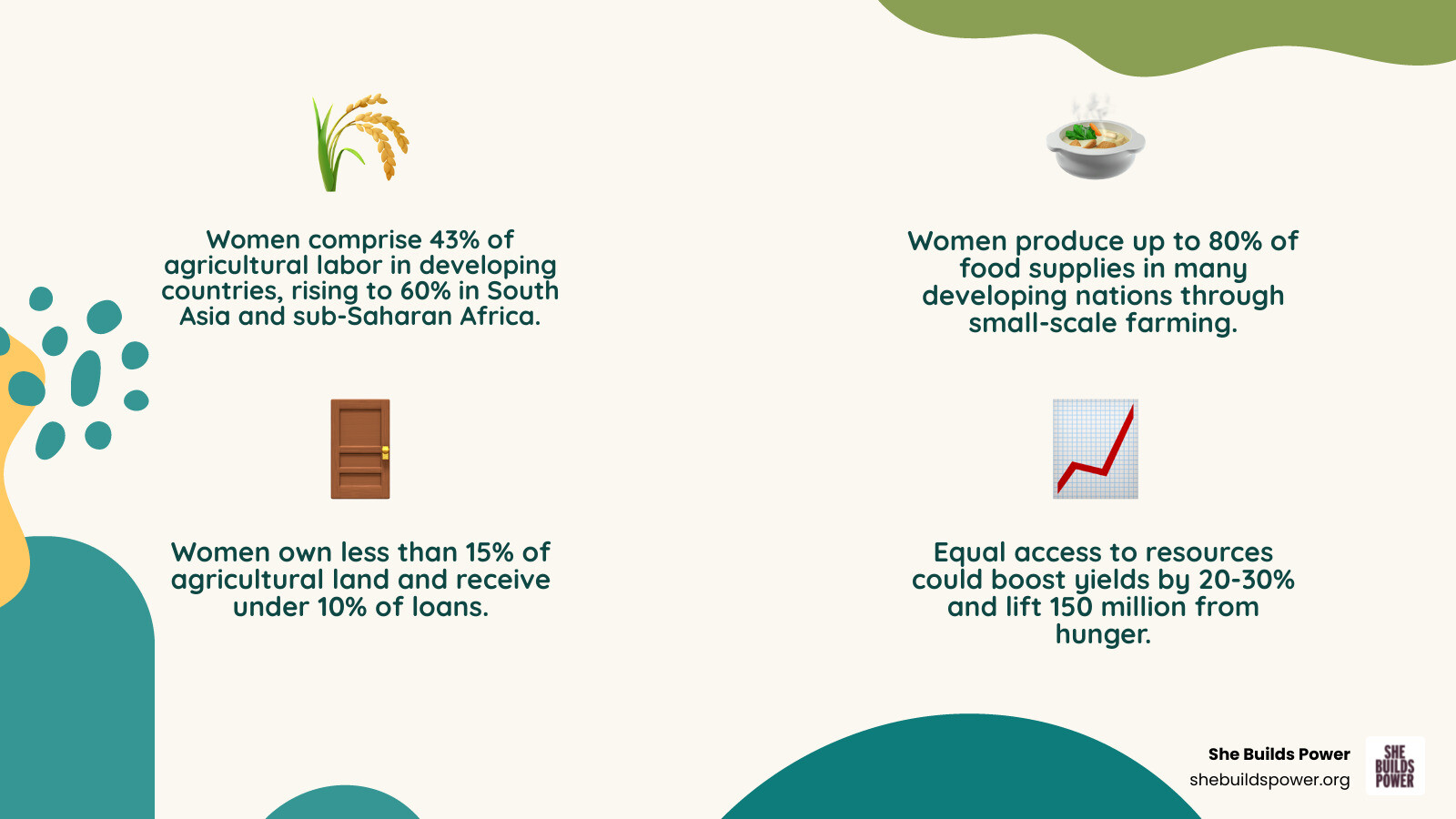
Women make up 43% of agricultural labor in developing countries. In parts of South Asia and sub-Saharan Africa, that number climbs to 60%. In many developing nations, women are responsible for up to 80% of the food on the table.
And yet — they own less than 15% of agricultural land. They receive less than 10% of agricultural loans. They earn 78 cents for every dollar a man earns doing the same work.
This isn’t a gap. It’s a locked door.
Women aren’t struggling to participate in agriculture. They are already carrying it. What they lack is not effort or skill — it’s the formal recognition, resources, and systemic support to lead it.
When that changes, everything changes. Not just for individual farmers, but for entire communities. Women reinvest in their families. They train their neighbors. They build systems that outlast any single project.
That’s not charity. That’s powerbuilding.
I’m Gemma Bulos, founder of She Builds Power, and I’ve spent my career training women to build and lead integrated systems across water, food, and finance — because I’ve seen that empowering women in agriculture is never just about crops; it’s about shifting who holds power in a community. In this guide, I’ll walk you through the barriers women farmers face, the strategies that actually work, and how integrated approaches create the kind of change that lasts generations.
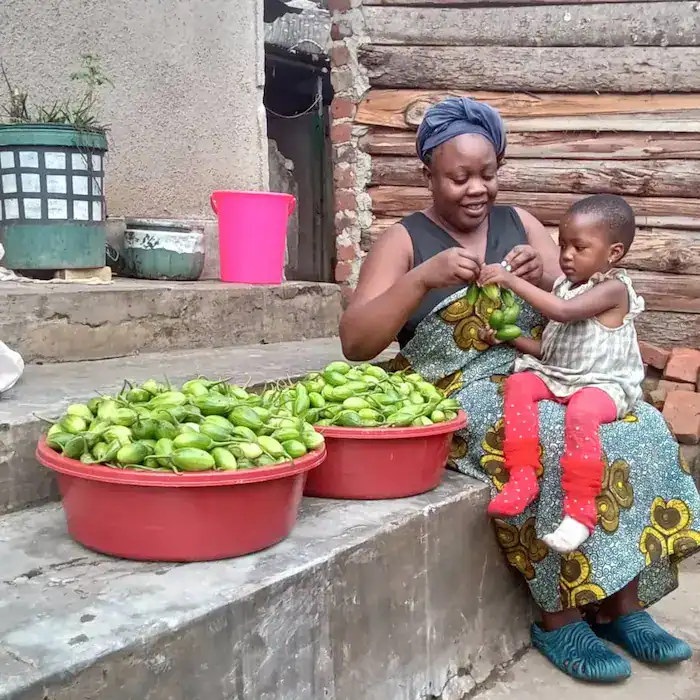
When we talk about global food production, we are talking about a system built on the backs of women. In sub-Saharan Africa, including our focus areas in Uganda and Kenya, women represent over half of the agricultural workforce. They aren’t just laborers; they are the primary managers of small-scale farms that produce over a third of the world’s food.
The importance of women in food security cannot be overstated. Research from the UN Food and Agricultural Organization (FAO) on The status of women in agrifood systems shows that when women are active participants in the agricultural economy, they provide up to 80% of national food supplies in developing countries. They are the ones selecting the seeds, weeding the rows, and ensuring the harvest reaches the family table.
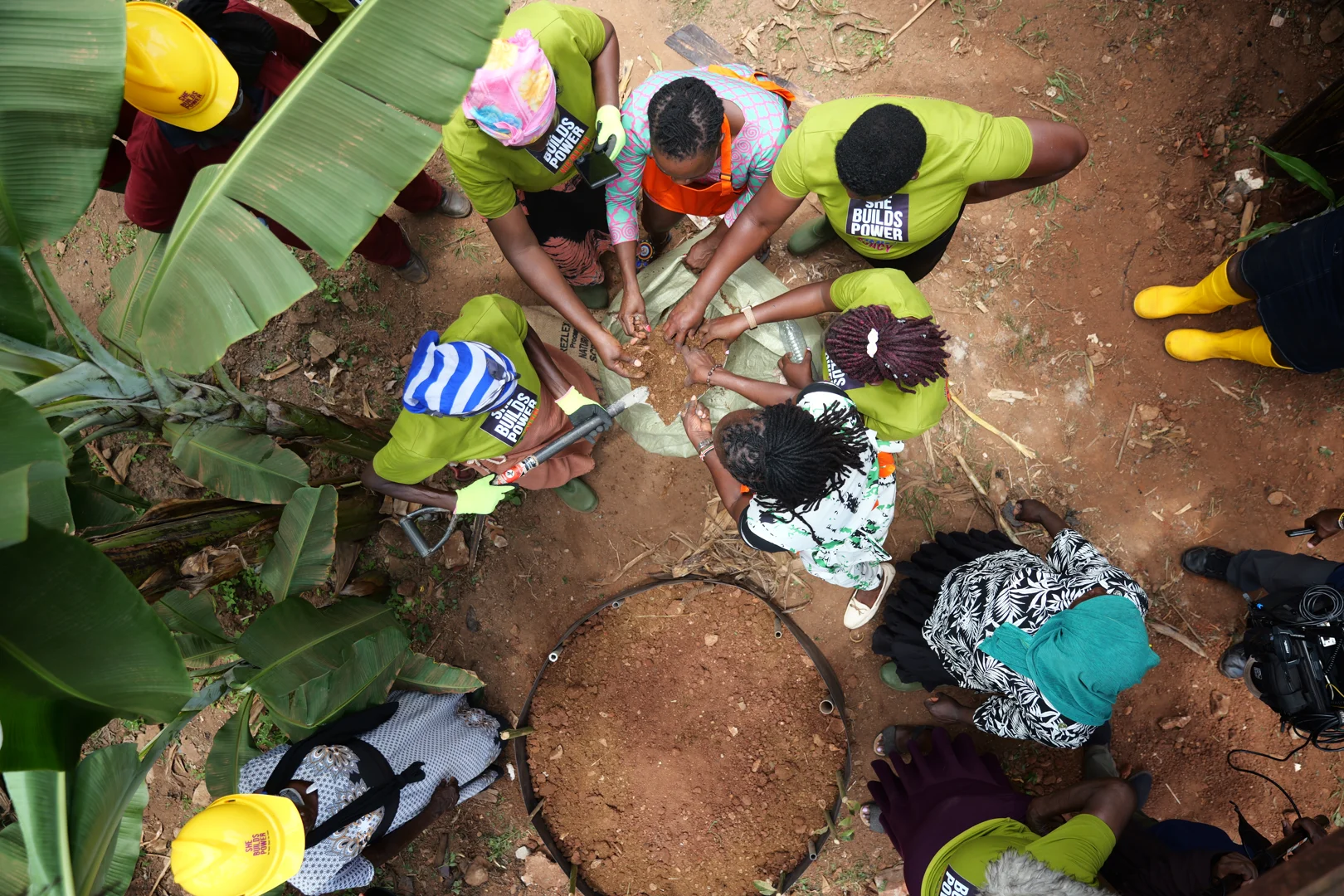
Stewards of Biodiversity and Nutrition
Women are the world’s original seed savers. Because they are often tasked with household nutrition, they prioritize food diversity over monocropping. While large-scale industrial farms might focus on a single cash crop, women-led smallholdings often feature a mix of indigenous vegetables, legumes, and grains.
This diversity is a natural insurance policy against climate shocks and pests. By maintaining a variety of crops, women strengthen local market resilience and ensure their families have access to a balanced diet. Their role as stewards of biodiversity is a cornerstone of community health; when a woman controls the garden, the household’s dietary diversity and overall food security significantly improve.
Breaking the Barriers: From Access to Agency
If women are so vital to the system, why do they produce 20% to 30% less than men? It isn’t a lack of talent. It is a lack of tools, resources and institutionalized support. This “productivity gap” is the direct result of systemic exclusion.
According to Gender-Lex, the barriers are structural:
- Land Tenure: Less than 15% of the world’s landowners are women. In many regions, women only access land through male relatives, leaving them vulnerable to displacement.
- Credit Discrimination: Women receive less than 10% of agricultural loans. Without credit, they cannot buy high-quality seeds, fertilizers, tools, or other inputs.
- The Unpaid Care Burden: Women perform a staggering amount of unpaid domestic work—contributing at least $10.8 trillion to the global economy annually. This “time poverty” means they have fewer hours to spend on their own farm productivity.
The Climate Gap and Rural Resilience
Climate change is not gender-neutral. In our work across Uganda, Kenya and Tanzania, we see how extreme weather hits women harder. Female-headed households lose 8% more income from extreme heat events and 3% more during floods compared to those led by men.
As noted in the FAO article The unjust climate: measuring impacts on rural women, women often lack the financial cushion to recover from a lost harvest. This is why empowering women in agriculture must include climate-smart training. When women are equipped with resilient and regenerative techniques, they don’t just survive the storm; they lead their communities through it.
The Economic Multiplier of Empowering Women in Agriculture
Closing the gender gap in farming isn’t just a moral imperative; it’s an economic powerhouse. If women had the same access to resources as men, agricultural production could increase by 2.5% to 4%. That might sound like a small number, but it is enough to lift up to 150 million people out of hunger and poverty.
The “multiplier effect” is real: women typically reinvest up to 90% of their income back into family welfare. When a woman’s harvest increases, her children are more likely to stay in school, visit the doctor, and eat nutritious meals. This creates a measurable impact that ripples through generations.
Closing the Productivity Gap
The current 24% land productivity gap exists because women are forced to farm smaller, less fertile plots with fewer inputs. Furthermore, women in agrifood wage employment earn only 78 cents for every dollar earned by men.
According to the FAO report Enhancing women’s empowerment and resilience, closing these gaps could raise global GDP by USD 1 trillion and reduce food insecurity for 45 million people. We aren’t just looking for “inclusion”—we are looking for equity in every part of the value chain.
Proven Strategies for Systems Change
At She Builds Power, we don’t believe in one-off handouts. We believe in building systems. We’ve found that combining technical training, investment of resources, and financial agency so that women can provide the basic essentials for themselves and their families, it is one of the most effective ways to break the cycle of poverty.
We build power across three interconnected layers—finance, knowledge, and ownership—because none of these work in isolation.
Build financial power: Through Village Savings and Loan Associations (VSLAs), women pool their savings, access small low-interest loans, and invest in what matters most—seeds, tools, irrigation, livestock, and small enterprises. This isn’t just about access to money. It’s about shifting from survival to stability, and from stability to growth. When women control capital, they make decisions that strengthen their families and their communities.
Build knowledge power: Women are trained in practical, climate-smart agriculture—soil health, crop spacing, pest management, food production, crop upcycling—and then go on to train other women. This peer-to-peer model is what makes it powerful. Knowledge doesn’t stay in one place; it spreads, adapts, and grows within the community. And with it, productivity increases, risk decreases, and food systems become more resilient.
Build ownership power: We support women and women’s groups to move beyond labor into leadership—through shared farming models, access to land, and tools that turn production into income, like mills, solar dryers, and livestock. Because growing food is one thing. Owning the process, controlling the output, and deciding how it’s sold—that’s where real power lives.
To keep this momentum going, we invite you to support-a-trainee or train-a-trainer to expand these systems across East Africa.
Global Strategies for Empowering Women in Agriculture
The world is finally waking up to this potential. The United Nations has declared 2026 the International Year of the Woman Farmer (IYWF 2026). This initiative aims to raise global awareness and encourage policies that dismantle the barriers women face. It creates a synergy with the UN Decade of Family Farming, placing women at the center of sustainable food systems. You can learn more about the movement through the Visual Identity Guidelines for IYWF 2026.
Policy Actions for Empowering Women in Agriculture
Legislation is a critical tool for change. Proposed actions like the Empowering Women in Agriculture Act seek to mandate that at least 10% of federal agricultural funds be directed to women-focused organizations. By officially recognizing women as “socially disadvantaged farmers,” these laws can unlock the funding and land rights necessary for women to compete on a level playing field.
Powerbuilding: Integrating Water, Food, and Finance
We’ve learned that you cannot solve food insecurity without solving water access, and you can’t solve either without financial agency. This is our water-food-and-finance-our-new-pillars-of-power approach.
If a woman has to walk four hours a day for water, she cannot spend those hours on her farm. If she has a great harvest but no way to store, process or sell it, she loses her profit to spoilage. By integrating these systems—using collective power with community-led finance—we turn access into agency.
Transforming Access into Long-Term Agency
Powerbuilding means that women aren’t just using a system; they are designing and sustaining it. When we train a woman in technical maintenance or financial literacy, she becomes a builder. She ensures the well stays functional. She manages the VSLA’s books – and her own. She leads the community’s response to drought. This is how we move from “aid” to “resilience.”
Frequently Asked Questions about Women in Farming
Why do women farmers produce less than men?
It is not a matter of capability. Women produce less because they are systematically excluded from the resources needed to succeed. They often farm smaller, lower-quality plots of land, have limited access to high-yield seeds and fertilizers, and are frequently denied the credit needed to invest in their farms. Additionally, “time poverty” from heavy domestic and caregiving duties limits the hours they can dedicate to agricultural production.
What is the International Year of the Woman Farmer 2026?
The IYWF 2026 is a UN-declared initiative designed to shine a global spotlight on the essential roles women play in agrifood systems. Its objectives include raising awareness of gender gaps, promoting policies that empower women farmers, and fostering international cooperation to ensure women have equal access to land, technology, and finance.
How does empowering women impact global hunger?
When women farmers have the same resources as men, their yields increase by up to 30%. This boost in production could reduce the number of malnourished people globally by 12% to 17%, effectively lifting 150 million people out of hunger. Because women reinvest the majority of their income back into their families, the impact extends beyond food to improved health and education for the entire community.
Conclusion
At She Builds Power, we know that empowering women in agriculture is the key to a sustainable future. We aren’t interested in temporary fixes or pity-driven narratives. We are a movement of builders—turning local knowledge into long-term resilience across Uganda, Kenya and Tanzani.
When women lead, systems change. Poverty cycles break. Communities thrive. We invite you to be part of this transformation. Don’t just give; invest in a future where women design the solutions they rely on.