Among high-return poverty-reduction strategies, investments in women are consistently cited by development economists as among the most cost-effective, and among the most chronically underfunded. The mechanism isn’t a new technology or a novel policy framework. It’s a behavioral pattern that researchers have documented for decades: women reinvest an estimated 90% of their income into their families and communities, compared to 30, 40% for men. That figure is a widely cited heuristic traced to World Bank and secondary development sources rather than a single controlled study, but the directional pattern it describes is consistent across household-budget research. Organizations that take this pattern seriously as a design principle build programs that look fundamentally different from those that don’t.
This article examines the macroeconomic evidence, the household-level mechanisms, and the program designs that convert that evidence into measurable outcomes, including what She Builds Power’s integrated model in East Africa demonstrates about how this principle scales in practice.
The Economic Case Is Stronger Than Most People Realize
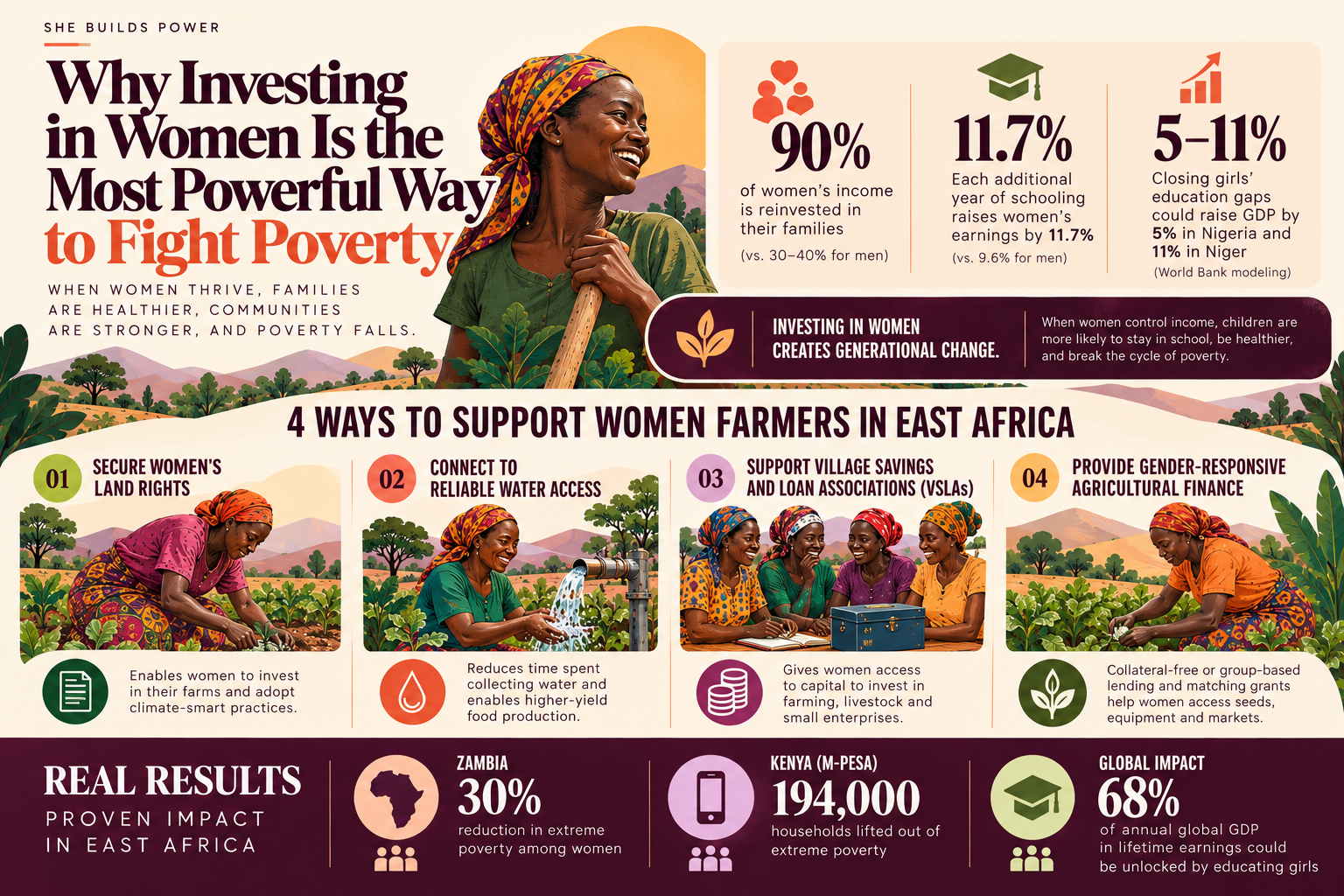
Most donors think of gender-focused giving as a moral priority. It is, but it’s also macroeconomic policy. A World Bank synthesis of growth-framework studies found that differences in gender gaps in education account for 0.4 to 0.9 percentage points of annual per-capita growth rate differences across regions. Country-level modeling goes further: closing girls’ schooling gaps could raise GDP by 5% in Nigeria and 11% in Niger under specified reform scenarios. These are not projections built on optimism. They come from Solow-framework studies that treat male and female education as separate human capital inputs with separate productivity effects.
The earnings data sharpens the picture further. Each additional year of schooling raises women’s earnings by an average of 11.7%, compared to 9.6% for men, figures drawn from World Bank and IMF policy summaries rather than a single peer-reviewed estimate, but directionally consistent with the broader education-returns literature. A World Bank working paper estimated that educating today’s girls to the next level of schooling could unlock lifetime earnings equivalent to up to 68% of annual global GDP. That figure sounds staggering until you trace its logic: more education means higher earnings, which means better household nutrition, longer school enrollment for children, and improved health outcomes across the family. The investment pays compound interest across generations.
Women Reinvest Differently, and That Gap Is the Whole Story
The 90% reinvestment rate is widely cited and occasionally contested as a precise universal number. What it captures, though, is a documented pattern in household spending decisions. When women control income, a larger share goes toward food, medical care, school fees, and home improvements, a directional finding supported by multiple household-budget and impact studies across low-income contexts. Men’s lower reinvestment rate isn’t a character flaw; it reflects different social obligations and spending norms that vary by context. The gap matters because poverty is fundamentally a household welfare problem. Income directed toward women stays inside the family system at a higher rate, and that is the mechanism that converts women’s economic empowerment into community-level transformation.
The generational effect compounds the initial gain. Children in households where women control income are more likely to remain enrolled in school, less likely to be undernourished, and more likely to reach adulthood with stronger health outcomes, findings documented in peer-reviewed literature and World Bank intergenerational studies. An empowered mother raises children with greater human capital, who enter the workforce better prepared, who then reinvest in their own families at higher rates. The poverty-reduction impact of investing in one woman doesn’t stop with her. It echoes forward, and that echo is measurable.
What This Principle Looks Like When It Actually Works
Zambia’s Supporting Women’s Livelihoods program offers one of the clearest documented cases. The government-implemented program delivered a bundled package: business and life skills training, a productivity grant of roughly $225, savings group formation support, and six months of peer mentoring. The World Bank’s evaluation found the full package decreased extreme poverty by 30% among women who received it. That result came from integration, not from any single component. The training alone didn’t produce it, nor did the grant. The combination of capital, skills, and social infrastructure working together did.
Kenya’s mobile money expansion tells a related story from a different angle. Research by Dupas and Robinson found that expansion of M-PESA agent access lifted approximately 194,000 households out of extreme poverty, with the strongest effects concentrated in female-headed households. Those households saw 22% fewer people living in extreme poverty and 22% higher financial savings. Access to a financial tool, when it reached women who controlled household finances, produced outsized poverty-reduction outcomes.
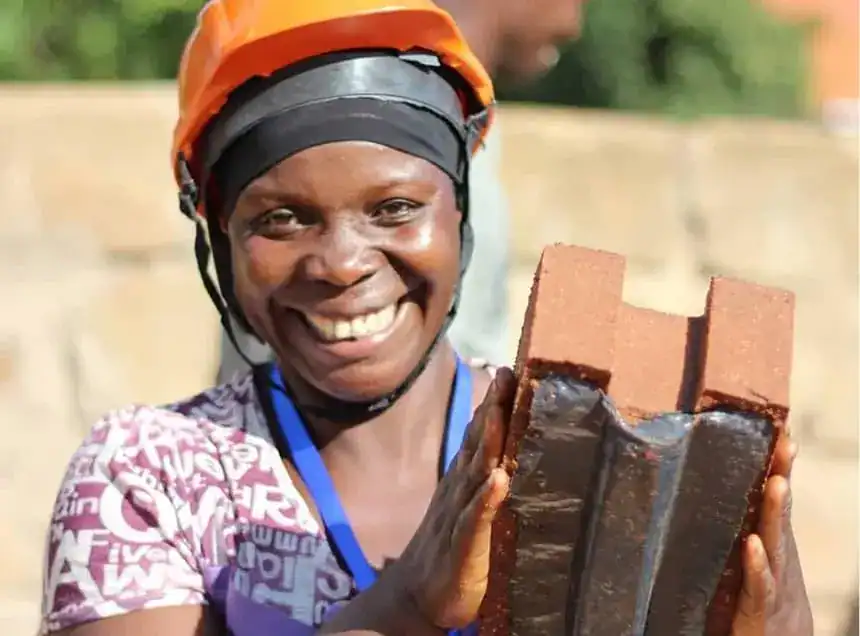
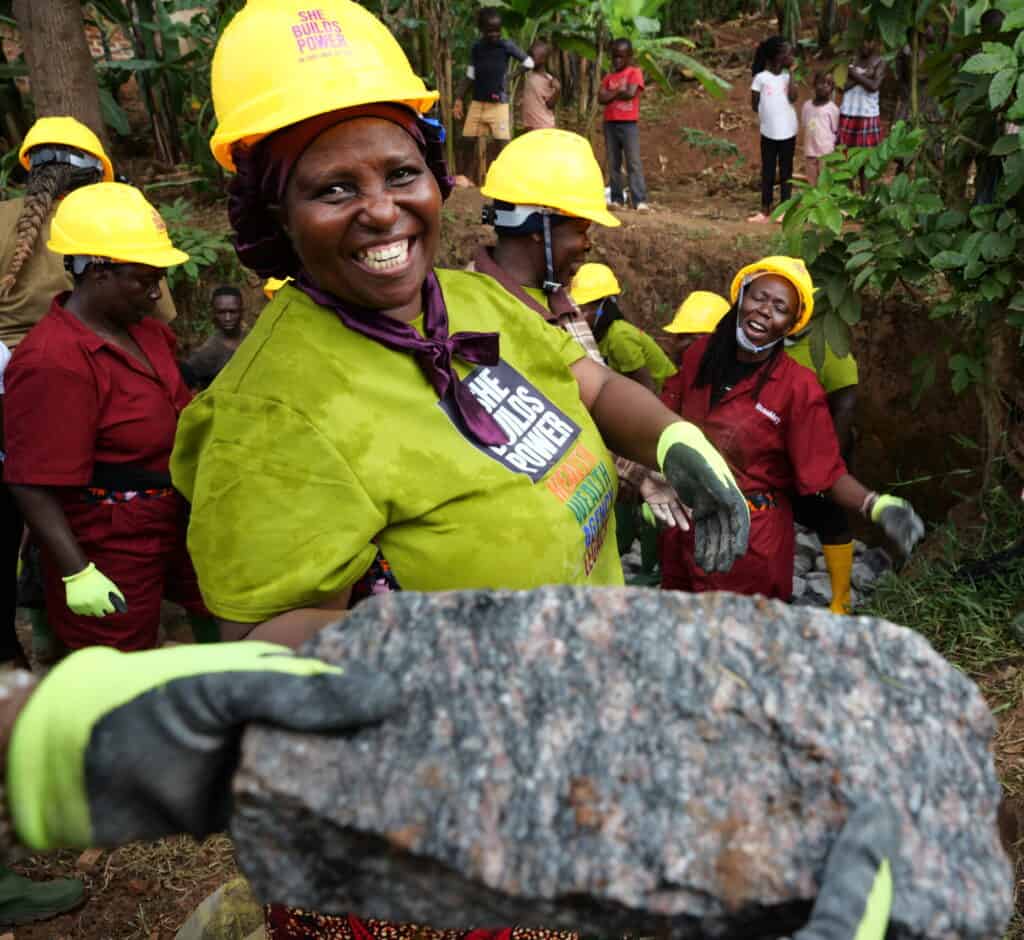
She Builds Power’s model applies this same logic through an integrated system: women receive technical training in water infrastructure, climate smart agriculture, and community finance through village savings and loan groups. A woman who learns to construct and maintain a biosand filter becomes the local water expert her neighbors rely on. That expertise, layered with agricultural and financial literacy training, creates a foundation for economic independence that extends well beyond a single household, a program model grounded in the same evidence base that produced documented results in Zambia and Kenya.
Five Ways to Fund What the Evidence Actually Supports
World Bank syntheses and comparative program reviews consistently show that bundled, integrated interventions outperform single-issue programs on income, assets, and savings. When evaluating where to give or how to design programs, the first question to ask is whether the model addresses multiple root causes together or treats symptoms in isolation. Water-only programs, microloans without financial literacy support, or agriculture training without market access rarely produce the scale of impact that integration does.
Beyond program design, these five practices align your funding with the strongest measured outcomes:
- Choose 100% program-directed giving models, like She Builds Power’s, so donor uncertainty about overhead doesn’t become a barrier to giving at meaningful scale.
- Prioritize organizations that collect sex-disaggregated data, because you can’t measure gender impact without tracking outcomes by gender.
- Support women-led, locally staffed teams, where lived experience and technical expertise live in the same person, local leadership is associated with stronger program uptake and long-term sustainability.
- Back programs with multi-year funding commitments rather than one-time grants, because sustainable transformation takes more than a single budget cycle.
- Advocate for gender-lens criteria inside institutional investment mandates, where the largest pools of capital sit.
These aren’t aspirational design features. They are the characteristics of the programs with the strongest documented outcomes across Zambia, Kenya, and cross-country World Bank synthesis research.
The Evidence Has Been Clear for a Long Time
Investing in women reduces poverty more durably, and with wider community reach, than most alternative strategies. The broad reinvestment pattern, women directing a significantly larger share of income toward household welfare than men, is a documented behavioral finding with macroeconomic consequences traced through World Bank growth syntheses and country-level modeling. The research from Zambia, Kenya, and cross-country growth models tells the same story: when women gain resources, skills, and decision-making power, communities transform in ways that persist across generations.
She Builds Power’s work demonstrates that this principle scales when the program design integrates capital, skills, and community infrastructure in a coherent system. The evidence on what works has accumulated for decades. The more pressing question is whether funding is moving at a pace that matches what that evidence actually demands. If you’re ready to direct resources toward programs with documented impact, contact She Builds Power’s team to learn how your support goes directly to women building real, lasting change on the ground.