How to ensure your water project doesn’t run dry
Why the Sustainability of Water Projects Determines Who Thrives
The sustainability of water projects is one of the most urgent — and most overlooked — challenges in global development today.
Here’s the hard truth up front:
- 2.2 billion people still lack safely managed drinking water
- 3.4 billion lack safe sanitation
- 25% of water projects in developing countries fail within two years of completion
- At the current pace, the world won’t achieve sustainable water management until at least 2049
And yet, the problem isn’t just building water systems. It’s keeping them running.
Projects collapse not because women in communities don’t care. They collapse because the systems built around them — financial, institutional, technical — weren’t designed to last. Hardware gets installed. Donors go home. And within two years, the pump breaks, the funds are gone, and no one knows whose job it is to fix it.
That’s not a water problem. That’s a systems problem.
Women are already doing the heavy lifting. In 8 out of 10 households without water access, women and girls are responsible for collecting it — often walking miles, losing hours, sacrificing education and income. When water systems fail, they pay the price first and hardest.
But when women lead water systems? Communities build something that lasts.
This guide breaks down exactly what makes a water project truly sustainable — from technical design and institutional governance to financial management and community ownership — and what it takes to stop the cycle of build-and-abandon for good.
The Core Pillars of Sustainability of Water Projects
When we talk about the sustainability of water projects, we aren’t just talking about a pump that works today. We are talking about a system that will still be providing clean, reliable water to the children of Mpigi or the farmers in Fort Portal twenty years from now.
To achieve this, we must look beyond the hardware. True sustainability rests on four core pillars: technical resilience, institutional governance, socio-economic impact, and environmental stewardship.
At She Builds Power, we view Water Resource Management as a holistic discipline. It’s not enough to have a great engineer; you need a formal group who will ensure the system is being being taken care of properly, a community that feels a sense of ownership, and a plan for when the rains don’t come. Organizations like the American Water Works Association (AWWA) emphasize that integrated resource planning is the only way to balance the competing needs of agriculture, industry, and households while protecting the environment.

Technical Excellence and Reliability
A water project is only as good as its weakest joint. Technical sustainability means the system is designed for the local context, using high-quality materials that can be maintained locally.
Research into community-based systems shows that technical success often hinges on three things: water quality, pressure management, and reliability. For example, in high-performing projects, over 90% of households report adequate water pressure. If the pressure is too low, people stop using the system; if it’s too high, the pipes burst.
We also have to consider the “hidden” technical factors. In regions like Kenya and Uganda, siltation in small dams and reservoirs can reduce capacity by 25-45% over a few decades if not managed correctly. We use Scientific research on the Deurali-Hupsekot Case Study to understand these technical dimensions. While that specific study looked at Nepal, the data is clear for our work in East Africa: technical excellence (which often scores high initially) must be matched by institutional strength to survive the long haul.
Institutional Governance and Local Leadership
This is where most projects fail. In many parts of Africa, only about 30% of community water projects remain operational after ten years. Why? Because the “who is in charge” question wasn’t answered.
Sustainability requires moving away from informal “water committees” toward registered Community-Based Water Supply Organizations (COWSOs). These entities need:
- Clear Roles: Everyone knows who fixes the leaks, protects the technology, and if there is a water fee, who manages the money.
- Operational Manuals: A “how-to” guide for the system that stays with the community, not the donor.
- Grievance Mechanisms: A way for neighbors to complain and get things fixed without a fight.
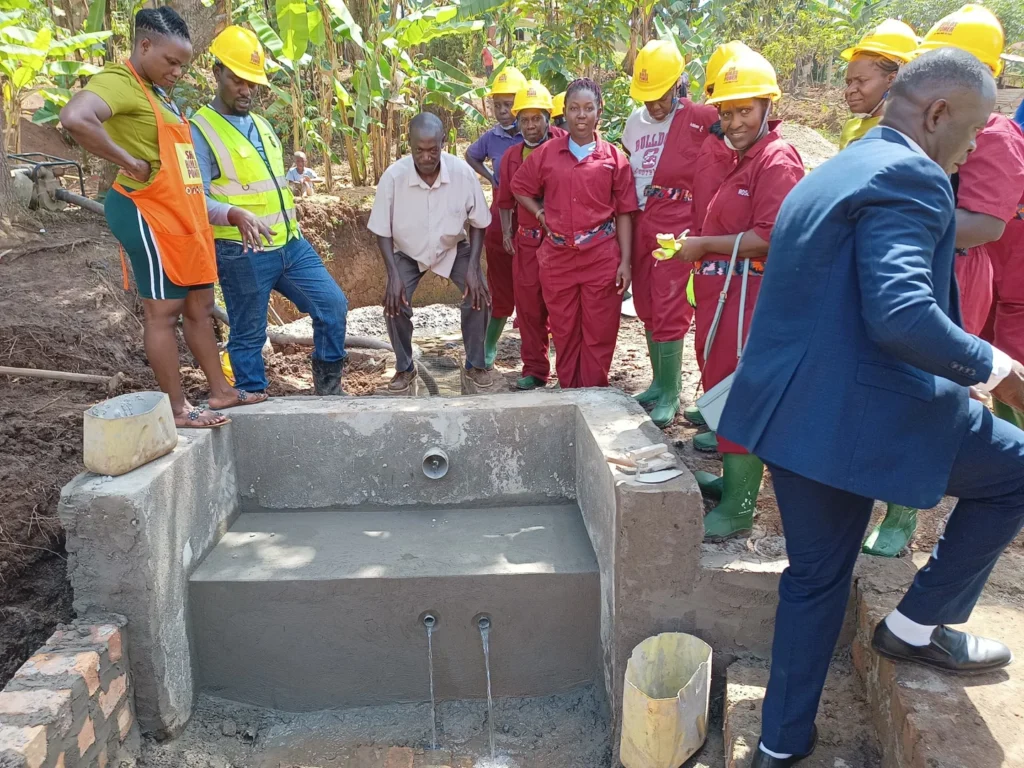
We focus on the Train a Trainer model because we know that when local women are the ones trained in governance and technical oversight, the “institutional memory” of the project stays in the village. They aren’t just “beneficiaries”; they are the managers, the mechanics, and the decision-makers.
Moving Beyond Fragmented Aid: The Systems Approach
For decades, international aid has treated water, food, and finance as separate buckets. You get a well from one NGO, seeds and farming inputs from another, and a microloan from a third. This is fragmented aid, and it’s why poverty cycles persist.
We take a different path. We believe in Water, Food, and Finance: Our New Pillars of Power. By integrating these systems, we ensure that the water project doesn’t just provide a drink; it powers a community garden, which generates food, which creates a surplus to sell, which provides the finance to maintain the water system.
| Feature | Fragmented Aid | Integrated Systems (Powerbuilding) |
|---|---|---|
| Primary Goal | Short-term access (ticking a box) | Long-term agency and resilience |
| Leadership | External experts/NGO staff | Local women-led committees |
| Funding | 100% Grant/Charity | Mixed: matching grants, loans, and community contributions |
| Maintenance | Reactive (fix it when it breaks) | Proactive (O&M fund and trained locals) |
| Impact | Temporary health improvement | Economic growth and climate resilience |
Financial Viability and Microenterprise
Let’s talk about money. If a water doesn’t have a way to pay for its own repairs, it is a at risk of failing. Sustainability of water projects requires a shift in how we think about “free” water. While water is a human right, the infrastructure to deliver it safely has a cost.
Successful projects implement tiered tariff structures. Research shows that roughly 78% of households are willing to pay for reliable water if they see the value. This revenue should cover:
- Daily operations (electricity or fuel for pumps).
- Salaries for local operators.
- A “rainy day” fund for major repairs.
In East Africa, we link water access to microenterprise. When women spend less time walking for water, they spend more time on income-generating activities. We explore this transition in From Wells to Wealth: How Water Builds Power. By turning access to water into an economic engine, the community ensures the system is never “too expensive” to fix — it’s too valuable to lose.
Evaluating Success: Methodologies for Long-Term Impact
How do we actually know if a project is sustainable? We don’t guess; we measure.
Experts use tools like the Analytical Hierarchy Process (AHP) to weigh different factors. Interestingly, while technical factors are often given the most weight (around 54%), institutional and socio-economic factors are what determine if that technical foundation actually stays standing.
Another vital tool is the Holistic Integrated Framework (HIF). This matrix looks at stakeholders at every level — from the local woman in Uganda to the local government. It helps us identify “feedback loops.” For example, if a project fails, the community loses trust and the next project is even harder to start. We break those negative loops by ensuring every level of governance is aligned.
Measuring the Sustainability of Water Projects in Real-Time
We live in an era where technology can help us bridge the gap between “built” and “sustained.” In more advanced systems, we see the use of IoT (Internet of Things) sensors for leak detection and AI-powered management to predict when a pump might fail.
Large-scale initiatives are already proving that data-driven replenishment works. You can find More info on global water stewardship regarding how major entities use AI to optimize water use. While our scale in Butambala is significantly different, the principle is the same: use data to be “water positive.” This means harnessing the water flow in spring wells, returning more water to the local watershed than the community consumes, through smart irrigation, rainwater harvesting, and forest restoration.
Social Dimensions and Gender Equity
You cannot have a sustainable water project if you exclude the people who use it most. In 80% of households without piped water, the burden falls on women. When we design projects, we measure “household satisfaction” and “time savings” as primary KPIs.
When a woman in Uganda no longer has to walk six miles a day, the impact is seismic. We see a 0% rate of waterborne diseases and a massive spike in school attendance for girls. We tell these stories to show that Every Drop Builds Power: Amina’s Story from Uganda is not an outlier; it is the blueprint. Sustainability is found in the agency of the women who no longer have to ask for permission to thrive.
Strategic Recommendations for Global Water Security
To meet the UN’s Sustainable Development Goal 6 (SDG 6) by 2030, we need a sixfold increase in our current rate of progress. That won’t happen through charity alone. It requires:
- Public-Private Partnerships (PPPs): Bringing together the efficiency of the private sector with the reach of the public sector.
- Climate Adaptation: Building systems that can handle the 9 out of 10 natural disasters that are water-related.
- Institutional Reform: Strengthening local regulations so that water utilities are accountable to the people they serve.
We align our work with the Scientific research on the UN Water Action Decade, which advocates for mobilizing action across all sectors to transform how we manage water.
Scaling Sustainability of Water Projects through Policy
Policy isn’t just for politicians; it’s for neighborhoods. We advocate for “devolution” — giving local counties in Kenya and districts in Uganda more power and budget to supervise water projects.
When the government, international funders like the Asian Development Bank, and local communities work together, the success rate skyrockets. We’ve learned that Why Two Heads and a Whole Neighborhood Are Better Than One is more than a catchy phrase; it’s a requirement for scaling. Policy should prioritize “Capacity Building” over “Capital Expenditure.” In other words: spend more on training the people and less on just buying the pipes.
Frequently Asked Questions about Water Sustainability
Why do 25% of water projects fail within two years?
Failure is rarely about a “bad pump.” It’s usually a “socio-technical” collapse. This happens when there is no money for spare parts (financial mismanagement), no one is assigned to fix it (institutional failure), or the community doesn’t feel they own the system because it was “given” to them without their input (lack of ownership).
There is also a gender dynamic. Studies have shown that a majority of water and sanitation projects fail due to the exclusion of women in the planning, design and implementation processes.
How does women’s leadership improve project longevity?
Women are the primary “end-users” of water. They have the greatest lived experience and the highest incentive to keep the water flowing. When women lead, they apply systems-thinking — connecting water to the health of their children and the success of their crops. They tend to hold positions that manage funds and they are statistically more likely to ensure transparent financial management within community committees.
What is the cost of achieving global water sustainability?
It is estimated that over $1 trillion is needed annually from 2015 to 2030 to deliver sustainable water management globally. This includes not just the initial infrastructure, but the long-term operation, maintenance (O&M), and climate adaptation strategies required to keep those systems resilient.
Conclusion: From Access to Agency
At She Builds Power, we don’t just want to give a community a tap; we want to give them the power to never be thirsty again. We transform women as the passive recipients of failed water projects, into water providers and entrepreneurs.
The sustainability of water projects is the bridge between a temporary fix and a permanent future. By transforming access into agency, we break the cycle of poverty and replace it with a cycle of resilience. When women lead the design, the financing, and the maintenance of their own systems, the water doesn’t just flow — it builds power.
Are you ready to build systems that last? Explore how we are changing the landscape of Water and join us in making “dry projects” a thing of the past.