What Is a Women’s Savings and Loan Group?
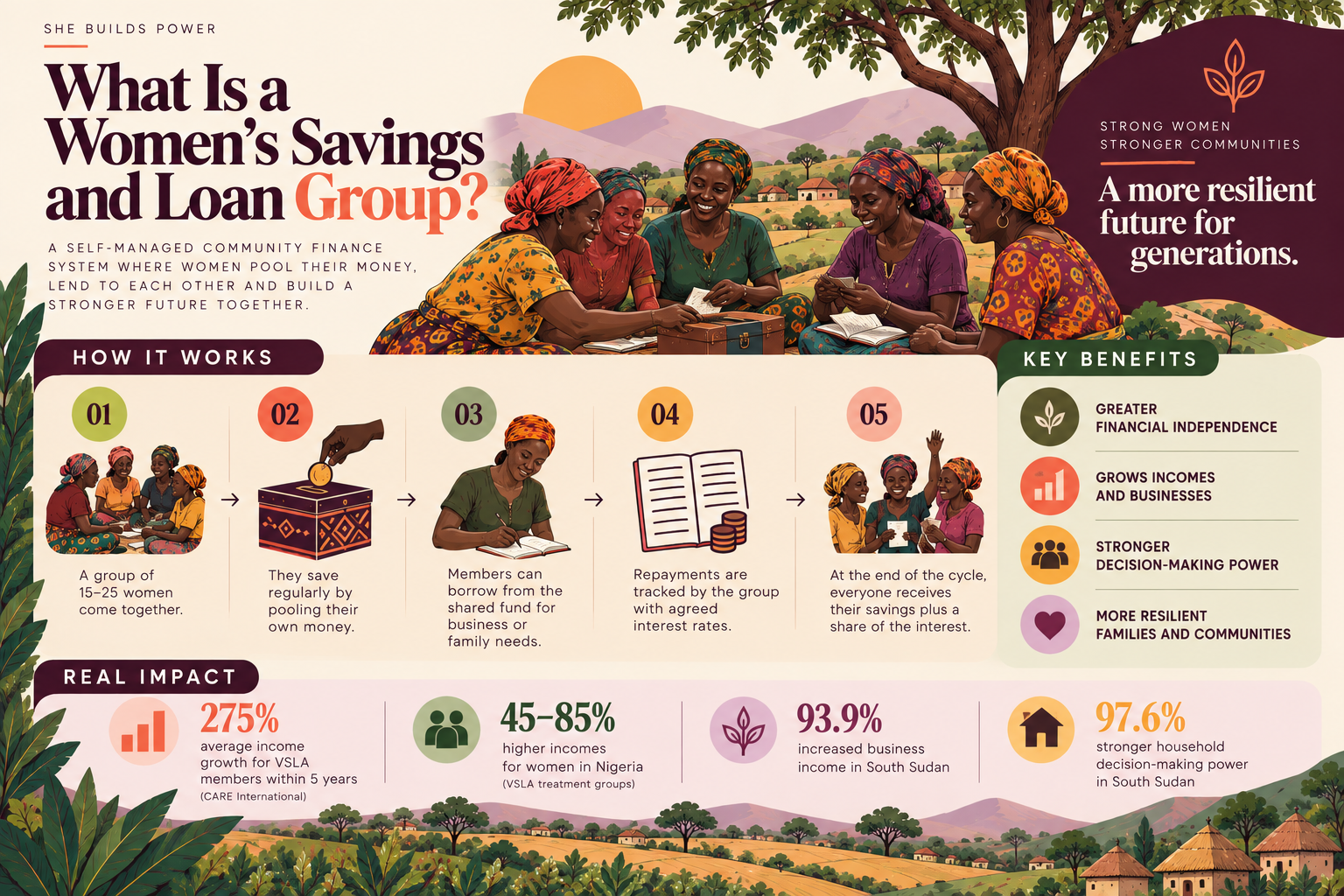
What is a women’s savings and loan group? It’s a small, self-managed community finance system where women pool their own money, lend to each other from a shared fund, and split the accumulated savings and interest at the end of a cycle. Formally called a Village Savings and Loan Association (VSLA), these groups meet weekly, not at a bank, but in homes, community halls, and under trees across East Africa, building something banks rarely offer women: meaningful access to credit. No outside lender. No credit score required. No NGO keeping the lights on.
Organizations like She Builds Power have made training women to lead these community finance systems a core part of their poverty-exit strategy in East Africa, because the model works and the evidence behind it is compelling. By the end of this article, you’ll understand exactly how a women’s savings and loan group functions, why these groups outlast most external programs, and what it takes to start one from scratch.
How a women’s savings and loan group actually works
VSLAs are built for communities with little or no access to formal banking. Groups of 15 to 25 women self-select based on trust, meet on a fixed schedule (usually weekly), and contribute savings at each meeting by purchasing shares in the group’s pooled fund. The rules around savings amounts, loan limits, interest rates, and penalties are set entirely by the group, not by any outside institution.
Who joins and how the group forms
Self-selection is the first governance tool. Members choose each other, and that act of choosing builds accountability from day one. Before any money changes hands, the group elects its own leadership, a chairperson, secretary, and treasurer, and agrees on written bylaws governing everything from meeting attendance to loan eligibility. This structure is intentional. Groups that begin with clear, enforceable rules are far less likely to dissolve early; research on community savings groups consistently links the absence of written bylaws to a higher risk of collapse within the first savings cycle.
The rhythm of a savings cycle
A typical cycle runs about 12 months. Savings accumulate week by week, lending begins once the pooled fund reaches a usable size, and at the end of the cycle each member receives her savings back plus a proportional share of the interest earned. Then the group votes to start a new cycle. CARE International reports that VSLA members see an average income growth of 275% within five years, with every $1 invested in a savings group generating $18.85 in member income over that period. The model is self-renewing, not dependent on continuous outside funding.
Where the pooled money goes and how members borrow
Once savings are established, the fund becomes a member-controlled lending pool. Women apply for loans at group meetings, stating the amount and purpose. The group approves requests based on each member’s savings standing and the available fund balance. Interest rates are set by the group and vary by context; many groups set moderate rates that keep borrowing affordable while still growing the shared fund. Repayments are tracked in a shared ledger. Most groups also maintain a separate social fund to cover emergencies like illness or funeral costs, so a personal crisis doesn’t derail the whole system.
How the loan process stays accountable
Because every loan comes directly from fellow members’ savings, the group has a personal stake in repayment. This creates natural accountability without any bank’s legal enforcement. Members monitor each other, and repayment rates in well-run VSLAs are consistently high. Many program evaluations report repayment rates around 99%, a figure that reflects the immediate, visible social consequences of defaulting in front of fellow members. (It’s worth noting that defaults do occur, particularly after member exits or economic shocks, and that the 99% figure represents a frequently-cited program summary rather than a universal rate across all evaluations.)
The share-out: why it changes how women think about money
The share-out at cycle’s end is more than a payout. It’s the moment women see concrete returns on their own disciplined saving, often for the first time. In Uganda, the median individual share-out is approximately $42, which may sound modest but represents a meaningful lump sum for women who have never held one. For many members, this moment reframes saving entirely: it stops feeling abstract and starts feeling like a strategy.
What is a women’s savings and loan group, and why does it outlast external aid?
VSLAs are generally built from members’ own savings and don’t require continuous external capital.
Many groups receive initial facilitation or training support, but the ongoing fund belongs entirely to members. When a funding cycle ends, externally financed programs often dissolve with it. A well-run women’s savings group continues because its capital is internal and its governance is owned by the people running it. This is precisely what most aid programs can’t claim, and it’s why the model holds up long after facilitators have left.
The evidence is consistent across multiple regions. A study of VSLA treatment groups in Nigeria found that women’s incomes were 45 to 85% higher than in control groups. Research in South Sudan showed that 93.9% of participants increased their business income and 97.6% reported stronger household decision-making power. Financial inclusion gains, higher savings, greater credit access, and expanded business activity, are the most consistently documented outcomes across evaluations in Ghana, Yemen, and elsewhere, including randomized controlled trials such as those tracked through J-PAL. It’s worth noting that while financial inclusion gains are robust, impacts on broader welfare and women’s empowerment vary across study designs and contexts.
This is precisely the gap that She Builds Power addresses. The organization doesn’t simply introduce women to the concept of savings groups. It trains women in East Africa to lead and manage these groups, developing the financial literacy, governance skills, and recordkeeping discipline that determine whether a group lasts one cycle or twenty years. VSLAs are one pillar in a broader strategy that connects water access, food security, and community finance as mutually reinforcing pathways out of generational poverty.
What can go wrong and how strong groups stay on track
No model is risk-free. The most common challenges include theft or mismanagement of pooled cash, loan defaults driven by over-borrowing or multi-group debt, and governance breakdowns from unclear rules or poor recordkeeping. Understanding these failure points is how groups prepare to survive them, not a reason to avoid the model altogether.
The risks that sink groups early
Physical cash holdings create a real security vulnerability. Groups with vague or unwritten bylaws are at higher risk of early collapse, typically over disputes about loan eligibility or fine enforcement. Members borrowing from multiple community savings groups to repay each other is a documented path to overindebtedness that can destabilize the entire fund. These are predictable failure points, which means they’re preventable with the right preparation.
Practices that protect the group’s integrity
Clear bylaws agreed on before the first contribution changes hands are the most reliable protection against early breakdown. Dual control over cash boxes, accurate meeting minutes, and regular loan audits prevent both honest mistakes and deliberate misuse. Financial management training, the kind She Builds Power delivers across East Africa, reduces governance failures by giving groups the tools to catch problems before they compound into something the group can’t recover from.
Starting a savings group: what it actually takes
Starting a women’s savings and loan group doesn’t require outside funding or formal registration. It requires trust, agreed rules, and consistent discipline. Here are the core steps to get a group off the ground:
- Bring together 15 to 25 women with shared goals and enough trust to hold each other accountable.
- Hold a formation meeting to agree on the group’s purpose, savings amounts, loan terms, and leadership structure.
- Elect officers and write basic bylaws before collecting any money.
- Set up simple recordkeeping: a savings ledger, a loan register, a cash book, and a minutes book.
- Begin weekly meetings with consistent savings contributions, and only start lending once the fund holds at least two to three full cycles of member contributions.
The goal is not perfection on day one. The goal is a clear structure that the group itself owns and can adapt as it grows. Groups that start with strong bylaws and trained leadership are the ones that make it to a second cycle, a third, and beyond.
The power of saving together
A women’s savings and loan group is not charity. It’s a community-built financial institution, one that women design, fund, govern, and benefit from on their own terms. Think of it as a rotating savings and credit association (ROSCA) model evolved into something more structured: a self-help group (SHG) with formal bylaws, elected leadership, and a full accounting system. The research confirms what thousands of groups across East Africa have already proven in practice: when women control the capital, they invest it wisely, repay reliably, and lift households alongside themselves.
Globally, about 81% of VSLA members are women (CARE International global outreach data), and that’s not coincidence. Women have long managed household resources under difficult conditions. A community-based financial group gives that existing expertise a formal structure and a collective return. Organizations like She Builds Power exist because the model works best when women are equipped with the skills to run it well, the governance and financial discipline that make a savings group last.
Saving together, week after week, is among the most well-documented strategies for improving financial inclusion and supporting women’s economic resilience. Evidence consistently shows gains in savings, credit access, and business income, and for many participants, a fundamentally different relationship with money. Not because someone designed it for women, but because women built it themselves.
Frequently asked questions about women’s savings and loan groups
What is a women’s savings and loan group?
A women’s savings and loan group, often called a VSLA (Village Savings and Loan Association), savings circle, or community savings group, is a small, self-managed group where women pool savings, lend to each other from a shared fund, and share the returns at the end of a cycle. No bank account, credit score, or outside lender is required.
How is a VSLA different from a bank or microloan program?
Unlike a bank or microloan program, a women’s savings and loan group is entirely member-owned. The rules, loan decisions, and fund management are controlled by the group, not by an external institution. Capital stays within the community, and profits are shared among members rather than paid to outside investors.
How long does a savings cycle last?
Most groups run a 12-month cycle. At the end, members receive their savings back plus a share of the interest the group earned, a moment called the “share-out.” Then the group votes whether to begin a new cycle.
What are the risks of joining a savings group?
The main risks include cash theft, loan defaults from over-borrowing, and governance disputes from unclear bylaws. Well-structured groups with written rules, dual cash control, and trained leadership significantly reduce these risks.
Can a women’s savings and loan group operate without NGO support?
Yes. Once established, these groups are designed to be fully self-sustaining. Many receive initial training or facilitation support, but the fund and governance belong to members, which is why VSLAs often continue operating long after external program support ends.
How Microloans Help Women Start Businesses in Africa
Amara runs her fingers over a notebook filled with calculations: ingredient costs, market prices, projected margins. She knows her food business will work. She’s been cooking for her community for years. She knows the local market, knows her customers, knows her margins down to the shilling. What she doesn’t have is $120 to buy her first bulk supply of produce. That gap, so small by any global standard, is the difference between a business and a dream deferred.
A common story across East Africa, Amara’s situation reflects what regional studies on capital access consistently document: the idea exists, the knowledge exists, the market exists, but startup capital remains out of reach for millions of women entrepreneurs. So how do microloans help women start businesses in Africa, and what determines whether that help actually sticks? She Builds Power has spent years working alongside women like Amara, learning exactly what capital access can change and, critically, what it cannot do on its own.
How Do Microloans Help Women Start Businesses in Africa: Key Mechanisms
A first microloan in East Africa’s group-lending programs typically ranges from $50 to $250, repaid over six-month cycles with modest flat interest rates. For a woman launching a food business, that amount unlocks something precise: bulk ingredients at a lower per-unit cost, a small market stall, basic equipment, or licensing fees. It isn’t charity. It’s a precision tool applied to a clearly defined constraint, and understanding how microloans help women start businesses in Africa begins with understanding that precision.
The reason many women can’t access this capital through traditional banks comes down to collateral. Banks require land titles or formal assets. According to the World Bank’s research on gender gaps in asset ownership, women across sub-Saharan Africa are significantly less likely than men to hold property in their own names, due partly to legal barriers and partly to inheritance systems that route property through male relatives. Group lending models, where women collectively guarantee each other’s loans, were designed specifically to route around these structural exclusions. The group’s solidarity replaces the land title. The system works because women’s networks already function as a form of distributed accountability. This is financial inclusion for women built from the ground up.
The Skill Layer That Turns a Loan into a Livelihood
Evidence from multiple evaluations, including a 2020 review of microfinance programs across sub-Saharan Africa, suggests that microcredit without complementary training often produces modest and mixed results. When women receive capital but don’t have grounding in pricing, supply chain basics, or market positioning, the money tends to get absorbed into daily expenses rather than growing a business. The loan opens the door. It doesn’t hand over the map.
This is where She Builds Power’s model earns its place in the conversation. The organization combines microloan access with hands-on agricultural entrepreneurship training, so women learn not just how to borrow but how to build. That training covers sustainable food enterprise skills: pricing for local markets, managing a crop cycle as a business asset, and building supply relationships that reduce cost volatility. The pairing creates compounding impact rather than a one-time cash injection.
Women who receive both capital and skills training report higher income retention and stronger business continuity than those who receive loans alone, a finding reflected across multiple microfinance-plus program evaluations. A study from Kenya found a 5.6% increase in monthly earnings specifically when both components were present. These outcomes illustrate why small business loans for women are most effective when paired with structured skill-building from the start.
How Amara’s Food Stall Becomes a Community Investment
IMF research puts women’s reinvestment rate at around 90% of income earned, compared to 30 to 40% for men. That gap isn’t a footnote. It’s the central argument for directing capital toward women through microfinance for women in Africa and related financial inclusion programs.
By her third loan cycle, Amara is employing two neighbors part-time and contributing to a village savings group that will fund the next woman’s start. This kind of ripple effect, while it varies in scale across contexts, reflects patterns documented in evaluations of group lending programs across East Africa. Group lending creates more than shared financial risk. It builds a social infrastructure where women hold each other accountable, share market intelligence, and collectively negotiate better prices from suppliers. The solidarity lending model isn’t just a logistical mechanism for loan delivery. Over time, it can grow into a community institution that women sustain well beyond the initial loan cycle.
What Separates Programs That Deliver from Those That Don’t
The design features that determine whether a microloan changes a life are well documented across program evaluations. Group lending outperforms individual credit models for women with limited collateral. Repayment schedules tied to harvest or market cycles reduce default risk and stress. Non-financial services, particularly business training and market linkages, consistently improve outcomes when integrated from the start rather than added as optional extras.
Programs that proactively address cultural and legal barriers, including engaging male community leaders to shift norms around women’s business ownership, show stronger long-term results than those that treat those barriers as external to their work. That last point matters more than most program designs acknowledge.
Even the best programs haven’t solved everything. High interest rates at commercial microlenders remain a real barrier. Digital identity gaps prevent many women from accessing mobile-based loan platforms. Deeply embedded cultural norms that restrict women’s mobility or limit their legal standing continue to shape what’s possible in certain communities. Acknowledging these constraints isn’t pessimism. It’s honesty about the terrain that practitioners, donors, and advocates need to understand to design programs that actually work.
The Calculations Were Right All Along
Amara’s notebook? Those calculations she ran at the start were correct. Her business is working. The microloan didn’t make the business, it made the business possible. The skill-building made it sustainable. The community reinvestment extended its impact in ways that a loan alone never could have.
How do microloans help women start businesses in Africa? The answer isn’t simply “by providing money.” It’s about what becomes possible when women have the right capital, the right training, and a network built to hold both. She Builds Power’s integrated model of water, food, and finance is designed around exactly that logic, and it’s being put into practice across East Africa. If you want to be part of building those conditions, learn how to donate or partner with She Builds Power.