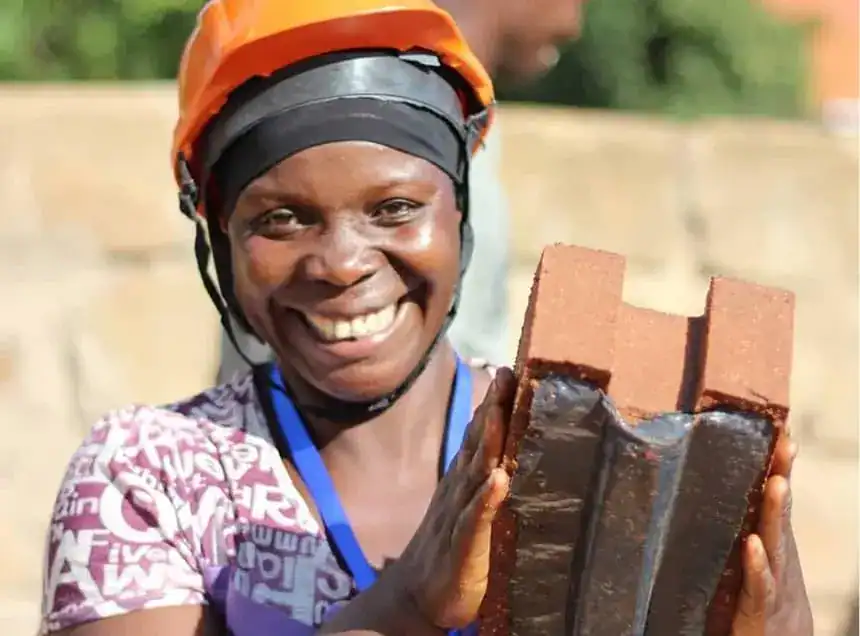
A woman in a drought-prone village studies the slope of a hill for weeks, mapping how water moves under gravity, until she finds the exact point to dig a channel that will carry it to her neighbors’ fields. No lab. No funding round. No press release.
A few thousand miles away, a founder pitches a “smart irrigation platform” to a room of investors and raises $4 million.
Only one of these gets called an innovator. That distinction is the subject of this piece — and I think it’s costing us more than we realize.
The definition we’ve been sloppy about
We treat innovation as a costume: patents, pitch decks, product launches, a stage and a headset mic. But strip away the costume and innovation is just this — creating something new, or improving something that exists, in a way that solves a real problem. Nothing in that definition requires a term sheet.
By that definition, the woman on the hillside is innovating. So is the mother who turns a small loan into a business that feeds her family and seeds a savings group.
So are the farmers who spend generations testing soil, spacing, shade, and timing long before anyone in Geneva calls it “climate adaptation.” The FAO estimates smallholder farmers produce roughly a third of the world’s food, much of it through locally developed techniques rather than formal agricultural research — knowledge built the same way a startup builds a product: hypothesis, test, iterate, ship.
The difference isn’t the quality of the thinking. It’s who’s holding the microphone when the thinking gets named.
- A woman solving a water problem is “coping.”
- A consultant describing the same solution is “innovating.”
- A community adapting to climate stress is “resilient.”
- A researcher documenting it is “producing knowledge.”
- A women’s group building a rotating savings fund is “informal finance.”
- A bank building the same mechanism is “fintech.”
Same idea. Different vocabulary. Different budget line.
Why this isn’t just a semantics problem
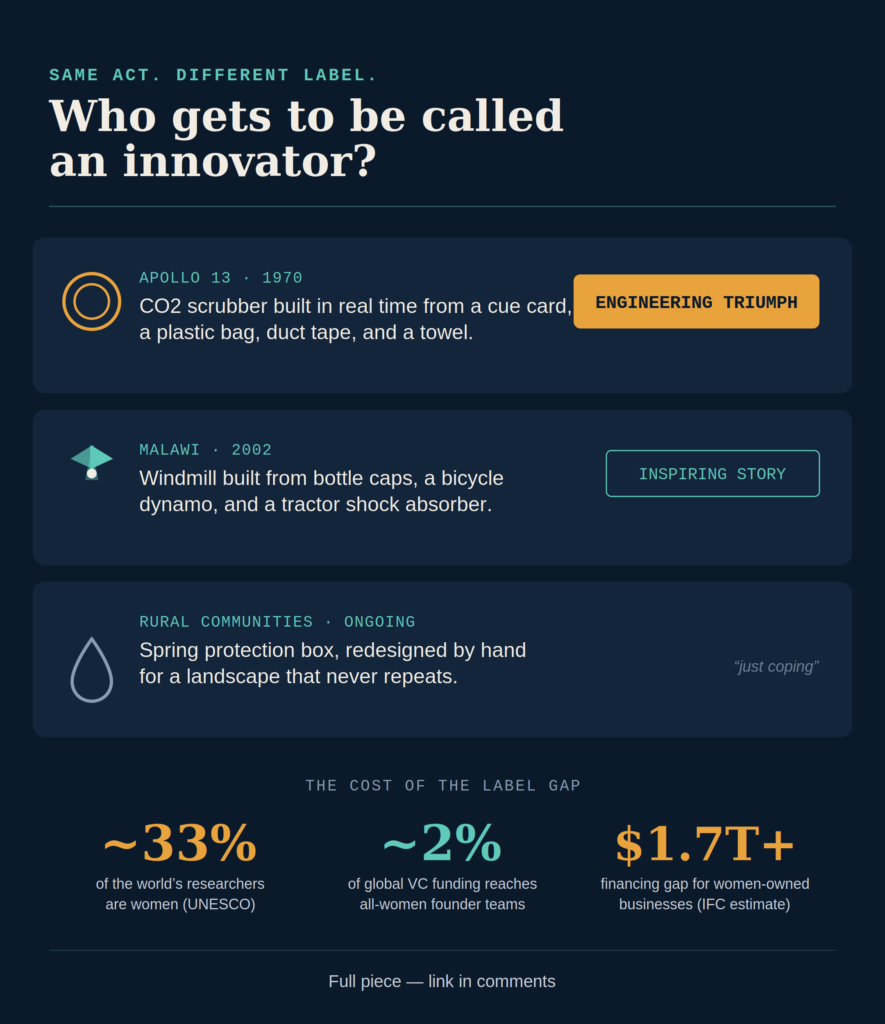
Words decide where money goes. UNESCO data puts women at roughly a third of the world’s researchers globally — lower still in many low-income countries — meaning the institutions that get to certify what counts as innovation are already skewed toward one demographic’s frame of reference. Add to that a well-documented capital gap: the World Bank and IFC have estimated a financing gap in the tens of billions for women-owned SMEs in emerging markets, and PitchBook’s venture data consistently shows all-women founding teams capturing only a low single-digit share of global VC dollars.
That’s not a coincidence sitting next to the labeling problem. It’s downstream of it. If your problem-solving isn’t recognized as innovation, it doesn’t qualify for the funding, curricula, or research attention that flows toward “innovation.” The label isn’t just descriptive — it’s a gatekeeping mechanism.
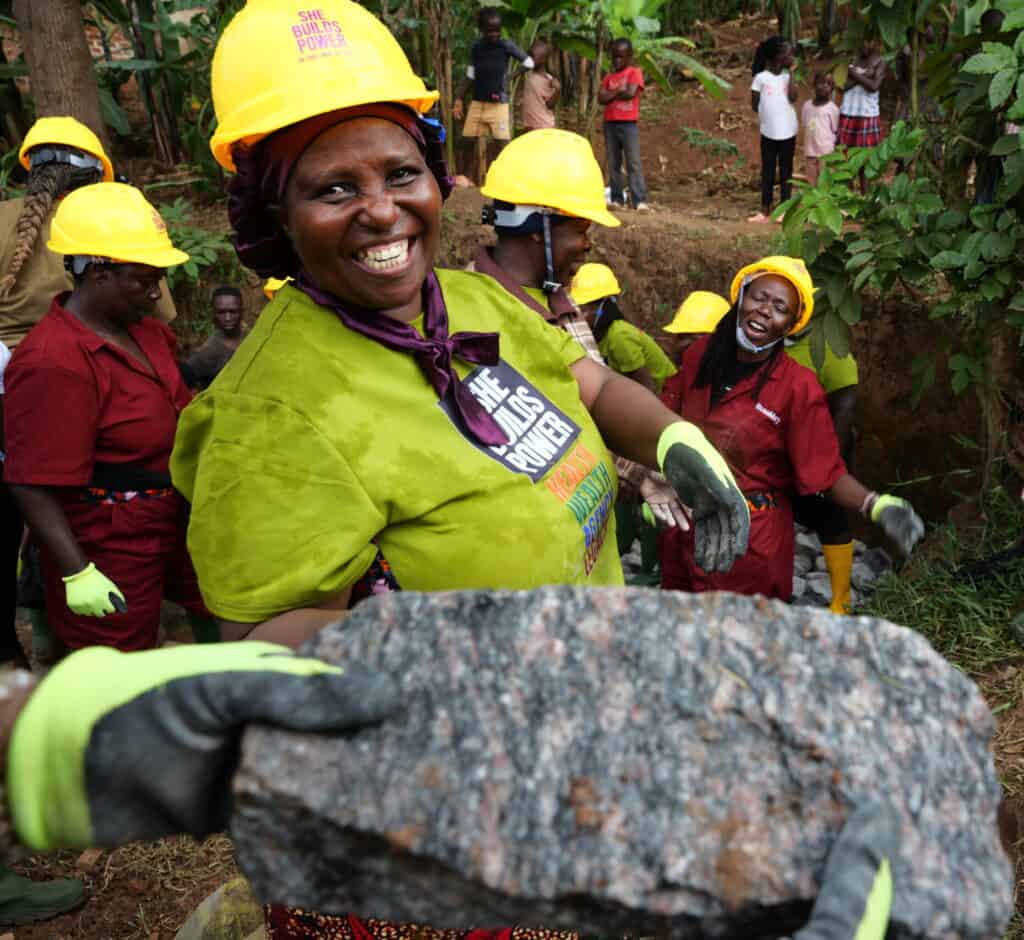
At She Builds Power, this shows up constantly: women don’t just absorb a training, they extend it — adapting a technique to their own soil, market, or water source, then teaching it forward. That loop — learn, adapt, test, teach — is the innovation cycle, just running without a whiteboard.
Innovation is also a condition, not just an output
There’s a second argument worth making, and it’s separate from the labeling problem above: innovation is partly defined by the conditions it’s built under, not only by the thing that gets built.
Take William Kamkwamba. After failed rains devastated Malawi’s 2001 maize harvest, famine spread through the country and intensified into early 2002. Kamkwamba had just started secondary school in mid-January that year; on February 2, his farming family could no longer afford the fees, and he was forced to leave. With no money for school, he spent his days at the local library, where he found a book called Using Energy and taught himself how a windmill generates electricity. Then he built one — not from a hardware store, but from a scrapyard and whatever was lying around: blue-gum tree trunks and poles lashed together for the tower, flattened PVC pipe cut into blades and reinforced with bamboo, an old tractor fan repurposed as the rotor, a discarded tractor shock absorber converted into the rotating shaft, a broken bicycle stripped for its frame, wheel, chain and sprockets, a 12-volt bicycle dynamo to generate current, and flattened bottle caps standing in for washers. It worked — the turbine lit a bulb, then powered four lights, two radios, and phone charging for his family’s home. The design existed in a book. The execution — figuring out what to substitute when you have no money and no supply chain, and making those substitutions actually hold up under load — did not exist anywhere. That part he had to invent.
This is worth sitting with, because it complicates the tidy version of the argument: Kamkwamba did have a reference. He wasn’t working from zero. The book had told him windmills could also pump water, and irrigating his family’s land beyond the rainy season was part of his original ambition — but that came later; the turbine he built as a teenager generated electricity, not water. Having a diagram is not the same as having the materials, the workshop, or the safety margin to build what the diagram assumes you can build. The innovation wasn’t the windmill concept — it was closing the gap between “what the book describes” and “what’s actually in front of me,” a gap that gets wider the fewer resources you have.
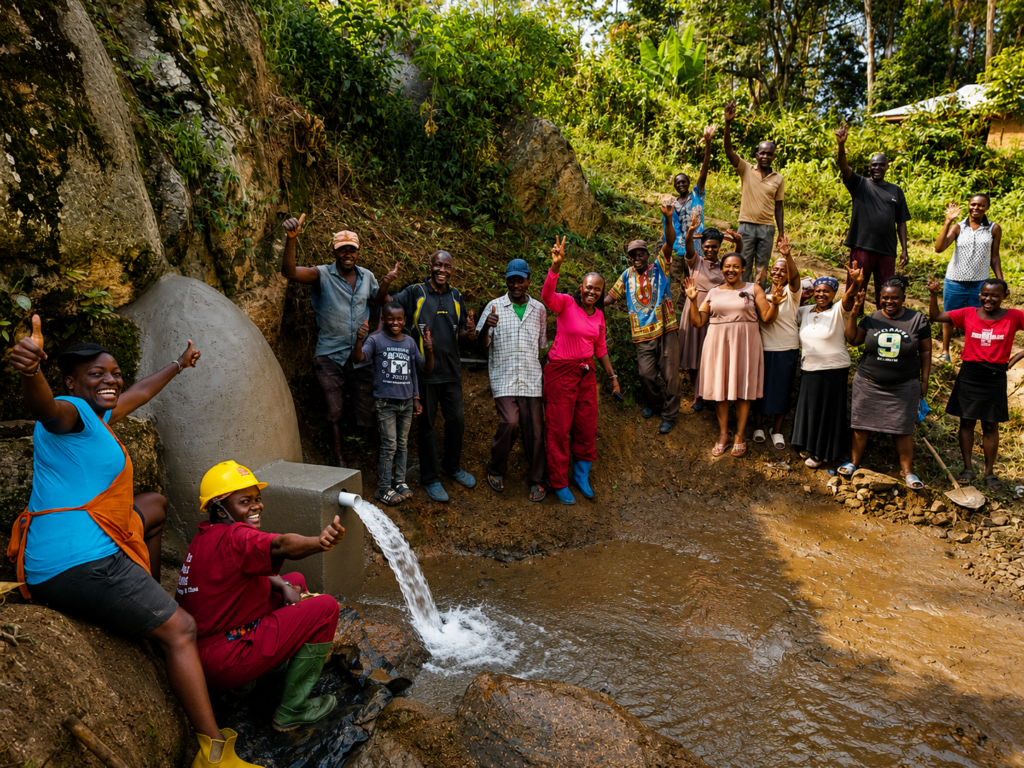
We see the same pattern at She Builds Power with spring protection boxes. The design elements are, on paper, standard: a cement box, pipes, a slow sand filter, a sealed structure to keep the spring from being contaminated by runoff or animals. It sounds like a template you could stamp out identically at every site. It isn’t. Every spring sits differently in its landscape — different flow rate, different soil, different slope, different seasonal behavior — which means the box has to be redesigned around that specific spring every time. There’s no factory version. The “standard design” is really a standard starting point; the actual engineering happens on-site, matching the structure to conditions that don’t repeat.