Why One Solution Is Rarely Enough: The Single-Issue Ceiling
The cumulative, place-based nature of intergenerational poverty is why any single fix tends to stall. Low income limits housing access; housing instability disrupts school quality; poor schools reduce lifetime earnings; lower earnings constrain housing choices for the next generation. These relationships are bidirectional, and parental income is the central connective mechanism because it determines the resources families can use to buffer shocks and invest in children.
U.S. program evidence reflects this clearly. Rental assistance reduces housing instability. Nutrition assistance improves later-life health outcomes for children. But these gains rarely compound into poverty exit because adjacent drivers remain untouched. Research modeling based on experimental evidence found that no individual policy reduced child poverty by 50%; only combinations of income support and work incentives produced simultaneous gains in both poverty reduction and employment. Stacking solutions deliberately is what changes the result.
What the research actually shows about multi-sector programs
Integrated wraparound services
The landmark integrated programs tell a consistent story. According to NBER working paper w15473, students entering Harlem Children’s Zone‘s Promise Academy gained more than 0.8 standard deviations in math by eighth grade, enough in the study’s estimate to close the Black-white math achievement gap. The Nurse-Family Partnership, which bundled prenatal guidance, parenting support, and health monitoring through repeated home visits, linked those combined services to reduced child injuries and longer-term school achievement in randomized trials. Moving to Opportunity found that children who relocated to lower-poverty neighborhoods at young ages earned significantly more as adults, while adolescent moves could be disruptive. Each program combined multiple service types and addressed social determinants of poverty rather than a single factor.
Timing, dosage, and structural inequality
The nuance matters: integration is most effective when participants face multiple, interacting barriers rooted in structural inequality, and when services are sustained rather than episodic. Head Start’s long-run gains came from bundling preschool, health screenings, and nutrition, not classroom instruction alone. Coordinated, sustained exposure to multiple domains produces compound effects that isolated exposure rarely does, a pattern that appears consistently across Graduation trials, Moving to Opportunity, and long-run evaluations of community-based wraparound models, though effect sizes vary by setting and population.
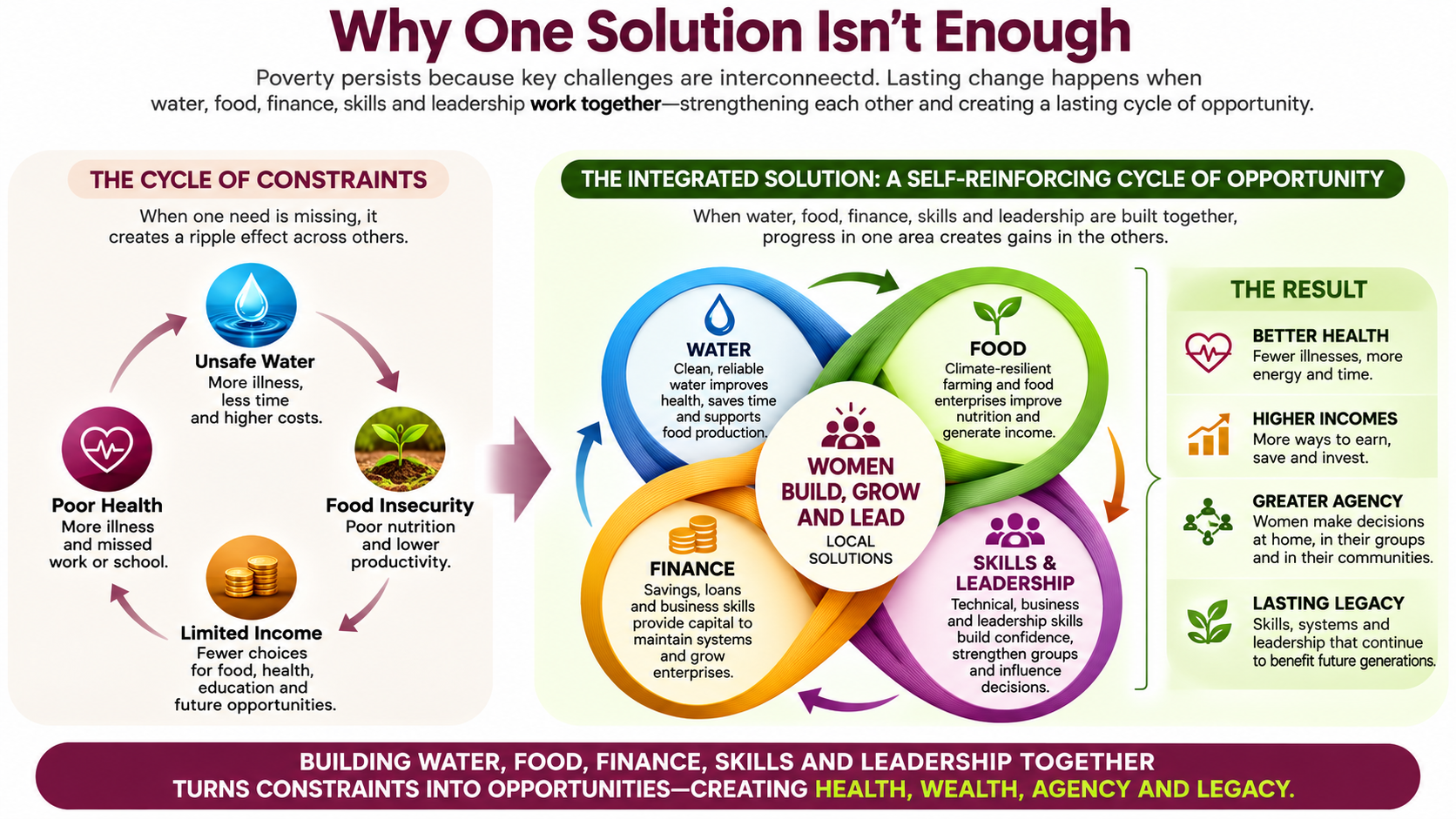
Why one solution is rarely enough to address generational poverty becomes clear when we examine how challenges reinforce one another: unsafe water undermines health and food security, food insecurity limits economic opportunity, and limited income makes it harder to invest in better water, food, and health systems.
Generational poverty isn’t one problem. It is a system of reinforcing constraints. Addressing one challenge can deliver meaningful improvements, but those gains may be limited when the conditions needed to sustain and build upon them remain unchanged.
Many well-funded, well-intentioned programs focus on water, food, or finance independently. Each can make a real difference. But lasting change requires understanding how these systems interact—and how progress in one can strengthen the others.
According to the Brookings Institution, poverty’s structural drivers, including education, health, housing, income, and social capital, are mutually reinforcing, not parallel tracks. A child in unstable housing attends an under-resourced school, faces higher health risks, and enters adulthood with constrained earning potential, which then limits housing choices for the next generation. A clean water tap doesn’t interrupt that chain. What does interrupt it is deliberate, coordinated action across the domains that create and sustain it. This article examines why the research backs that systems view and what it means for how anti-poverty programs should be designed, funded, and measured.
Key takeaways
- Poverty is a system: Education, health, housing, and income reinforce one another, meaning a change in one domain alone rarely produces lasting results.
- Single programs hit a ceiling: Domain-specific interventions produce meaningful but narrow gains that rarely compound into poverty exit when adjacent drivers remain untouched.
- Multi-sector programs often outperform: Integrated packages that combine assets, skills, savings, and health components tend to produce larger, more durable welfare gains than isolated programs in many settings, though effects vary by context.
- Timing and dosage matter: Sustained, coordinated exposure to multiple domains produces compound effects; episodic single-touchpoint programs rarely do.
- Funding must match the model: Short grant cycles and siloed budgets undermine integration before its gains can compound.
How building women’s capabilities across water, food, and finance changes community outcomes
The research reinforces an important principle behind She Builds Power‘s approach: lasting solutions must reflect how challenges, resources, and opportunities are interconnected.
We train women to build and maintain essential water infrastructure, grow food through climate-resilient agriculture, develop enterprises, and establish and manage community-based financial systems. Alongside these technical and entrepreneurial capabilities, women strengthen their leadership, mobilize their communities, and engage local institutions.
These are not three isolated programs. They are interconnected systems that women and their communities already navigate every day.
When water, food, and finance work together, progress in one area creates opportunities in another. A reliable water system can improve health and free time for farming and enterprise. Food production strengthens household nutrition while creating opportunities for income. Community-managed savings and lending provide capital to invest in businesses, maintain infrastructure, and respond to emergencies.
But skills and resources alone are not enough. Women also need the conditions to put their capabilities to work: recognition, trust, access to resources, decision-making authority, and ownership.
This is the foundation of She Builds Power’s Operating System to Catalyze Local Power. Rather than simply delivering solutions, we work with women and communities to strengthen both the capabilities and the conditions that allow them to build, adapt, and lead essential systems long after external support ends.
What it actually takes to design integration that lasts
The barriers to sustained integration are structural, not accidental. Short grant cycles fund launch and immediate outputs but not maintenance, capacity, or adaptation. Siloed agency budgets create fragmented services and misaligned incentives. Narrow evaluation windows measure outputs rather than whether gains persisted, compounded, or transferred to the next generation. Eligibility cliffs interrupt support just as people begin improving.
Effective alternatives include multi-year, flexible funding; coordinated investment across interconnected priorities; and decision-making authority held by the communities building and managing these systems. Accountability must extend beyond immediate outputs to whether local capabilities, leadership, and ownership continue to strengthen over time. clearly assigned accountability. Evaluation frameworks recommended by OECD and UNDP guidance that track poverty headcount, employment quality, human development indicators, and resilience, disaggregated by sex, geography, and baseline poverty level. Measuring a water program by liters distributed or a food program by tons delivered misses whether those gains persisted or compounded. Effective evaluation tracks how outcomes in one domain shift conditions in adjacent domains over time. She Builds Power operates a 100% program-directed giving model.
The real cost of choosing one thing at a time
Intergenerational poverty is self-reinforcing because its causes are interlocked. A program that addresses one cause without the others creates temporary relief that the system eventually absorbs. Evidence from wraparound programs, longitudinal housing research, and community-based models shows a pattern that appears across many rigorous evaluations: coordinated, sustained, multi-sector intervention produces compound gains that isolated solutions rarely replicate, though context, implementation quality, and funding duration all shape how large those gains are.
The question for donors, funders, and development practitioners isn’t whether to choose water or food or finance. It’s whether we’re willing to invest in the interconnected systems that communities depend on—and trust the people who understand those systems best to lead them.
At She Builds Power, we don’t treat women as recipients of separate interventions. We recognize them as builders, growers, entrepreneurs, and leaders capable of shaping their communities’ futures. Our role is to strengthen their capabilities and help create the conditions in which those capabilities can flourish.
Because breaking cycles of poverty isn’t simply about solving today’s problems. It’s about strengthening communities’ ability to address tomorrow’s challenges.
The real measure of “enough” in anti-poverty work isn’t a tap installed or a harvest improved. It’s whether the women who built those systems are still leading them, improving them, extending them, and passing their knowledge and leadership to the next generation.
When we invest in capabilities, conditions, and local ownership together, we don’t just fund solutions. We help build the power to create what comes next.
Frequently Asked Questions
How does timing and dosage influence whether integrated programs break poverty cycles?
Timing and dosage determine whether services produce compound, lasting effects rather than episodic gains. Sustained, coordinated exposure across multiple domains is more likely to produce compound effects, while episodic single-touchpoint programs rarely do, evidence from Graduation trials, Moving to Opportunity, and long-run evaluations of wraparound models shows sustained integration matters most.
What funding and governance approaches are necessary to make integration last?
Lasting integration requires pooled multi-year funding, flexible local delivery authority, and cross-sector governance with clearly assigned accountability. Short grant cycles and siloed agency budgets undermine maintenance, capacity, and adaptation, so funding must match the integrated model to allow programs to sustain and compound gains.
How do women trained across water, food, and finance contribute to community sustainability and who has She Builds Power reached so far?
When women are trained simultaneously in water infrastructure, climate-resilient agriculture, and financial skills, gains in one area reduce cost and risk in others and create self-reinforcing local capacity. She Builds Power has impacted over 500,000 lives across four countries in East Africa, empowered more than 12,700 women leaders, and operates a 100% program-directed giving model to support locally led maintenance and long-term sustainability.