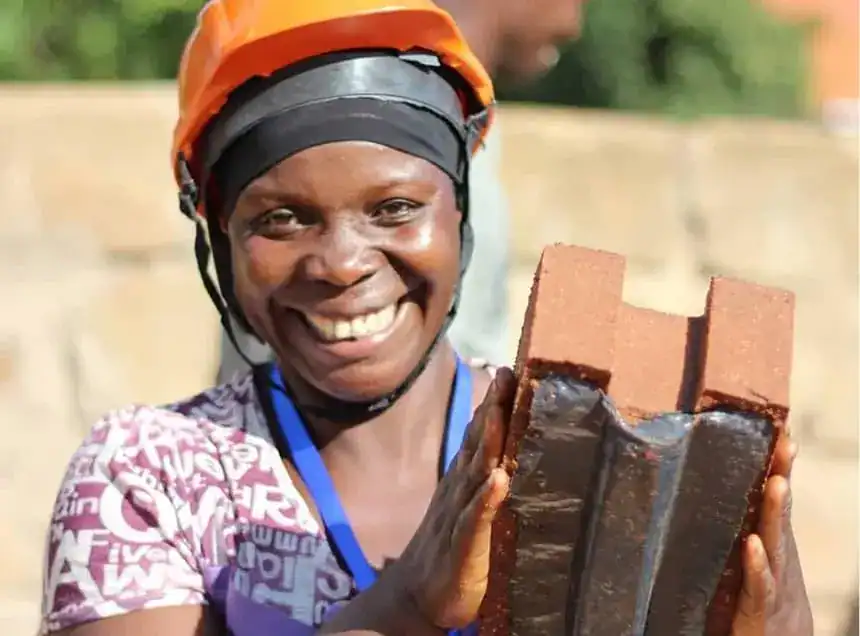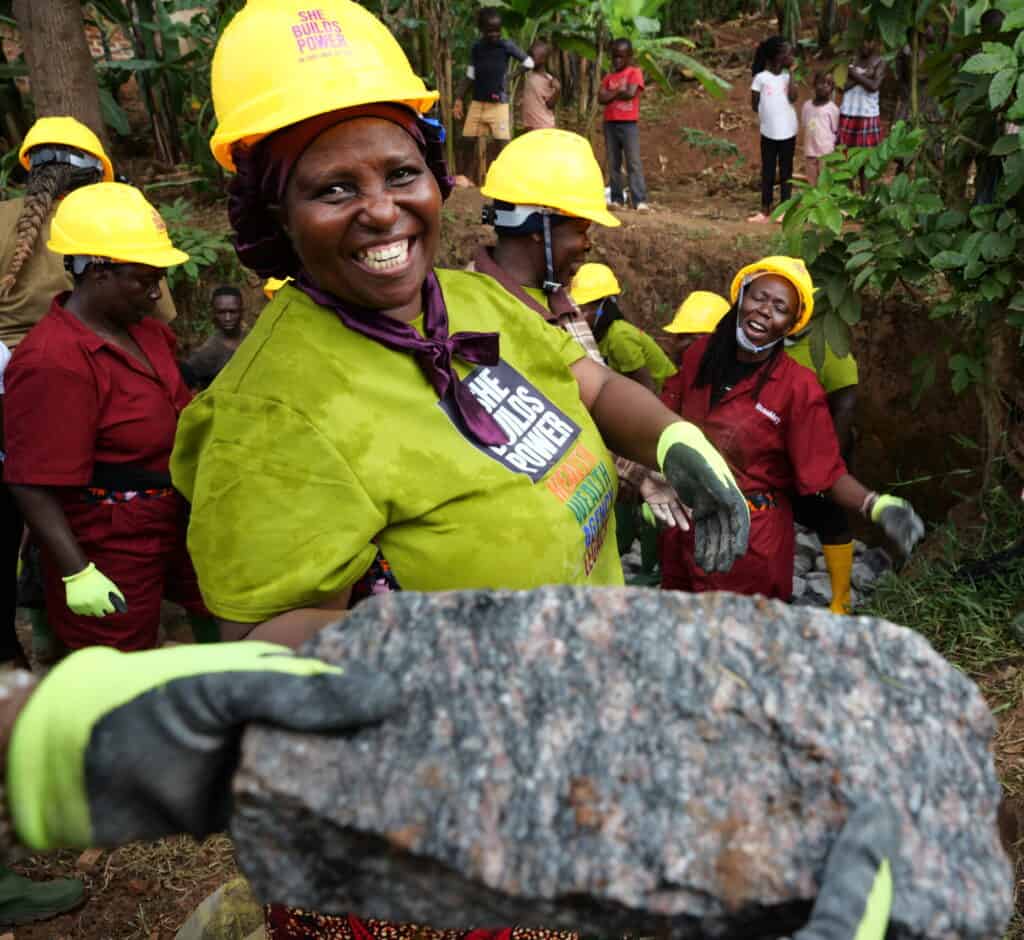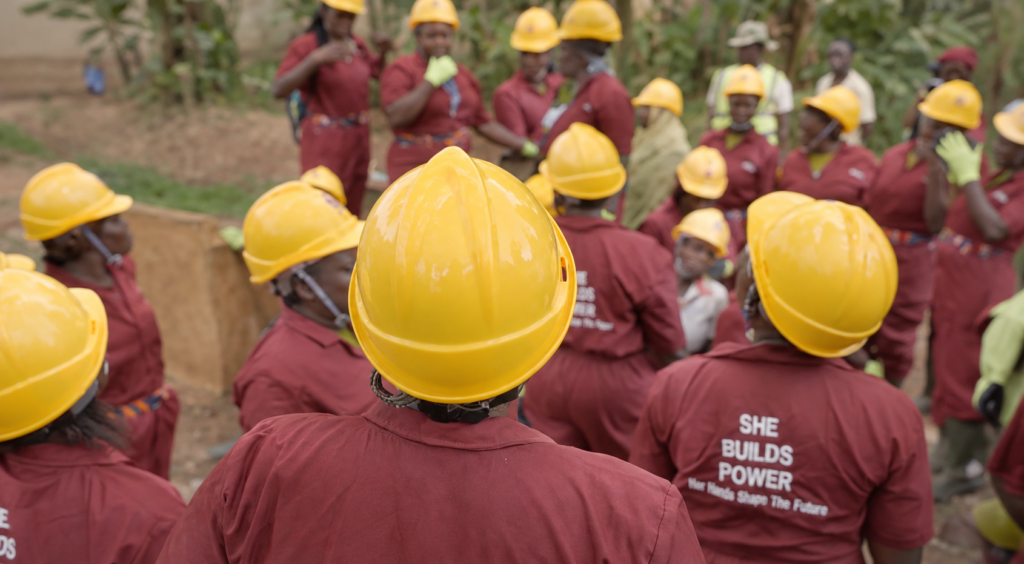
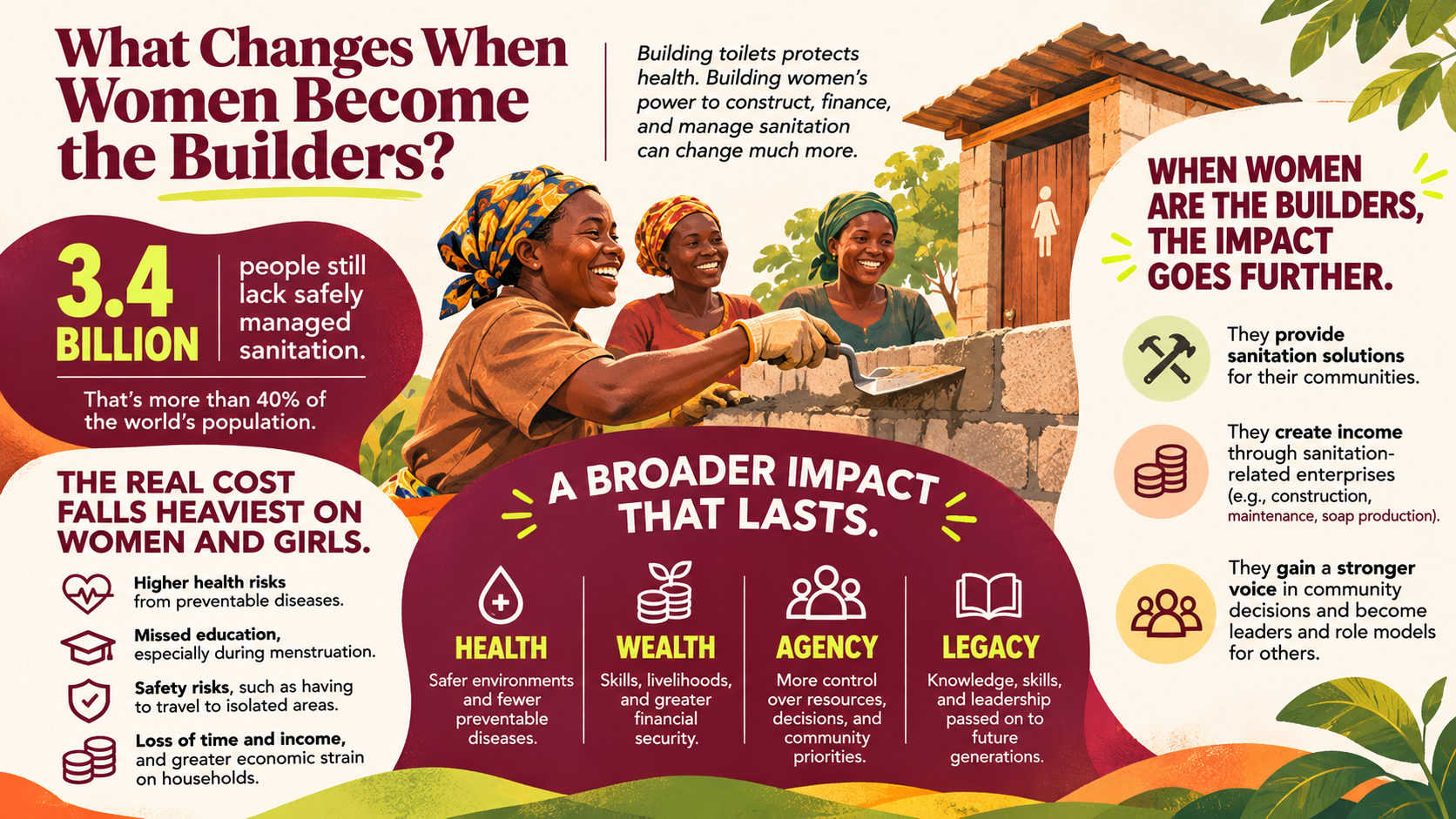
Building toilets protects health. Building women’s power to construct, finance, and manage sanitation systems can change much more.
Every year on World Toilet Day, we confront a staggering statistic: 3.4 billion people still lack safely managed sanitation. According to WHO and UNICEF, that’s more than 40% of the world’s population.
The conventional response is straightforward: we need more toilets.
And we do.
But there’s another question we should be asking: What happens when the women most affected by inadequate sanitation become the people building the solutions?
Because the sanitation crisis isn’t simply about missing infrastructure. It’s about the systems that determine who can build it, who maintains it, who makes decisions, and who benefits from the opportunities it creates.
And that changes how we should think about development.
The Real Cost of Inadequate Sanitation Isn’t Just Poor Health
Unsafe sanitation contributes to diarrheal diseases, parasitic infections, and other preventable health conditions. It also exposes women and girls to risks that rarely appear in construction budgets.
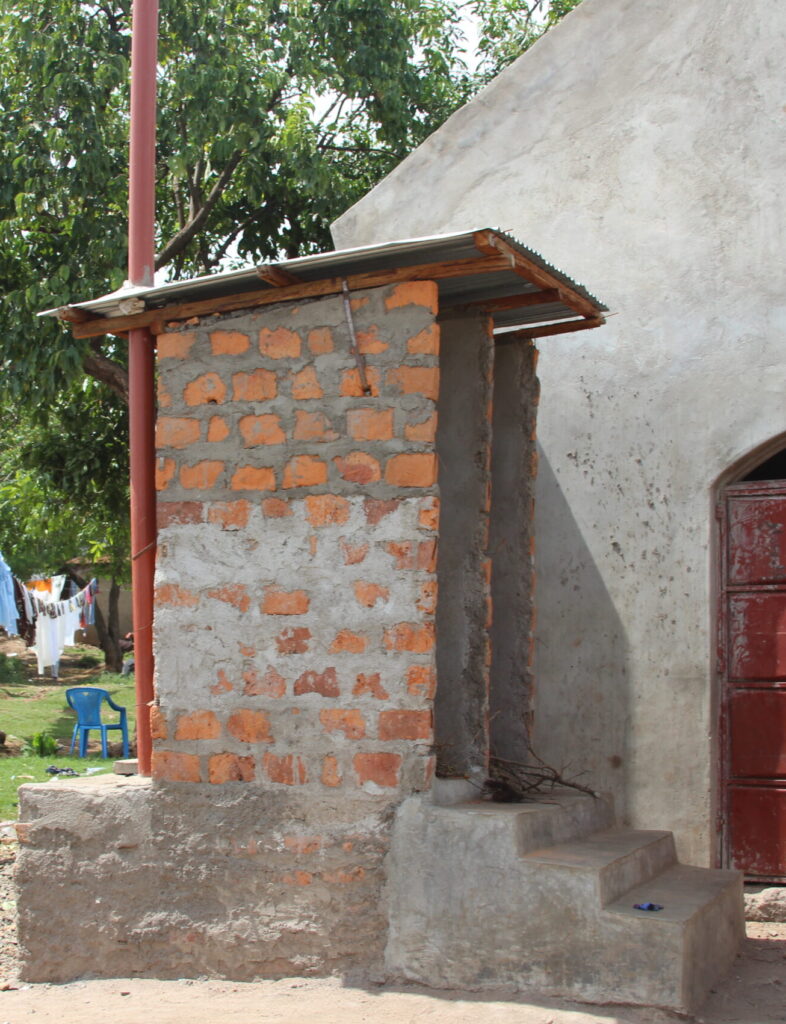
Without safe, private toilets, women may have to travel to isolated areas, sometimes after dark. Girls attending schools without appropriate menstrual hygiene facilities face additional barriers to participation. When preventable illness affects a household, women often shoulder much of the unpaid caregiving.These consequences compound.
A sick child can mean lost working hours. Repeated illness can drain household savings. Missed school can limit future opportunities. Unsafe facilities can restrict women’s freedom of movement.
What begins as a sanitation problem becomes a health, economic, educational, and personal security problem.
The cost of inadequate sanitation is not simply the absence of a toilet. It is the opportunities people lose because the systems around them don’t work.
And women disproportionately bear those costs.
The System Behind the Sanitation Crisis
Consider what makes a toilet genuinely useful.
It needs appropriate construction, safe waste management, water and hygiene facilities, privacy, and regular maintenance.
Someone must know how to repair it. Resources must be available when something breaks. Households and communities need ways to finance improvements and make decisions about shared infrastructure.
None of these conditions operates independently.
A toilet without handwashing facilities leaves health risks unresolved. A facility without maintenance eventually deteriorates. A sanitation project that overlooks women’s needs may fail to address the very barriers it was intended to remove.
This is why water, sanitation, and hygiene — collectively known as WASH — must function together.
But there’s another interconnected system that receives far less attention: the relationship between people’s capabilities and the conditions that allow them to use those capabilities.
A community may have people with construction knowledge but limited financing. Women may understand their community’s sanitation needs but lack authority over infrastructure decisions. Local entrepreneurs may have viable solutions but struggle to obtain tools, contracts, or recognition.
The knowledge exists. The potential exists.
What is missing are the conditions that allow that potential to become action.
Why Building More Toilets Won’t Solve the Whole Problem
Development organizations have become very good at counting infrastructure.
Toilets constructed. Wells drilled. Facilities installed. Households reached.
These are important measures. But they tell us surprisingly little about what happens after construction.
Who repairs the toilet when it breaks?
Who has the technical skills to build another?
Who controls the financial resources needed for maintenance?
And who gets to decide which sanitation investments the community makes next?
A construction-focused approach measures what a project delivers.
A systems-focused approach also examines what a community becomes capable of doing because of that investment.
This distinction matters because infrastructure can improve immediate conditions without necessarily changing the underlying distribution of resources, knowledge, and decision-making power.
When communities depend entirely on external organizations to construct, finance, or maintain essential services, they may remain dependent on the next project.
But when local capabilities expand alongside resources, recognition, trust, and authority, communities can take greater control over their development.
The goal isn’t to stop building toilets.
It’s to ensure that building toilets also helps build the local capacity and power to sustain and improve sanitation systems.
The Missing Infrastructure Is Often Human
Consider what happens when a water system breaks.
Who recognizes the problem? Who repairs it? Who has the tools, resources, and authority to act? Who decides how maintenance is funded?
These questions reveal another layer of WASH that rarely receives the attention given to physical infrastructure.
At She Builds Power, our experience alongside women in East Africa has reinforced a fundamental principle:
Capability and the conditions to exercise it must be developed together.
A woman may know her community’s water challenges better than an outside technical expert. She may recognize contamination risks, understand why sanitation facilities aren’t being used, or identify households facing the greatest vulnerability.
But recognizing a problem is different from having the power to solve it.
Does she have technical training? Can she obtain materials? Is her expertise recognized? Can she influence decisions? Does she control resources?
These conditions determine whether existing knowledge becomes effective action—and whether that action can be sustained.
Women Are Not Just Users of WASH Systems. They Can Be Their Builders.
Women often carry disproportionate responsibility for collecting water, maintaining household hygiene, and caring for sick family members.
Yet responsibility does not automatically come with decision-making power.
The people experiencing inadequate WASH most directly are not always invited to design, construct, finance, or govern its solutions.
That’s an enormous loss of local expertise.
Across East Africa, we’ve seen what becomes possible when women become builders, technicians, entrepreneurs, and community leaders. They learn to construct protected spring wells, produce water filters, build sanitation facilities, and develop hygiene-related enterprises.
Equally important, they develop financial management, organizing, negotiation, and leadership skills to mobilize resources and transfer their knowledge to others.
WASH Is What They Build. Local Power Is What Grows.
In Uganda, Engineer Godliver Businge has spent years training women to construct and manage essential water and sanitation systems.
One of those women is Emily, a 69-year-old grandmother who first joined our programs as a village trainee. Emily developed skills in WASH, food production, entrepreneurship, and financial management, eventually becoming a respected community leader.
This year, she returned for advanced training with Godliver and helped lead the construction of a protected spring well serving approximately 360 households, sharing her technical knowledge with other community members along the way.
Consider what that represents.
Godliver’s expertise became part of Emily’s capability. Emily is now transferring that knowledge to others, helping grow the number of people who can contribute to future projects.
The well serves today’s households. The knowledge can serve generations.
The true legacy of a WASH project isn’t only what gets built. It’s who can build what comes next.
What Changes When Women Become the Builders?
At She Builds Power, we train women across East Africa to build essential water and sanitation systems, grow food, develop enterprises, and strengthen community finance.
But training is only part of our approach.
A woman may learn to construct a toilet, yet still face obstacles to becoming a recognized builder.
Does her community trust her technical expertise? Can she obtain materials and financing? Will households hire her? Can she influence decisions about sanitation projects? Does she have opportunities to teach others?
Capability is what someone can do. Enabling conditions determine whether they can actually do it.
We work to strengthen both.
Consider Florence, a woman in Uganda who developed her skills in sanitation and soap production through our training.
She went on to build a sanitation enterprise and has been involved in constructing more than 700 toilets.
Think about what that represents.
Hundreds of sanitation facilities. Technical skills put to productive use. An enterprise providing services that communities need. A woman occupying an economic role traditionally associated with men.
Florence’s story illustrates a different kind of investment.
The training didn’t simply prepare her to participate in a sanitation project. It contributed to her ability to provide sanitation solutions herself.
Of course, training alone doesn’t guarantee that outcome. It also requires demand, resources, relationships, and opportunities to turn skills into sustained economic activity.
That’s precisely the point.
When women gain both capability and the conditions to exercise it, they can become builders, entrepreneurs, employers, and decision-makers — not simply recipients of infrastructure.
And the potential benefits extend beyond sanitation.
What Should We Actually Be Measuring?
If our ambition is to improve sanitation, counting toilets makes sense.
But if our ambition is lasting community development, we need a broader definition of success.
At She Builds Power, we examine four interconnected outcomes:
Health: Do families have safer environments that reduce preventable disease?
Wealth: Are women developing skills, enterprises, and financial security through the solutions they build?
Agency: Do women have greater authority over resources, decisions, and community priorities?
Legacy: Are knowledge, technical capabilities, and leadership being sustained and passed forward?
These outcomes don’t happen automatically. Building a toilet doesn’t guarantee economic opportunity. Technical training doesn’t necessarily translate into influence.
But when investment strengthens both capabilities and enabling conditions, it creates opportunities for multiple outcomes to reinforce one another.
A woman who builds sanitation facilities may earn income from her work. That income can strengthen her household’s financial security. Recognition of her expertise may expand her influence in community decisions. Teaching others can extend those capabilities beyond a single project.
The infrastructure matters.
But so does the local power that grows around it.
This World Toilet Day, Let’s Expand What Success Looks Like
We need more safe toilets. Billions of people are still waiting.
But we also need to reconsider what our investments are designed to achieve.
If we measure only facilities constructed, we will continue prioritizing construction.
If we measure functioning sanitation systems, we’ll invest in maintenance, financing, and local management.
If we measure lasting local power, we’ll also invest in who has the skills, resources, recognition, and authority to build those systems.
That’s a fundamentally different approach to development.
Because a toilet can improve someone’s immediate circumstances.
But a woman who can build, finance, maintain, and lead essential systems has the potential to improve the circumstances of many others — long after the original project ends.
A toilet is infrastructure. The ability to build and sustain it is local power.
And when women build, power shifts.