The Ripple Effect of Empowering Women Through Clean Water
Why Women and Water Security Defines the Future of Global Development
Women and water security are inseparable — and understanding that connection is one of the most important steps toward building communities that truly thrive.
Here is what you need to know at a glance:
- Who carries the burden? Women and girls are responsible for water collection in 4 out of 5 households where water is not on-site
- How much time is lost? Globally, women and girls spend 250 million hours every single day collecting water — more than three times the hours men spend
- What does it cost? In some countries, water collection consumes up to 10.8% of a woman’s minimum monthly earnings
- What is at stake? Lost time means lost education, lost income, and lost power — for women, families, and entire communities
- What is the solution? When women lead water systems, project effectiveness increases up to seven times — making women not just the most affected, but the most powerful force for change
This is not a water problem with women in it. It is a power problem — and women are the solution.
Every day, millions of women wake before dawn to walk hours for water. That time is stolen from their children, their farms, their businesses, and their futures. One woman in Madagascar walked three hours each day to a river. When her community got clean water nearby, she opened a restaurant. That is not a story about charity. That is a story about what happens when a system finally works.
The scale of this crisis is staggering — but so is the opportunity. When women gain access to water, they do not just survive. They build.
I’m Gemma Bulos, founder of She Builds Power, and I’ve spent years working at the intersection of women and water security, training women to build and lead the integrated community systems that turn clean water into lasting economic and social power. In this guide, we break down the full picture — the crisis, the costs, and the women-led solutions already proving what’s possible.
The Structural Crisis of Women and Water Security
When we talk about women and water security, we aren’t just talking about a lack of taps. We are talking about a structural crisis that anchors women in poverty. Across the globe, 1.8 billion people still live in households without water on the premises. In two-thirds of those homes, the responsibility for fetching every drop falls squarely on the shoulders of women and girls.
The Stolen Hours: 250 Million Every Day
The most immediate impact of water insecurity is “time poverty.” In 53 countries with available data, women and girls spend 250 million hours per day on water collection. That is more than three times the time spent by men and boys. In regions like sub-Saharan Africa, including our focus areas in Uganda and Kenya, this figure balloons to an estimated 40 billion hours a year—roughly equivalent to the entire annual labor force of a country like France.
Climate Change: A Crisis Multiplier
Climate change isn’t a future threat; it is a current reality that makes the walk for water longer and more dangerous. Rising temperatures cause groundwater depletion, forcing women to walk further or wait longer at dwindling sources. Current projections suggest that without intervention, the number of people facing water scarcity could double from 1.6 billion to 3.2 billion people within two decades. When water disappears, women are the first to feel the heat.
From Time Poverty to Economic Agency
At She Builds Power, we don’t see water as a “gift” to be given; we see it as an engine for economic agency. When we solve for water, we unlock a woman’s ability to participate in the economy.
Closing the Productivity Gap
In low- and middle-income countries, women provide nearly half of all agricultural labor. However, their agricultural productivity is often 20–30% lower than that of male farmers. Why? Because they lack the same access to irrigation and the time to manage their crops. When women are freed from the 8-hour daily walk for water, that time is immediately reinvested into high-yield, small-scale irrigation and microenterprises.
The Education Dividend
For girls, water security is a prerequisite for the classroom. Research shows that halving water-fetching time increases girls’ school attendance by an average of 2.4 percentage points. In places like Siaya County or Butambala District, this shift prevents girls from dropping out during puberty and ensures they have the same foundational power as their male peers.
Health, Safety, and the Systems of Dignity
Water insecurity is a direct threat to a woman’s physical safety and biological dignity. The “Ripple Effect” isn’t just economic; it’s a matter of life and death.
The Hidden Violence of Insecurity
When women must travel to remote areas or use shared latrines in the dark, they face a heightened risk of gender-based violence. In some regions, sanitation-related assaults are a daily fear. At She Builds Power, we know that safety is a prerequisite for participation. A woman who was harassed at a water point the night before is unlikely to lead a community meeting the next morning. We build systems that prioritize well-lit, secure, and accessible water points to eliminate these “predator zones.”
Menstrual and Maternal Health
Inadequate WASH (Water, Sanitation, and Hygiene) services in schools and clinics specifically sideline women. Globally, 28% of schools lack improved sanitation, and only 39% provide menstrual health education. This leads to reproductive tract infections and missed opportunities. Furthermore, clean water is vital for safe births; unclean environments contribute to 1 million deaths associated with childbirth annually. By integrating water into the healthcare and education systems, we protect the builders of the future.
Powerbuilding: Women as Architects of Water Governance
The traditional aid model views women as “beneficiaries.” We view them as engineers, negotiators, and leaders. This is the core of Powerbuilding.
Breaking the Participation Barrier
Despite being the primary users and collectors of water, women are historically excluded from the rooms where decisions are made. As of 2023, 15% of countries still had no mechanisms for women’s participation in water resources management. Furthermore, only 15% of national environmental ministries are led by women.
Why Women-Led Management Works
When women are trained in technical roles—like pump maintenance and solar-grid management—systems last longer. Why? Because women have the greatest “skin in the game.” They are the ones who suffer when a pump breaks, so they are the most diligent in ensuring it is repaired. Our work in Uganda and Kenya focuses on moving women from “carrying the water” to “managing the resource.”
Frequently Asked Questions about Women and Water Security
How does climate change specifically impact women and water security?
Climate change acts as a “threat multiplier.” In regions like sub-Saharan Africa, it causes erratic rainfall and prolonged droughts. This dries up local wells, forcing women to walk further into unfamiliar and often dangerous territory to find water. It also depletes the groundwater used for the small-scale farming that many women rely on for food and income. According to the United Nations, water is at the very center of the climate crisis, and women are on the front lines of that battle.
What are the primary barriers to women’s leadership in water management?
The barriers are often structural and legal. In many places, membership in “Water User Associations” is tied to land ownership. Since women hold title to less than 2% of the world’s private land, they are legally locked out of decision-making. Other barriers include discriminatory social norms, a lack of technical training, and the sheer “time poverty” that leaves no room for leadership roles.
Why is women and water security the foundation of community resilience?
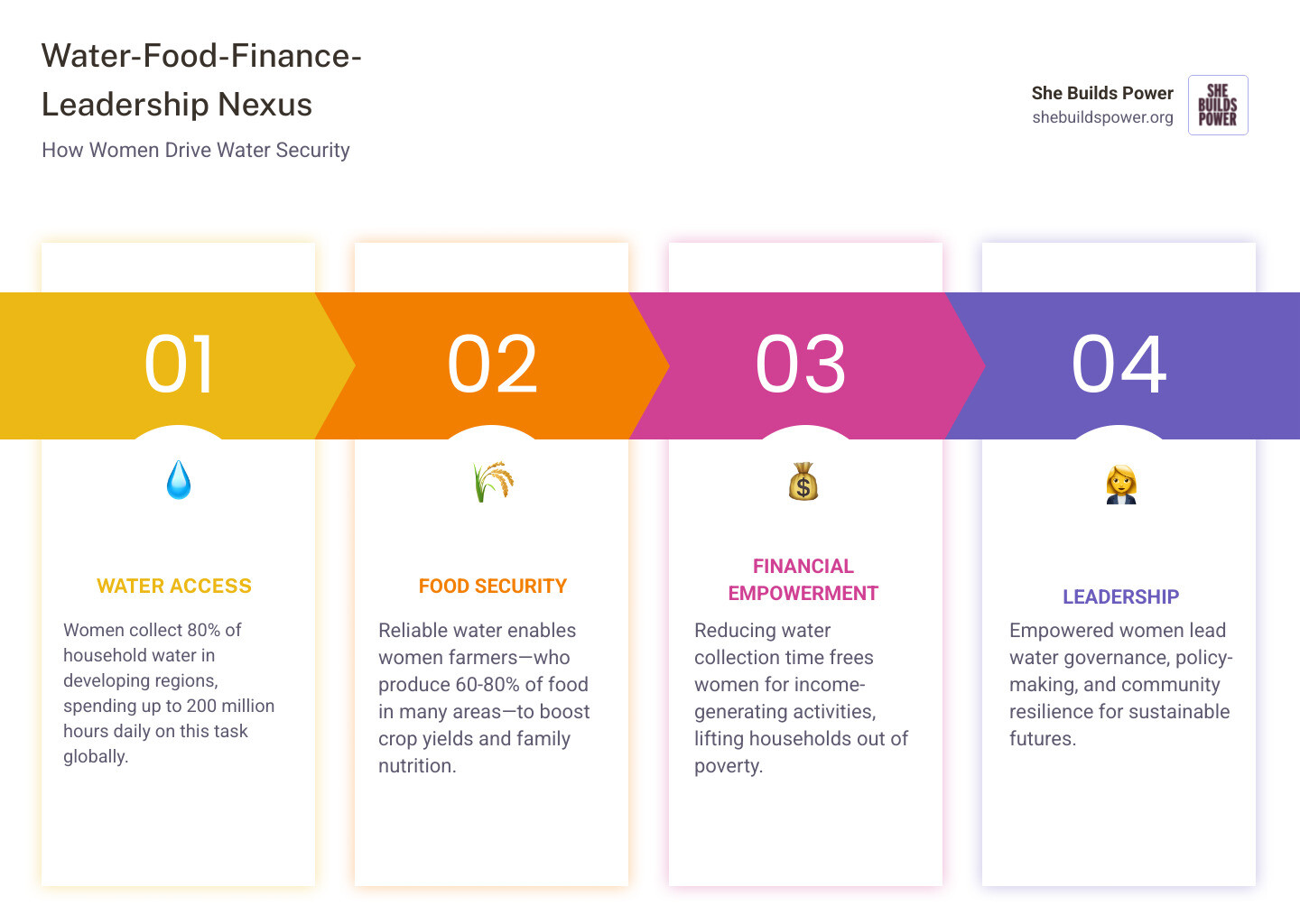
Because water is the first domino. When a woman has water security, she gains time. With time, she can engage in Water Resource Management and Food Security initiatives. This leads to financial independence through microenterprise. A woman with her own income and a reliable food source is a woman who can lead her community through the next climate shock. It is a From Wells to Wealth transition that creates a system that lasts.
Conclusion: Investing in Women and Water Security
At She Builds Power, we are replacing the “charity” mindset with a “systems” mindset. We don’t just dig wells; we train women to be the architects of their own resilience. Whether it’s through Every Drop Builds Power stories in Uganda or integrated systems in Kenya, we are proving that women and water security are the bedrock of a stable world.
Building long-term resilience requires more than a one-time donation; it requires a partnership in Powerbuilding. We invite donors, foundations, and CSR teams to join us in transforming access into agency. When you invest in a woman’s leadership, you aren’t just giving her Water; you are giving her the tools to build a future that stays built.
Are you ready to build power? Donate Now Water and help us scale these women-led systems across East Africa. Together, we can turn the walk for water into a march toward equality.