Fueling Progress: Empowering Women Through Improved Nutrition and Sustainable Livelihoods
Why Nutrition and Livelihoods Women Must Be at the Center of Systems Change
Nutrition and livelihoods of women are not separate issues — they are the same issue, rooted in the same system of inequality.
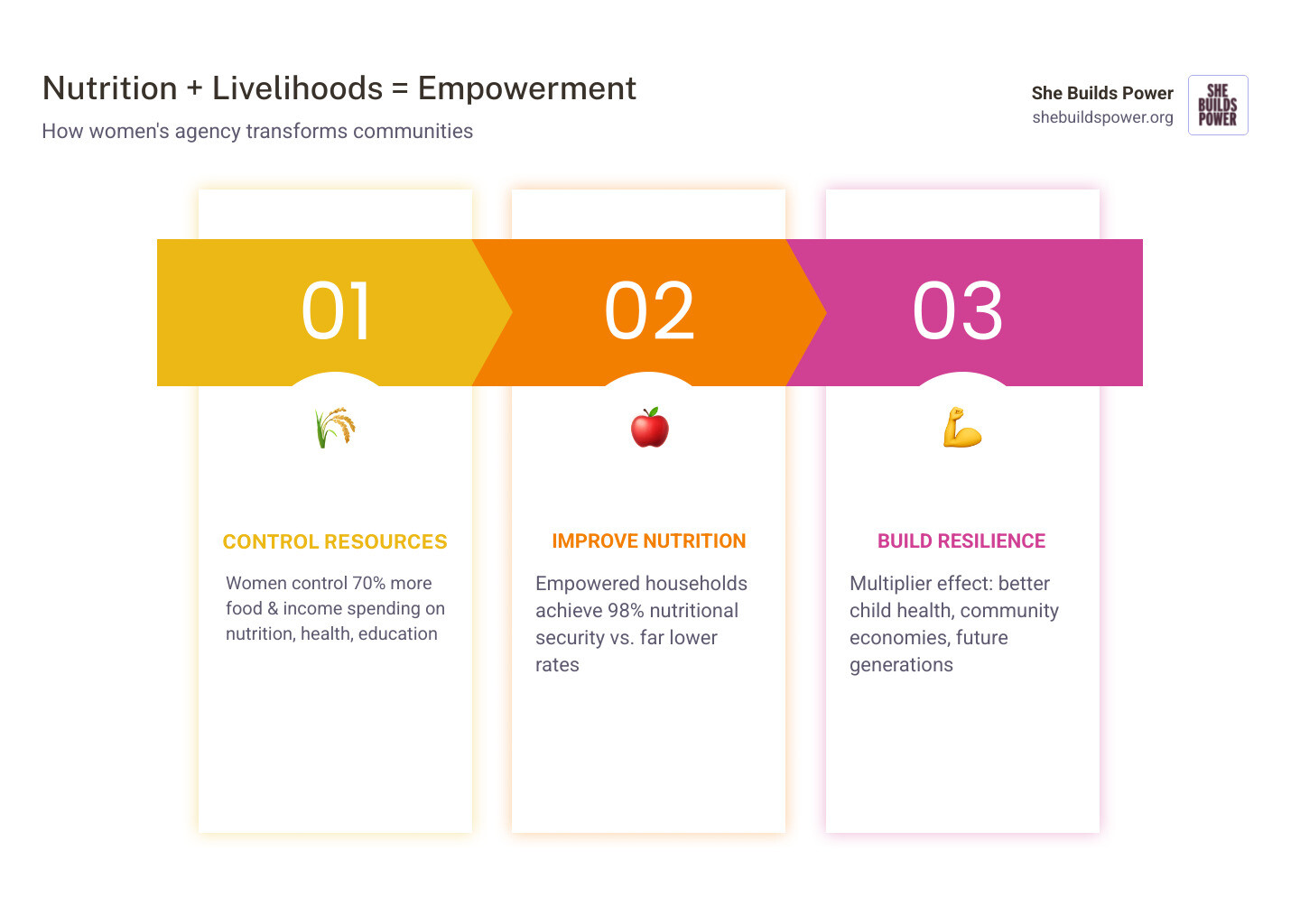
When women control their food, their income, and their resources, everything transforms. Not just for them. For their families, their communities, and future generations.
Here is the core connection at a glance:
| Factor | What It Means for Women |
|---|---|
| Nutrition access | Women of reproductive age are disproportionately malnourished — nearly 2 in 3 globally have micronutrient deficiencies |
| Livelihood control | Women who control income spend more of it on food, health, and children |
| Empowerment impact | In empowered households, 98% are nutritionally secure vs. far lower rates in disempowered ones |
| Food system role | Women produce more than half the world’s food but own less than 15% of agricultural land |
| Multiplier effect | Investing in women improves child nutrition, community health, and local economies |
This is not about charity. It is about correcting a structural imbalance that holds entire communities back.
Women are already doing the work. They farm, fish, process food, feed families, and manage households — often without formal support, land rights, or financial access. The gap is not effort. The gap is power.
Research consistently shows that when women gain decision-making power — over what they grow, earn, and eat — nutrition outcomes improve dramatically. A study of rural households in Pakistan found that empowered women led to households that were 70% food secure and 98% nutritionally secure. The numbers are hard to ignore.
The barriers are real: social norms, limited mobility, unpaid labor burdens, climate shocks, and exclusion from the markets and systems they help sustain. But so are the solutions — and they work best when women build them.
I’m Gemma Bulos, founder of She Builds Power, and for over two decades I’ve worked at the intersection of nutrition and livelihoods women — training communities to integrate clean water, sustainable food systems, and local finance into lasting change led by women themselves. What I’ve seen on the ground mirrors what the research confirms: when women have the tools and the power, they don’t just rise — they build.
The Power of Agency: How Nutrition and Livelihoods Women Intersect
At She Builds Power, we recognize that a woman’s ability to nourish her family is inextricably linked to her economic agency. This intersection of nutrition and of livelihoods women is where true community resilience is born. When we talk about “agency,” we aren’t just talking about the ability to work; we are talking about the power to make decisions that stick.
Research into household security highlights a profound reality: nutritional security is a byproduct of empowerment. In our work across Siaya County and Butambala District, we see that when women are equipped with the skills to lead, the “nutrition gap” begins to close. Empirical data supports this; for instance, Scientific research on empowerment and food security demonstrates that in regions where women have higher levels of autonomy, the prevalence of food insecurity drops significantly.
The difference between a “food secure” household and an “empowered” one is often found in the quality of the diet. While food security might mean having enough calories, nutritional security means having the right nutrients—iron, zinc, and protein. We have found that women who manage their own micro-enterprises or lead local water committees are far more likely to invest in diverse, nutrient-dense foods for their children.
Comparing Security Outcomes in Rural Contexts
To see why Powerbuilding matters more than one-off aid, compare outcomes in households where women help make key decisions with those where they do not. Research consistently links women’s decision-making power with stronger food security, better nutrition, and greater household resilience, including evidence from a multi-country study on empowerment and food security published through Harvard Dataverse.
| Metric | Empowered Households | Disempowered Households |
|---|---|---|
| Nutritional Security | 98% | ~50% |
| Food Security (Calories) | 70% | ~33% |
| Dietary Diversity | High (Protein, Greens, Micronutrients) | Low (Staple-heavy, Starch) |
| Child Growth Outcomes | Improved height-for-age scores | Higher rates of stunting/wasting |
This data confirms that economic well-being is not just about the amount of money coming in; it is about who holds the purse strings. In the hands of a woman, income becomes a tool for health. This is why our integrated systems approach—linking water, food, and finance—is designed to put that tool firmly in her hands.
Critical Dimensions: Mapping the Domains of Empowerment
Empowerment is not a monolith. It is composed of specific, measurable domains that dictate a woman’s daily reality. To move the needle on nutrition and livelihoods of women, we must address the structural barriers in these key areas:
- Mobility and Safety: In many rural areas of Kenya and Uganda, the ability to “travel safely” is a primary determinant of economic success. If a woman cannot safely reach a market in Siaya to sell her catch or buy seeds in Butambala, her livelihood is capped.
- Time Allocation: Time poverty is a silent thief. Women in developing regions often work 13 hours more per week than men. When a woman spends four hours a day fetching water, she has zero hours for profit-making activities or childcare.
- Freedom from Violence: Domestic and community violence are not just human rights issues; they are economic ones. Lack of safety at home directly undermines a woman’s ability to participate in the workforce or make independent nutritional choices.
- Resource Control: Access is not ownership. Many women can “access” land but cannot decide what to plant or whether to sell the harvest. True empowerment requires control over the means of production.
We use frameworks like Visualizing empowerment domains to identify exactly where a community’s power is leaking. By addressing social norms and leadership capacity simultaneously, we ensure that women aren’t just filling roles—they are redefining them.
Strengthening Household Resilience Through Nutrition and Livelihoods Women
The ripple effect of an empowered woman reaches the youngest members of the community first. Maternal health and child nutrition are the primary beneficiaries of increased female agency. In Butambala District, we’ve observed that women who participate in our integrated finance and food programs are more likely to adopt “nutrition-sensitive” agricultural practices.
Instead of only growing cash crops like sugarcane or coffee, empowered women diversify. They plant kitchen gardens, raise poultry, and incorporate biofortified staples. This shift is critical because Research on dietary patterns shows that dietary diversity is the single most effective way to combat the “hidden hunger” of micronutrient deficiencies.
When women lead, knowledge transfer becomes organic. A woman who learns about the importance of animal-source foods (ASF) for brain development doesn’t just feed her own children; she teaches her neighbors, her sisters, and her daughters. Our field research indicates that women are much more likely to share important health knowledge freely, while men will wait to be paid. This community health model replaces the need for external “intervention” with internal “evolution.”
Strategic Interventions for Regenerative Farming and Food Preservation
In agriculture communities, food loss is just as urgent and often even less visible. Women do much of the growing, harvesting, drying, sorting, and storing, yet weak storage, poor roads, and limited processing can wipe out a huge share of what they produce. In many low- and middle-income countries, fruits and vegetables see post-harvest losses of 30% to 50% before they are eaten. That means nutrition, income, and hard work disappear long before food reaches a family table or local market.
We tackle food spoilage by treating food systems as a whole. We do not just provide short-term support; we help women build practical skills in food preservation, composting, and dehydration techniques that protect household food supplies and create new income opportunities. By reducing spoilage, extending shelf life, and turning organic waste into useful compost, these approaches strengthen both nutrition and livelihoods women depend on, while keeping more nutritious food available in the community.
Closed-Loop Livestock Systems and Smarter Feed Solutions
On land, one of the biggest opportunities sits inside livestock systems, especially when women can turn feed, waste, and animal care into a closed-loop livelihood. This matters because women make up a large share of the agricultural labor force in many low- and middle-income countries, yet they often have less access to land, livestock assets, credit, and extension support. The result is lower productivity, lower income, and weaker household diets.
Livestock also acts as a “living bank.” Programs like the Rotating Buffalo Fund in other regions provide a blueprint for what we do with poultry and goats in Uganda. A woman receives a productive asset, uses a portion of the milk or eggs for household nutrition, and sells the rest to repay the “loan” into a community fund that then supports the next woman. It is a self-sustaining cycle of growth.
A smarter strategy is to improve both animal nutrition and household nutrition at the same time. That can include low-cost, locally produced feed such as Black Soldier Fly larvae for poultry and fish, along with vermiculture and composting that turn organic waste into fertilizer instead of pollution. These systems can cut feed costs, improve soil health, reduce post-harvest and food waste, and create new income streams women can manage close to home. When women gain more control over livestock production and the resources around it, households are more likely to diversify diets, strengthen food security, and build resilience over time.
Our work aligns with global efforts like the CGIAR Science Week, where the focus is shifting toward gender-responsive solutions that recognize women as the primary drivers of food system resilience.
Scaling Systems Change for Nutrition and Livelihoods Women
To scale, we must move beyond the “project” mindset and into “systems” change. This means integrating water access with microenterprise. If a woman has a point of use water system, she can irrigate a garden year-round, provide clean water to her livestock, and sell surplus water to her neighbors.
This integrated approach ensures that nutrition and livelihoods women are supported by a foundation of reliable infrastructure. When we link these women to market systems, they stop being subsistence farmers and start being “agripreneurs.” They become value chain actors who demand better prices and better resources. Evidence on gender-responsive solutions proves that when technologies are tailored to women’s specific roles—such as post-harvest processing—the potential for economic growth is unleashed.
Dismantling Structural Barriers to Long-Term Resilience
We cannot talk about the future of nutrition and livelihoods women without addressing the elephant in the room: systemic exclusion. Women produce more than two-thirds of the food in most developing countries, yet they hold less than 15% of agricultural landholders globally. This land-rights gap is a fundamental barrier to long-term investment and climate resilience.
Climate change is not gender-neutral. It disproportionately affects women because they are more dependent on natural resources but have fewer assets to fall back on when disaster strikes. In the Lake Victoria Zone, shifting rainfall patterns and rising temperatures are already damaging the infrastructure women rely on. Gender inequality and climate change are interconnected; as the climate becomes more volatile, the gender gap in food insecurity grows.
To dismantle these barriers, we must:
- Challenge Social Norms: We work with men and community leaders to redefine “women’s work” and ensure that women have a seat at the decision-making table.
- Bridge the Resource Gap: Providing access to finance, quality seeds, and modern tools is only half the battle. We must also ensure women have the legal right to own the land they till.
- End Labor Discrimination: Women work longer hours for less pay and often have no control over the income they generate. Our Powerbuilding model ensures that women keep the value they create.
Frequently Asked Questions about Women’s Nutrition and Livelihoods
How does women’s empowerment improve community food security?
Empowerment shifts the focus of the household from simple survival to long-term health. When women have decision-making power, they prioritize dietary diversity and child nutrition. Research shows that empowered women are 98% more likely to live in nutritionally secure households. Furthermore, women are “multipliers”—they reinvest up to 90% of their income back into their families, compared to 30-40% for men.
What are the biggest barriers to women’s economic participation in agriculture?
The primary barriers are structural and social. These include a lack of land ownership rights (less than 15% globally), limited access to credit and financial services, and “time poverty” caused by the heavy burden of unpaid domestic labor like fetching water and wood. Additionally, climate change hits women harder because they lack the capital to adapt to shifting seasons and crop failures.
Why is access to diverse, nutritious food so important for women’s health?
Women often carry the heaviest responsibility for earning income, preparing meals, caring for children, and protecting household health. That makes reliable access to diverse, nutritious food especially important. Diets that include iron-rich foods, protein, fruits, vegetables, and safe water support maternal health, energy levels, and day-to-day well-being. When women have more control over income, food choices, and household decisions, families are also more likely to eat a wider range of foods. In that sense, better nutrition is not just a health outcome. It is part of the foundation that helps women stay strong, care for others, and sustain their livelihoods.
Conclusion
At She Builds Power, we don’t believe in “helping” women. We believe in getting out of their way and providing the structural support they need to lead. The connection between nutrition and livelihoods women is the foundation of every thriving community we’ve worked with in Uganda and Kenya.
By moving beyond short-term support and focusing on long-term systems change, improved nutrition can become a foundation for women’s agency and livelihoods. When women have better access to nutritious food, income opportunities, and decision-making power, households are more food secure and communities are more resilient. The goal is not charity, but lasting progress driven by women’s knowledge, leadership, and everyday choices.
This is Powerbuilding. It is the shift from being a beneficiary to being a builder. It is the path to a future where no child is stunted, no woman is excluded, and every community has the resilience to withstand whatever challenges the future may bring.
Are you ready to invest in a system that works? Join us in fueling progress. Let’s build power, together.